
Definition:
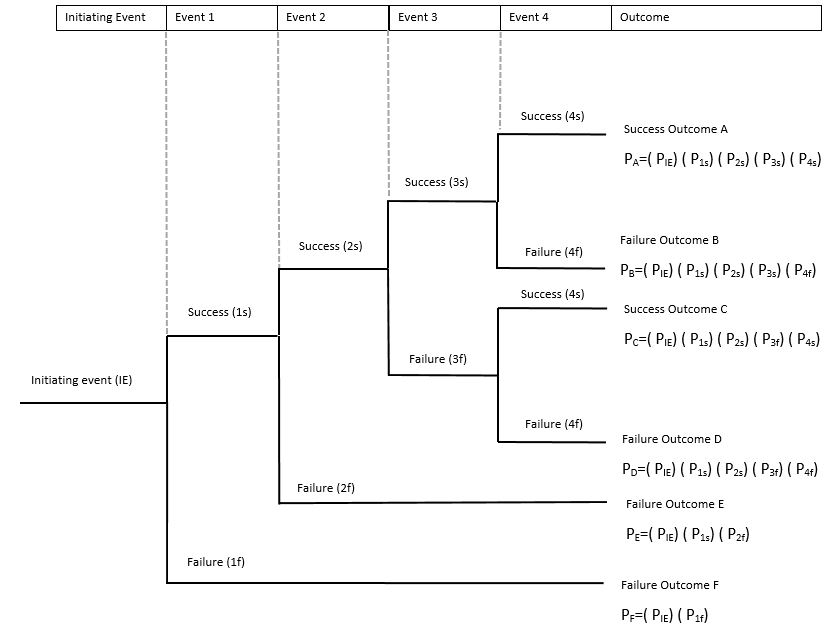
Event Tree Analysis (ETA) is a scenario modeling method that flows left to right. It is a forward logic model that starts with an initiating event (such as loss of containment of a flammable gas) and evaluates how different sequences of barrier successes or failures produce possible outcomes. ETA is itself a framework that can be used quantitatively, qualitatively, or in a semi-qualitative way. But it is typically quantitative (QRA).
The initiating event is always on the left, and the consequences are on the right.
“If this initiating event occurs, what could the outcomes be depending on whether protections succeed or fail?”
It looks superficially similar to a risk graph, but is fundamentally different in both logic and purpose.
How it fits: For an overview of how ETA fits alongside the other hazard and risk analysis methods in an IEC 61511 H&RA, see Hazard and Risk Analysis Methods.
Key Points:
- Models the progression of an initiating event through various system responses.
- Complements fault tree analysis for quantitative studies.
- Outputs an event tree diagram
Example:
Begin with a hazardous gas release as the initiating event. ETA shows that one outcome path could be an explosion if the gas is not detected and isolated in time.
See Also: FTA, RBD, layer of protection analysis (LOPA), PHA, bowtie, QRA
Cited Source:
- CCPS – Guidelines for Chemical Process Quantitative Risk Analysis.
- NTNU – ETA Presentation
- Wikipedia – Event tree analysis