
Definition:
A Proof Test is a planned, periodic test carried out on a safety instrumented function (SIF). Its primary purpose is to find dangerous undetected failures (λDU) that are not found during normal operation. Proof testing is critical to maintaining the designed Safety Integrity Level (SIL) of a system over time.
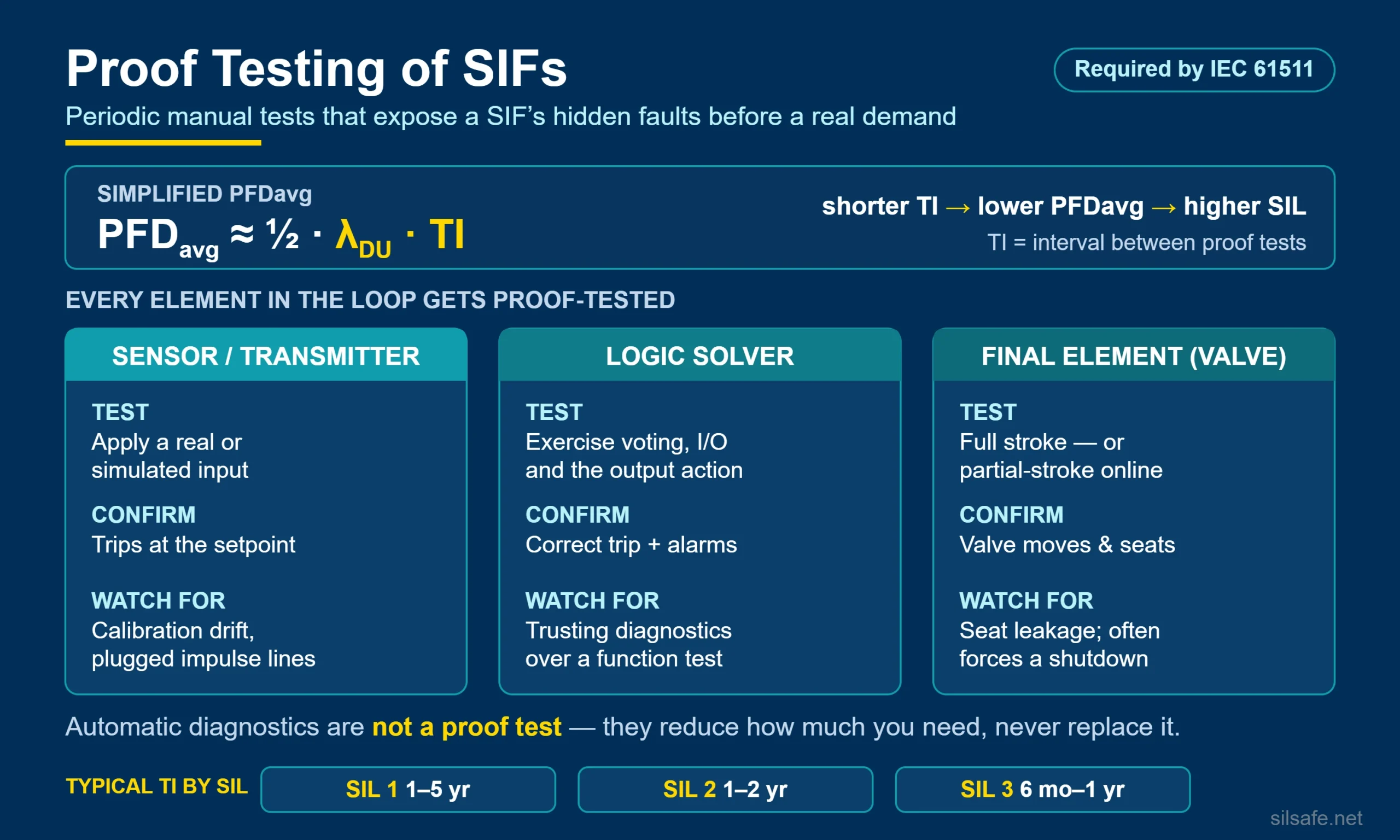
Proof tests can vary depending on the component and the approach used by the facility. Proof tests are not perfect, and their inability to capture all dangerous undetected failures is represented by proof test coverage. Cpt.
Note that proof tests will also find safe failures, and that is a good thing. Just note that that does not feed into the PFDavg calculation. This goes into the reliability and spurious trip rate (STR).
Proof tests can occur while the facility is shutdown or with the facility online with some sort of bypass/overide.
Key Points:
- Must be thorough enough to find dangerous failures not caught by automatic diagnostics.
- Proof Test Interval (TI) directly impacts the PFDavg.
- Proof Test Coverage (Cpt) measures how effective a proof test is at finding dangerous undetected failures.
- Proof testing requirements should be clearly defined in the Safety Requirements Specification (SRS).
- Note a point of possible confusion – “detected” and “undetected” refer to diagnostics. A proof test’s purpose is to find/detect failures, primarily dangerous undetected. Don’t confuse the two uses of the term “detect”.
Example:
A shutdown valve is stroked and functionally tested every 12 months to verify it closes properly in response to a trip signal, thereby fulfilling its proof test requirement.
See Also: proof test interval (TI), proof test coverage (Cpt), failure rate, failure rate full article, bypass, PVST
Cited Source:
- IEC 61511-1:2016, Clauses 3.2.56, and 16.3.
Deep dive: Proof Testing of SIFs