Definition
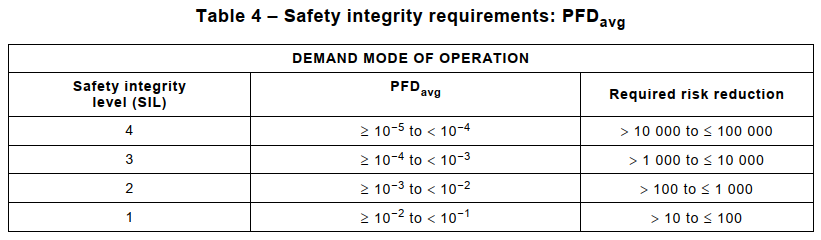
A Safety Integrity Level (SIL) is a discrete level (1 through 4) defining the target risk reduction for a safety function. This is a key term that is intertwined throughout the functional safety ecosystem of standards, such as IEC 61511 and IEC 61508. It quantifies the level of risk reduction necessary, not necessarily the technology or architecture. The SIL corresponds to a target PFDavg or dangerous failure per hour.
A Safety Instrumented Function (SIF) will have an assigned SIL based on something like a LOPA. That SIF has components which must meet SC 2 requirements (or “be SIL rated”). The various components in a SIF would have SIL ratings that work together to meet the various requirements in IEC 61511 (such as HFT, SFF, and others).
Other industries outside of the Process Industry are beginning to utilize Safety Integrity Level (SIL), which is an exciting development. For example, a contract may require that all instruments be at least SIL 1, and instruments on a particularly important system be SIL 3. This would not be part of a formal Functional Safety program, but it is an easy way to ensure at least a basic level of quality. The EU Machinery Directive and the US version of machinery safety (ANSI B11 and NFPA 79) when implemented by facilities often have requirements that trigger certain components being SIL rated.
Different levels of PFDavg relate to permitted safety integrity levels (SIL) per the table below.
Key Points
- Higher safety integrity level = higher risk reduction = better equipment = tighter process = more expensive
- SIL 1 items are readily available
- SIL 3 is the highest SIL level that is typically seen.
- SIL 4 is the highest integrity, requiring the most rigorous design. Few things need this. Few things can achieve this. The ones that do are very expensive. Engineers often go back and re-design other things to avoid SIL 4.
Example
A SIL 2 SIF requires reducing risk by at least 100–1000 times. Railroad switches are one of the few things that often require SIL 4.
See Also: SIF, systematic capability, PFDavg, SIS, ASIL
Cited Source
- IEC 61511-1:2016, Clause 3.2.69
- Wikipedia – Safety Integrity Level
Deep dive: SIL Verification: The Three Gates