Definition:
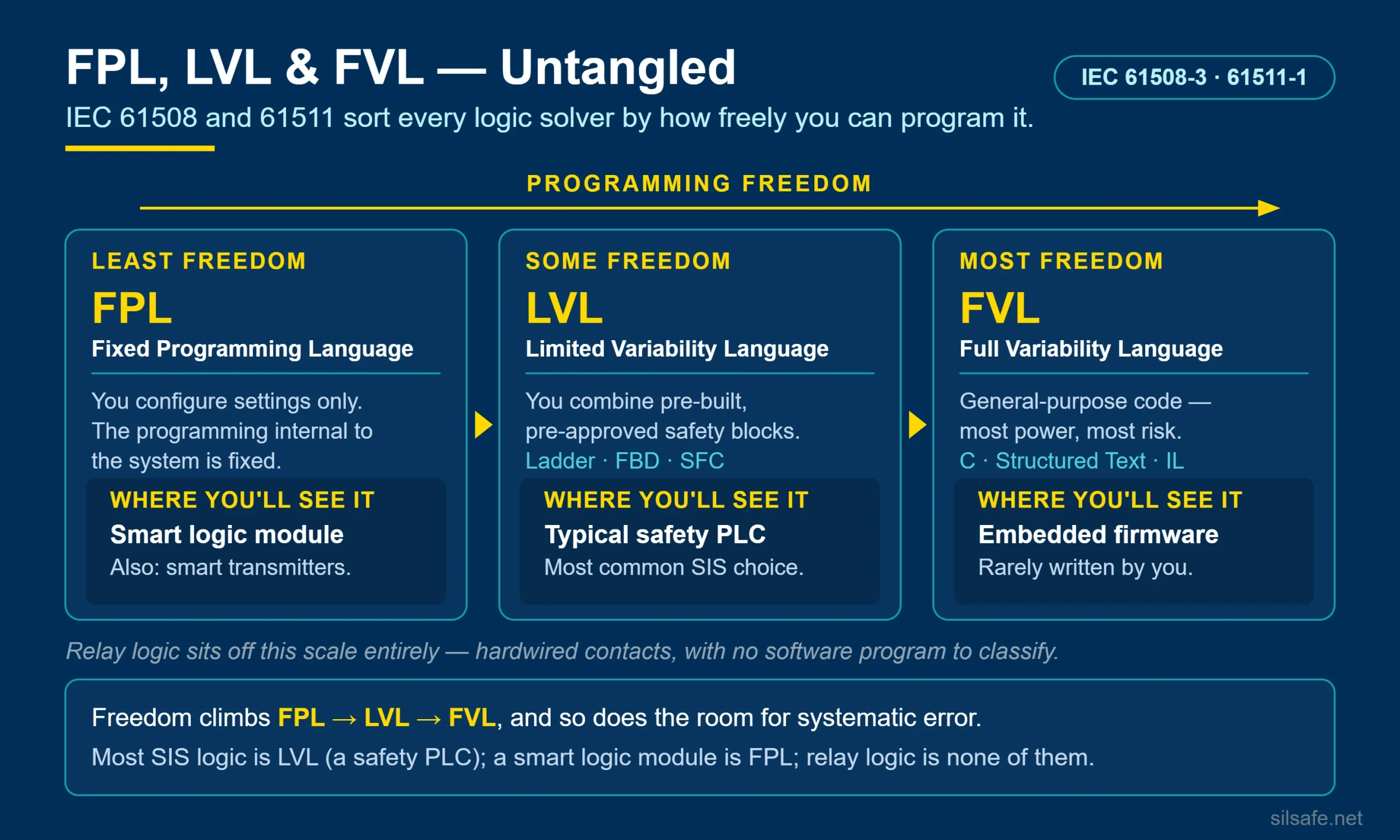
Limited Variability Language (LVL) is a IEC 61508 and IEC 61511 programming category that includes languages that use pre-defined and pre-approved functionalities. Safety function blocks pre-built into the PLC’s software application are the most common scenario. This is the most common approach in SIS Engineering, the more complex being FVL, and the less complex being FPL.
For example, in Siemens TIA Portal there are normal function blocks and safety function blocks. The safety ones offer less configurability and fewer bells-and-whistles. They have already gone through the IEC 61508 process (TUV is their certification body).
This is designed so that the same programming team on the BPCS can be used here, with some extra oversight of the FSM process. Note that a LVL is fully within IEC 61511 and entering into 61508 is not needed by the facility.
LVL typically uses the programming languages ladder diagram (LD), function block diagram (FBD) and sequential function chart (SFC). But there can be variants.
Key Points:
- Uses pre-configured and pre-approved functionalities in the PLC’s software application. Often called safety function blocks.
- Most common of the three IEC programming categories.
- Under the requirements of IEC 61511 §12, but importantly does not require IEC 61508 oversight.
- The PLC programming portal manufacturer must go through the IEC 61508 certification on the safety functionalities.
- Programming language choice can vary just like in FVL.
Example:
A facility has 30 SIFs. After consideration it was decided to use the Siemens TIA portal safety function blocks to do the programming. All of their needs were within the bounds of the safety function blocks. This would constitute an LVL approach.
See Also: FPL, FVL, application program
Cited Source:
- IEC 61511-1:2016, Clause 3.2.75
- Moore Industries SLA