Definition:
Markov Modeling (also called Markov Analysis) is an advanced state-space reliability modeling technique. It models systems whose state changes over time according to defined transition rates between discrete states. This is a notoriously confusing topic for functional safety professionals.
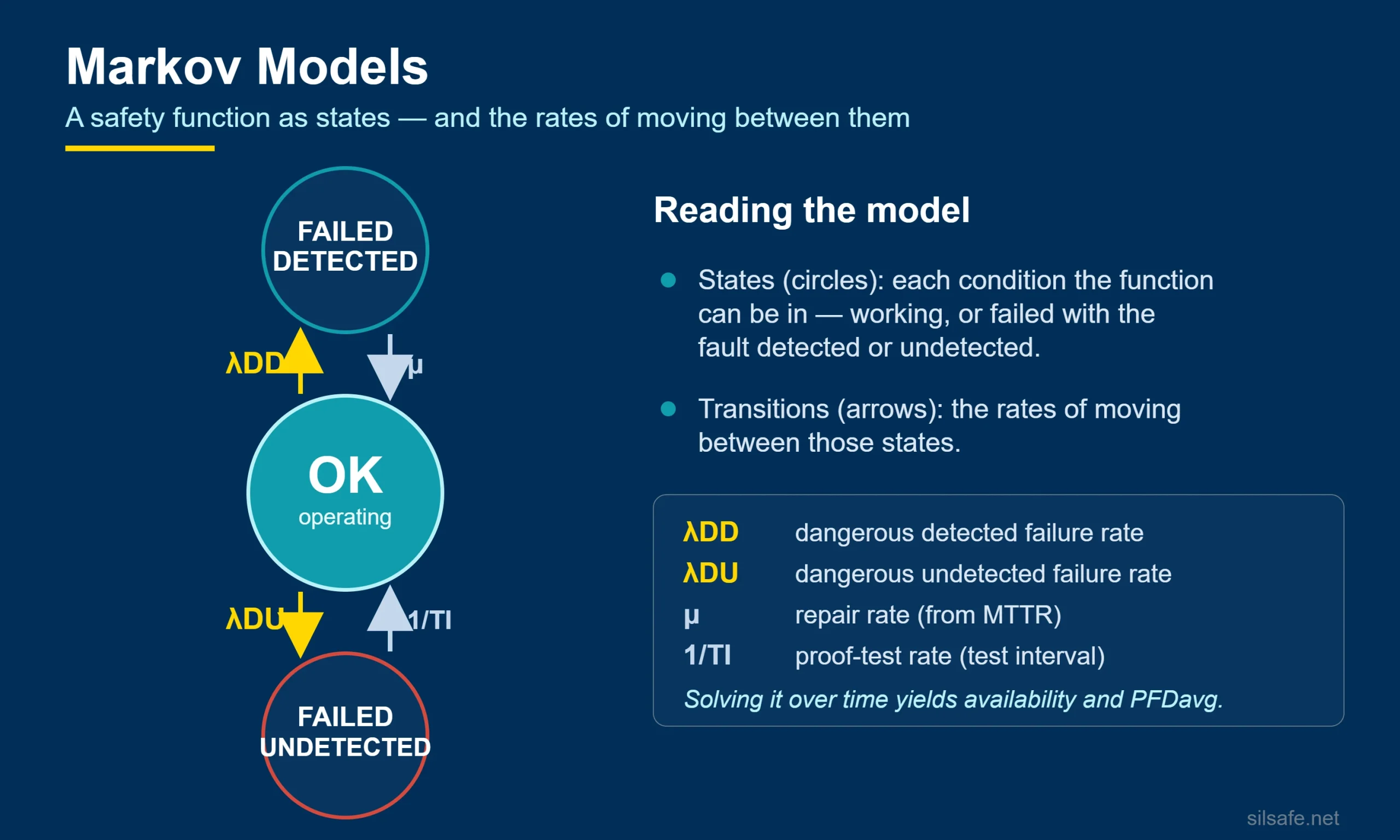
A Markov model represents a system as a set of discrete states (e.g., all channels healthy, one failed via a dangerous undetected warning, under repair, in test) with transition rates between those states driven by failure, repair, test, and demand processes. The key Markov assumption is that the future evolution of the system depends only on the current state and transition rates (memoryless), which allows calculation of time-dependent unavailability and related metrics such as PFDavg and PFH for complex redundant architectures.
Markov models can be applied in SIL verification (the PFDavg calculations) and occasionally for quantitative risk analysis (QRA).
Neither IEC 61511 nor 61508 series require Markov Analysis to be done when doing SIL calculations, but it is recognized as a method. However, it could make sense for the most complex scenarios like diverse channels, staggered testing, shared spares, and extensive diagnostics
Key Points:
- Not required per IEC 61511 or IEC 61508, but is an acceptable technique
- Could be used in very advanced SIL verifications particularly for complex voting, diagnostics, or maintenance strategies.
Example:
A facility has an unusual SIL 2 SIF. In this SIF the instruments are 3oo5 and the valves are 1oo2. Additionally, the two valves are different types and of the five instruments there are two different types. The proof testing is staggered on the instruments. After consideration, the facility decides to keep this design (versus a more traditional 2oo3 setup). The Safety Requirement Specification for this SIF specifies that, due to the uniqueness, a Markov model will be done for SIL verification.
Cited Source:
- IEC 61508-6:2010, Annex B.
- NTNU training slides
- Science Direct – Advanced Methods of Risk Assessment and Management