Maximum Experimental Safe Gap (MESG) is the largest gap width through which a flame, ignited inside a sealed test chamber, cannot propagate outward to ignite the surrounding flammable gas or vapor mixture. It is measured under standardized test conditions defined in IEC 60079-20-1, using a 25 mm long flame path and the most ignition-sensitive concentration of the specific gas or vapor in air.
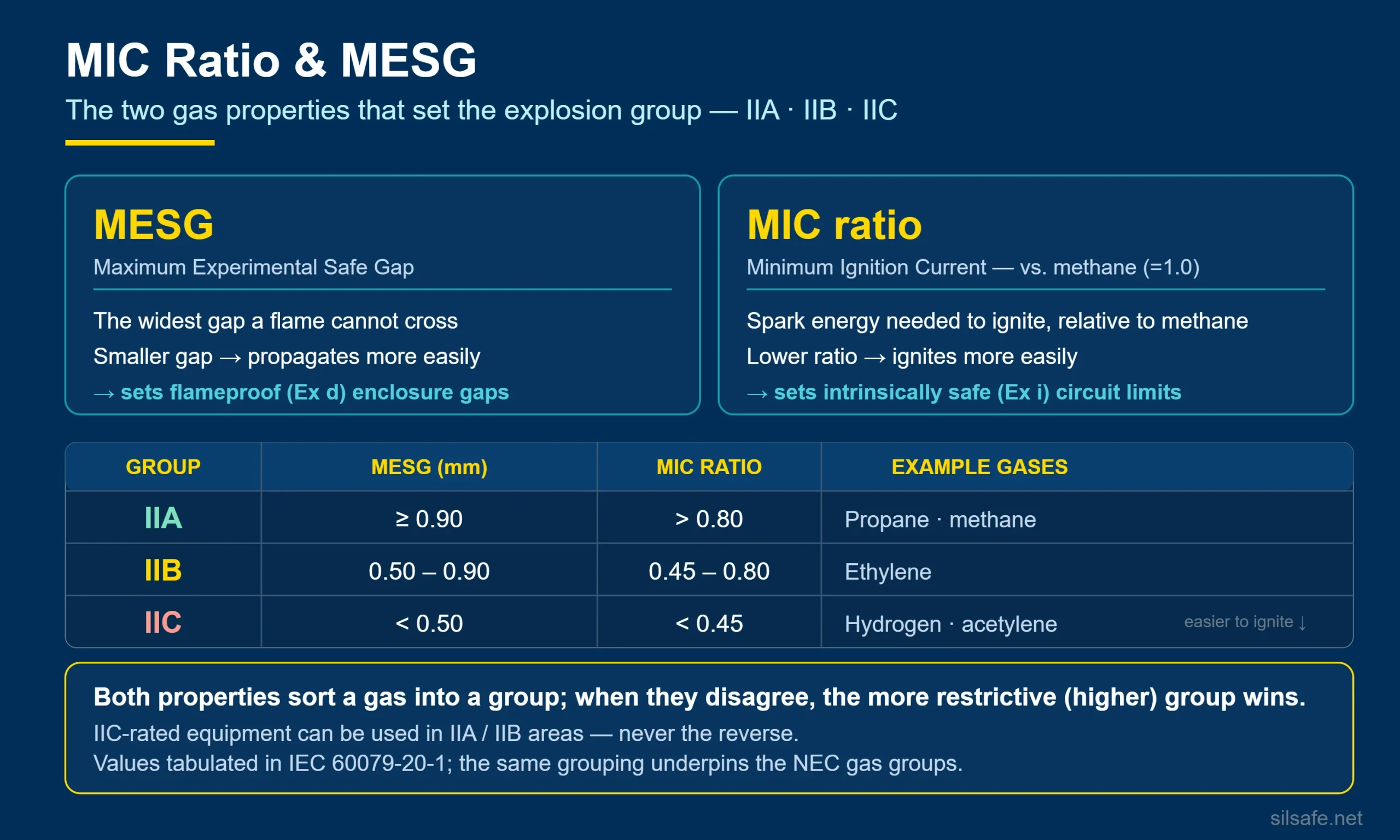
MESG is one of two key parameters, alongside the MIC ratio, used to assign flammable gases and vapors to groups under both the NEC and the IEC 60079 series. The explosion group determines the minimum joint-gap construction requirements for flameproof (Ex d) enclosures and the appropriate selection of flame arresters. A smaller MESG indicates that the gas is more capable of propagating a flame through a narrow gap, requiring more restrictive equipment design.
For example, H2 being a small flammable molecule, would be fairly low.
Key Points
- MESG is a property of the gas or vapor, not of the enclosure; the equipment standard (IEC 60079-1) specifies the maximum allowable flange gap for each equipment group based on MESG thresholds.
- Equipment rated for a lower-MESG group (e.g., IIC) is suitable for use with higher-MESG gases (e.g., IIA), but a device rated for Group IIA cannot be used in a Group IIC environment.
- MESG values for common industrial gases and vapors are tabulated in IEC 60079-20-1 and NFPA 497.
Example
Hydrogen has an MESG of about 0.29 mm, placing it in Group IIC, while propane sits near 0.92 mm in Group IIA. A flameproof (Ex d) enclosure certified for a propane atmosphere cannot be used in a hydrogen atmosphere: its joint gaps are wide enough for a hydrogen flame to cross. A Group IIC enclosure, machined to tighter gaps, is required.
See Also: MIC ratio, flammable gas, hazardous areas, ATEX, IECEx
Cited Sources
- IEC 60079-20-1:2010, Explosive Atmospheres – Material Characteristics for Gas and Vapour Classification
- IEC 60079-1:2014, Explosive Atmospheres – Equipment Protection by Flameproof Enclosures “d”