
Performance level (PL) is a machinery safety term, defined in ISO 13849-1, that expresses how reliably a safety-related part of a machine’s control system carries out its safety function. It runs across five discrete grades, PLa through PLe, where PLa delivers the least risk reduction and PLe the most. Each grade is tied to a band of average probability of dangerous failure per hour (PFHd), from PLa at roughly 1E-5 to 1E-4 down to PLe at 1E-8 to 1E-7. If you live in the process world under IEC 61511, the easiest way to place it is this: PL is the machinery world’s answer to SIL, with the same job of quantifying integrity but a different standard and a different scale.
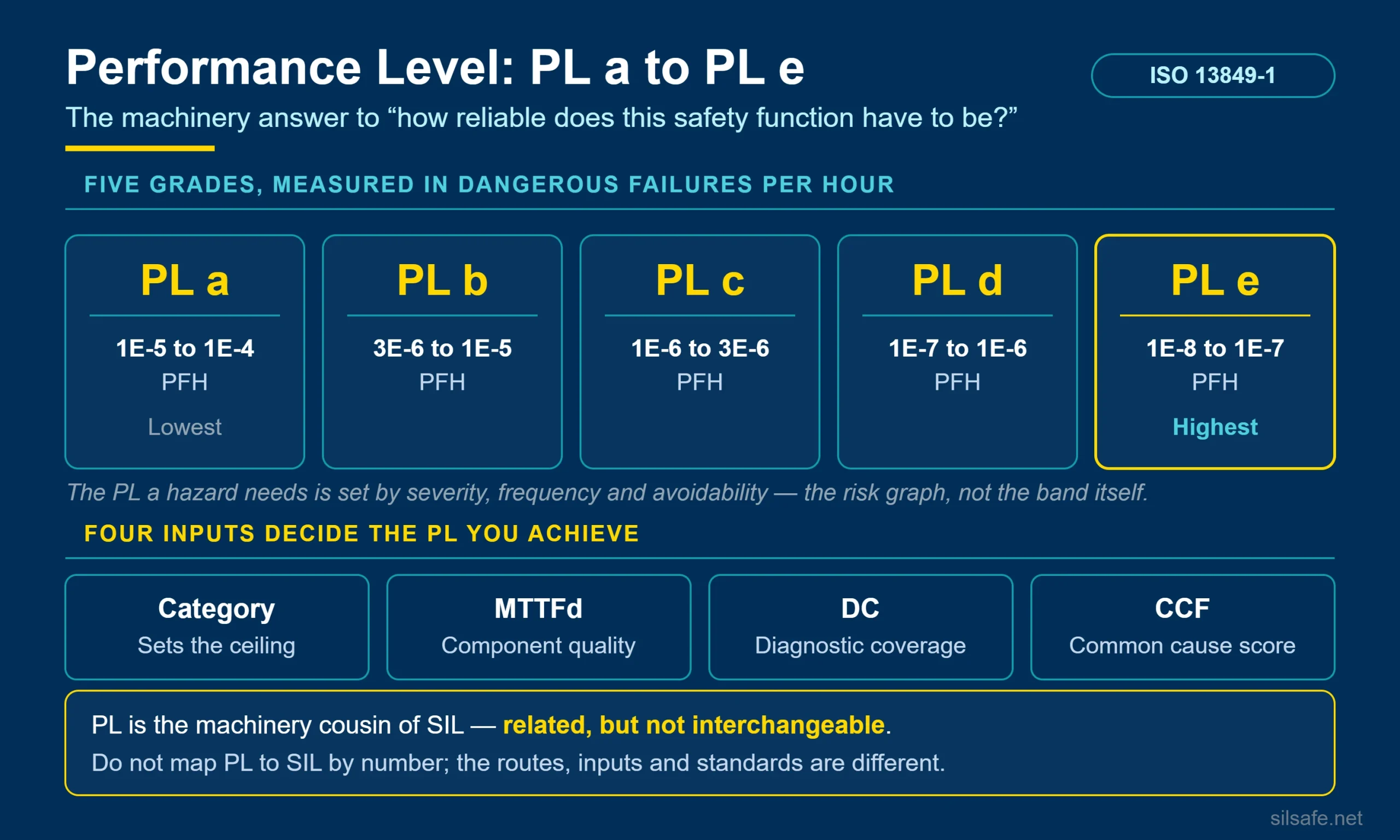
A PL is more than a failure-rate number. ISO 13849-1 derives it from the designated architecture (Category B, 1, 2, 3, or 4), the mean time to dangerous failure (MTTFd) of the components, the diagnostic coverage (DC), and the measures against common cause failure (CCF). During risk assessment you first set a required performance level (PLr) for each safety function, usually using a risk graph, then design until the achieved PL meets or beats it. For anyone crossing over from process safety, PL lines up with SIL as shown below, with one catch: machinery tops out at SIL 3.
- PLa = no SIL equivalent
- PLb = SIL 1
- PLc = SIL 1
- PLd = SIL 2
- PLe = SIL 3
Key Points
- Performance level is a machinery safety term defined in ISO 13849-1, running from PLa (lowest risk reduction) to PLe (highest), with each grade tied to a band of PFHd.
- It is calculated from architecture (Category B–4), MTTFd, DC, and CCF, not from a failure rate alone.
- PLr is the required level set during risk assessment, typically using a risk graph, and the design must achieve a PL at least equal to PLr.
- PL maps onto SIL, with PLe equal to SIL 3, PLd to SIL 2, and PLc to SIL 1.
Example
An industrial robot is guarded by a light curtain that stops hazardous motion when an operator reaches in. The risk assessment rates the hazard as severe, with frequent exposure and little chance of avoidance, which yields a required PLr of d. The designer builds the function on a Category 3 dual-channel architecture using a well-proven light curtain (high MTTFd) with 90% diagnostic coverage, achieving PLd. That satisfies the PLr of d and corresponds to SIL 2.
See Also: SIL, machinery safety, risk graph, PFH
Cited Sources