
Definition:
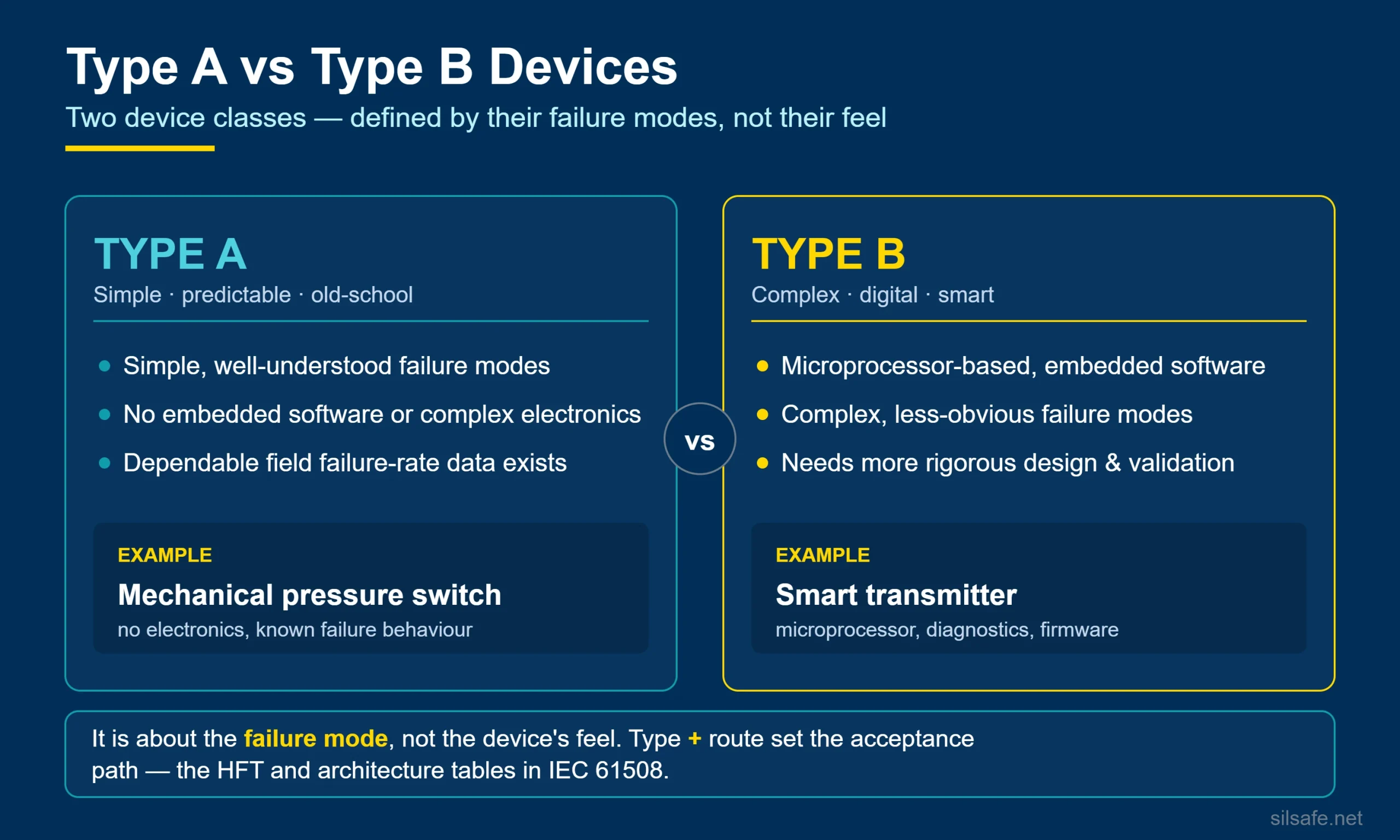
Type A devices have simple, well-known failure modes. Think old-school type components. They have sufficient and dependable failure rate data. They typically have no embedded software or complex electronics. Per IEC 61508-2 Clause 7.4.3, a device qualifies as Type A only if all three of the following are met:
- The failure modes of all constituent components are well defined.
- The behaviour of the subsystem under fault conditions can be completely determined.
- There is sufficient dependable failure data to show that the claimed rates of failure for detected and undetected dangerous failures are met.
Type B devices are complex and often include microprocessor-based components and embedded software. Thus this would include complex failure modes. Would include modern smart (diagnostic) equipment.
It is not just the type/feel of the device. It is about the type of failure mode.
Key Points:
- Type B devices require more rigorous design and validation. Think that they are riskier.
- The type along with route dictate the different paths of acceptance.
- These types relate to Route 1H, and only route 1H.
Example:
A mechanical pressure switch with no electronics is Type A; a smart transmitter is Type B. This, along with the route, dictates various requirements and tables.
See Also: instrument, logic solver, final element
Cited Source:
- IEC 61508-2:2010, Clause 7.4.4.