MIC ratio (Minimum Ignition Current ratio) is the ratio of the minimum electrical current required to ignite a specific flammable gas or vapor mixture to the minimum current required to ignite methane under identical test conditions, as defined in IEC 60079-20-1. Methane serves as the reference gas with a MIC ratio of 1.0. A lower MIC ratio means the gas ignites more easily from a low-energy electrical spark.
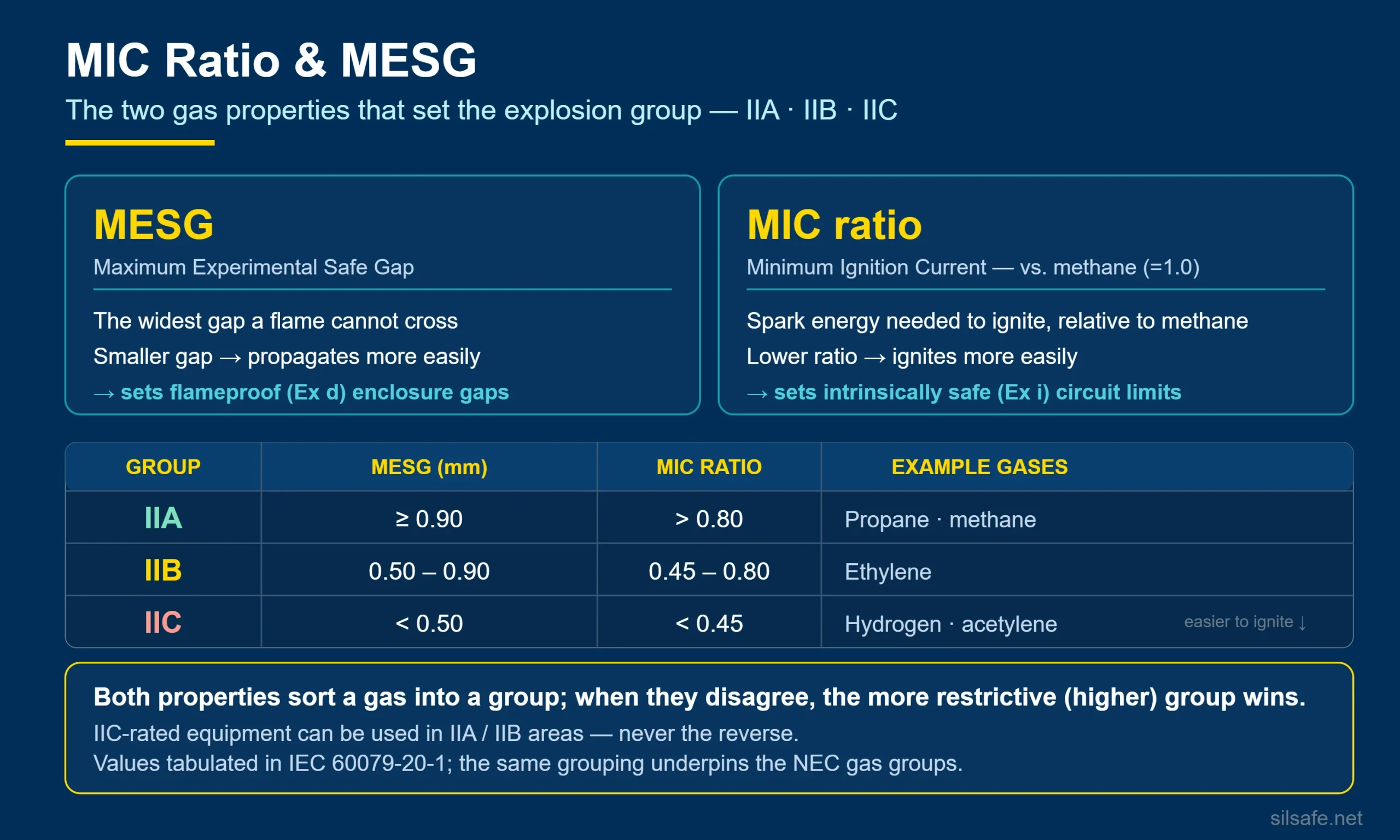
MIC ratio, along with MESG, is used to classify flammable gases and vapors into explosion groups under the NEC and IEC 60079 series. It is especially relevant to intrinsically safe (Ex i) circuit design under IEC 60079-11, where the maximum allowable electrical energy in a circuit must remain below the minimum ignition energy of the flammable gas area. When MESG and MIC ratio yield different group assignments for the same substance, the more restrictive (higher) group governs.
Key Points
- MIC ratio is the dominant parameter for intrinsic safety design — it directly defines how much circuit energy is permissible in a certified Ex i barrier or isolator for a given gas group.
- If MESG and MIC ratio point to different explosion groups for the same substance, the more stringent group applies.
- MIC ratio values for common industrial gases and vapors are tabulated in IEC 60079-20-1 and referenced during equipment selection and hazardous area documentation.
Example
Acetylene has a MIC ratio of approximately 0.22, placing it firmly in Group IIC per the IEC system. An intrinsically safe temperature transmitter certified for use in a propane atmosphere (Group IIA) cannot be used in an acetylene environment: the same circuit energy that is safe for propane could ignite acetylene. A Group IIC-certified barrier is required.
See Also: MESG, flammable gas, hazardous areas, ATEX, IECEx
Cited Sources
- IEC 60079-20-1:2010, Explosive Atmospheres — Material Characteristics for Gas and Vapour Classification
- IEC 60079-11:2011, Explosive Atmospheres — Equipment Protection by Intrinsic Safety “i”