
Definition:
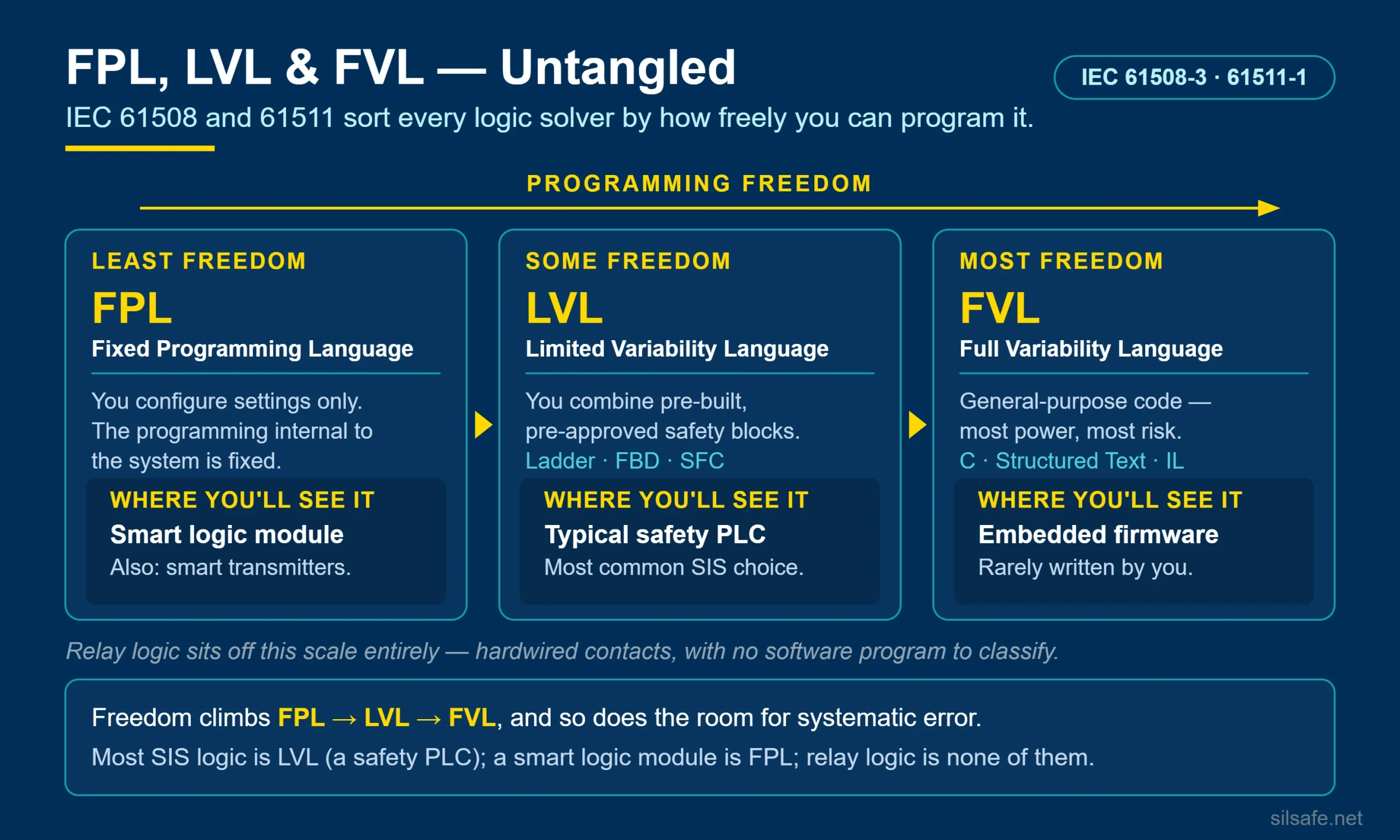
Fixed Programming Languages (FPL) are an IEC 61508 and 61511 programming category which represents predefined programming environments with limited flexibility to avoid introducing systematic faults. This is a situation that is more “configured” and less “programmed”. A smart logic module is a classic example of this. Programming a safety PLC with safety function blocks is not.
Key Points:
- Used to reduce the likelihood of introducing dangerous coding errors, minimize engineering, and reduce cost.
- The actual software is often behind the scenes of the users, and would be the responsibility of the manufacturers.
- The manufacturer would have to own the IEC 61508 certification
Example:
A facility has two SIFs, a very small number. Rather than using a higher-category approach, a FPL approach is used to save time, cost, and risk. They decided to use a pre-configured smart logic module.
See Also: limited variability programming language (LVL), full variability programming language (FVL), smart logic module, application program
Cited Source:
- IEC 61511-1:2016, Clause 3.2.75