
Definition:
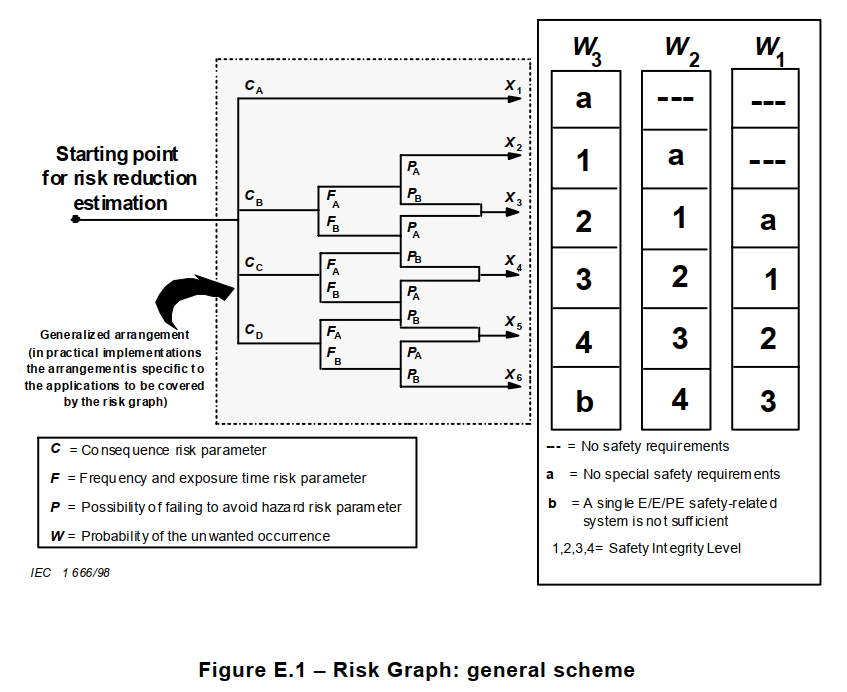
A risk graph is a compressed H&RA and SIL selection approach rolled into one tool. A risk graph is a semi-quantitative risk assessment (SQRA) tool used to assess risks along with estimating the required SIL levels by mapping severity, frequency, and exposure factors. If an facility or project is doing a risk graph, they are often not doing a HAZOP and/or a LOPA. Although some facilities do both but more for screening checks. Bottom line, it can perform both the assessment part of an H&RA and SIL Selection portions of the Functional Safety Life-cycle.
Don’t confuse it with a Risk Matrix!
How it fits: For an overview of how risk graph fits alongside the other hazard and risk analysis methods in an IEC 61511 H&RA, see Hazard and Risk Analysis Methods.
Key Points:
- Simpler and faster than quantitative risk assessment (QRA).
- Frequently used early in a project’s hazard assessments.
- Often used in machinery safety and the EU Machinery Directive
Example:
High-consequence, high-frequency events map to a SIL 3 requirement using a Risk Graph.
See Also: H&RA, risk matrix, LOPA, SQRA
Cited Source:
- IEC 61511-3:2016, Annex E
- IEC 61508-5:2010, Annex E
- Mary Kay O’Connor Process Safety Center – On the Use of LOPA and Risk Graphs for SIL Determination