
Definition:
A Basic Process Control System (BPCS) is the standard control system responsible for day-to-day operation of a process, distinct from safety-specific systems. It is the system that essentially runs the plant. It’s use within functional safety is to distinguish it from the safety instrumented system (SIS), as the two must remain separate systems with cross connection, with minimal cross connections.
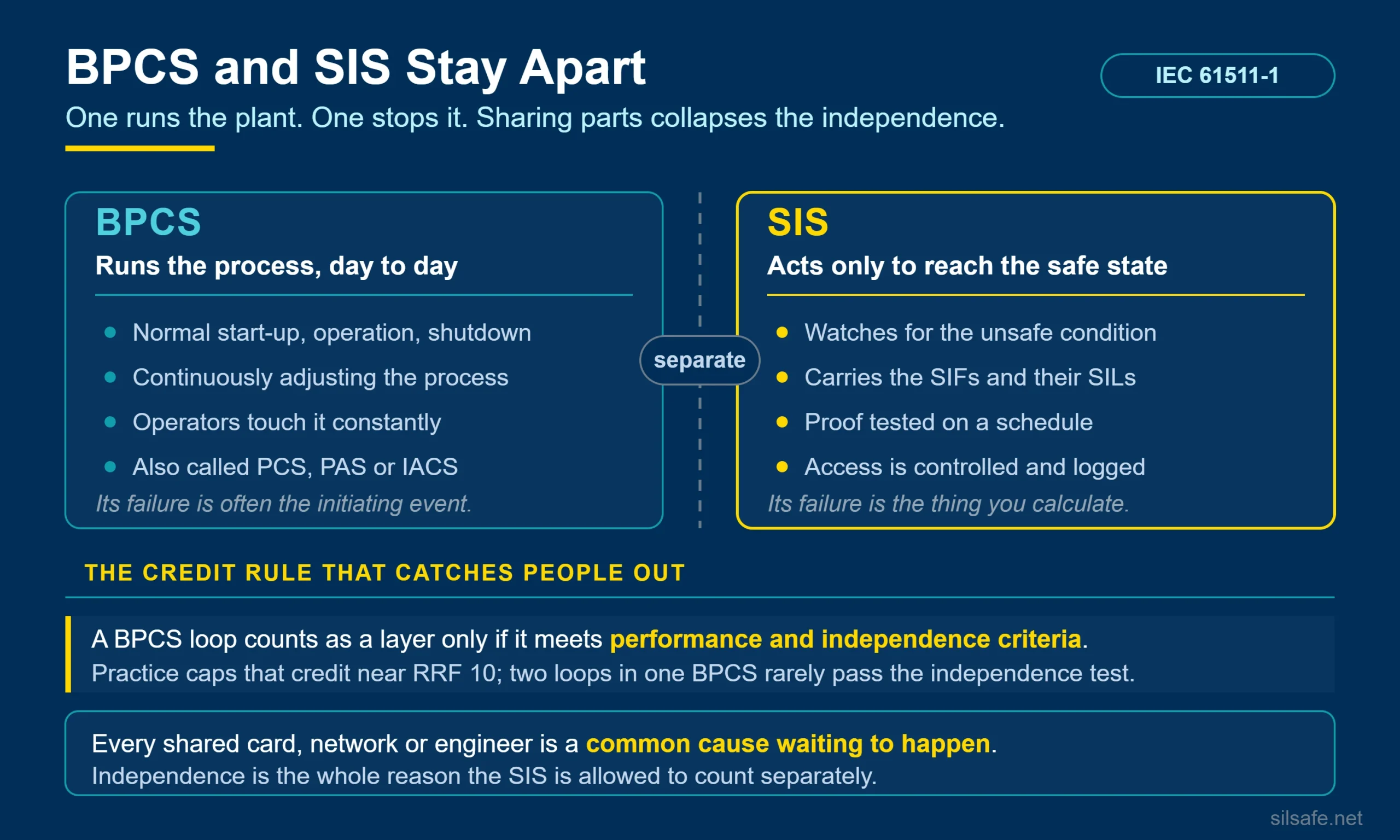
This term is defined and used within functional safety, but is not much used outside this space. Other similar terms are industrial automated control system (IACS), process control system (PCS), or process automation system (PAS).
Key Points:
- BPCS typically manages normal startup, shutdown, and operating functions.
- BPCS can sometimes be credited as a risk reduction measure if it meets performance and independence criteria.
Example:
A temperature control loop regulating reactor temperature through a DCS is part of the BPCS.
See Also: SIS
Cited Source:
- IEC 61511-1:2016, Clause 3.2.3
- Icarus-ORM Academy – BPCS vs SIS
Deep dive: Layer of Protection Analysis: Deep Dive