
Definition:
The PEAR Model categorizes potential consequences of hazardous events into four groups: People, Environment, Assets, and Reputation. Entities will think through tolerable risk through the light of these four criteria.
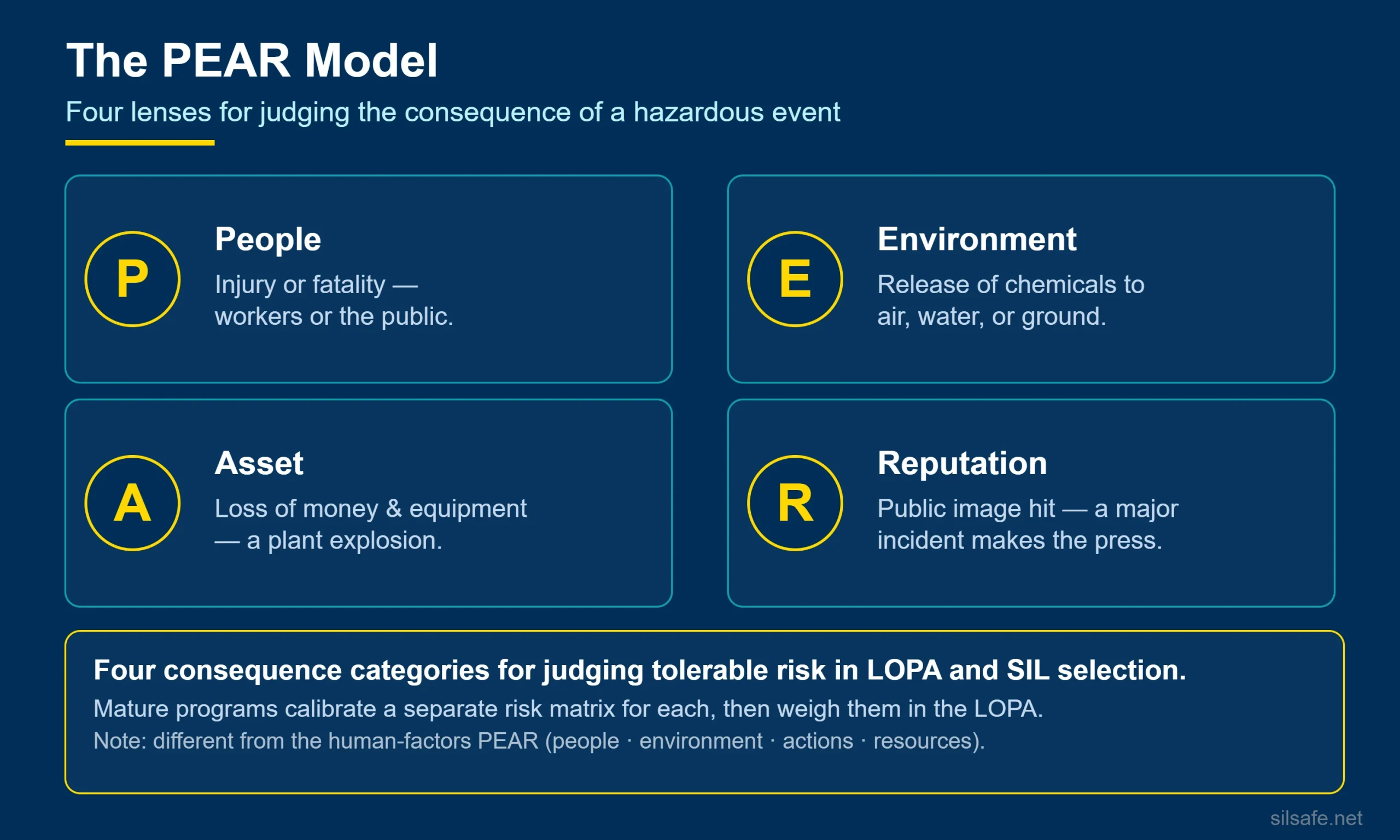
- People – injury or fatality of workers or the public
- Environment – release of chemicals
- Assets – loss of money and equipment. A plant blowing up for example
- Reputation – any major accident is going to get press and make the company look bad
In well developed programs, there is a different calibrated risk matrix for each of the four. The LOPA would consider them independently. At times some or all of these could be merged.
Key Points:
- Helps prioritize hazards during risk analysis.
- Common framework for LOPA and SIL selection.
- PEAR can also mean something different in the world of human factors: people / environment / actions / resources. Beyond the scope here.
Example:
A toxic gas release lighter than air and vented high could impact the Environment (pollution) and Reputation (public image). But not People or Assets.
See Also: LOPA, calibrated risk matrix
Cited Source:
- CCPS – Risk-Based Process Safety
- SKYbrary – an aviation-centered safety website – PEAR Model
Go deeper: Layer of Protection Analysis: a deep dive