
Definition:
Probability of Failure on Demand (PFD) measures the likelihood that a safety function will fail when required to operate. In reality, when discussing PFD, it is really PFDavg. It is the most core mathematical concept of all of Functional Safety.
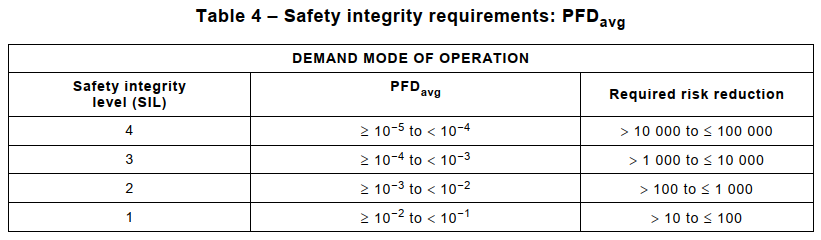
Different levels of PFDavg relate to permitted safety integrity levels (SIL) and risk reduction factor (RRF).
Key Points:
- Primary risk metric for low-demand SIFs.
- Calculated based on failure rates, proof testing, diagnostics, and architecture.
Example:
If PFDavg is 1E-2, the safety function has a 1% chance of failing on demand.
See Also: SIL, probability of failure per hour (PFH), failure rate (λ), RRF, markov model
Cited Source:
- IEC 61511-1:2016, Table 4
- IEC 61508-6:2010, Annex B.