Definition:
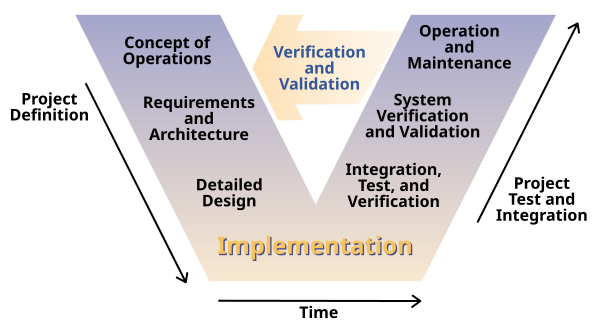
The V-Model is a software development and validation methodology where system testing mirrors each development phase, following a V-shaped workflow. Can also be called a Software Development Life Cycle (SDLC).
With respect to the IEC 61508/61511 programming categories, this would fall under LVL and FVL.
Key Points:
- The left side of the “V” focuses on specification and design (requirements, architecture, detailed design).
- The bottom point of the “V” represents code implementation.
- The right side of the “V” focuses on various levels of testing (unit testing, integration testing, system testing, acceptance testing).
- While not directly cited in IEC 61511, the V-Model underpins many software development lifecycles referenced in IEC 61508-3 (software requirements for functional safety systems).
- The V-Model emphasizes early planning of verification activities alongside development.
Example:
System architecture is validated by integration testing according to the V-Model process.
See Also: functional safety management, application program, LVL, FVL
Cited Source:
- IEC 61508-3:2010, Annex A
- Wikipedia – V-Model