
Definition:
Response Time (or SIF Response Time) refers to the total elapsed time from the moment the process is at a trip condition to the completion of the protective action. This must be faster than the process safety time.
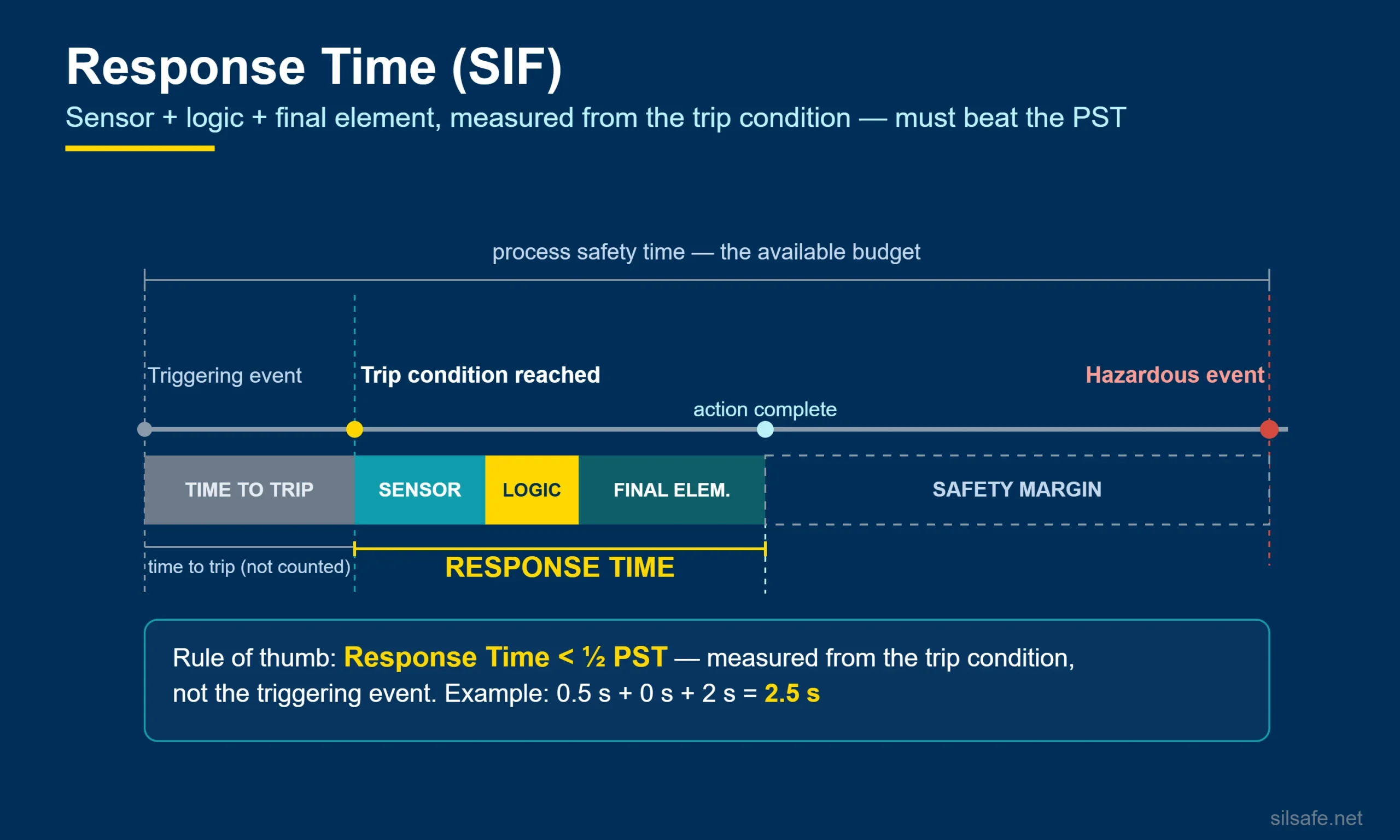
Note that some sources state this is when the instrument senses the trip condition, but that is not the definition SIL Safe uses.
The rule of thumb is that response time should be <1/2 of the PST. This is a conservative design margin to accommodate unforeseen delays. A 50% margin is a common design practice to account for degradation (e.g., slow valves) over the life-cycle.
Key Points:
- Must be less than the Process Safety Time (PST).
- Rule of thumb is that this would be <1/2 of the PST. This is a conservative design margin to accommodate unforeseen delays.
- Affects sizing of instrumentation and final elements.
- Unfortunately, people do use this term differently.
- The final element, if it is a valve, will vary greatly. A small solenoid valve will be < 1 sec, while an eight-inch 90-degree rotary ball valve could take perhaps 10 secs.
Example:
A tank reaches 150F which initiates a SIF. The SIF is a temperature element in a thermowell which then repositions a large valve with a 2 sec valve closure time. The time delay of the temperature instrument is 0.5 sec due to the mass of the thermowell. The logic solver (PLC) operates at essentially 0 sec delay. The total SIF response time would be instrument lag (0.5 sec) + PLC (0 sec) + valve (2 sec) = 2.5 sec.
See Also: process safety time (PST) for a very similar term
Cited Source:
- IEC 61511-1:2016, Clause 10.3.2
- Panaam – Process Safety Time (PST) Part 6 / A Worked Out Example – an interesting article about PST and response time