
A common mode failure (CMF) is two or more devices failing in exactly the same way at the same time. Two transmitters that both freeze at a normal reading, two valves that both stick open. CMF describes how the devices failed. Common cause failure (CCF) describes why: one shared event took them out together. The two terms get swapped constantly, but they are not the same thing. CMF sits inside CCF. It is the case where the shared cause fails every channel the same way, while plenty of common cause failures take the channels out in different ways.
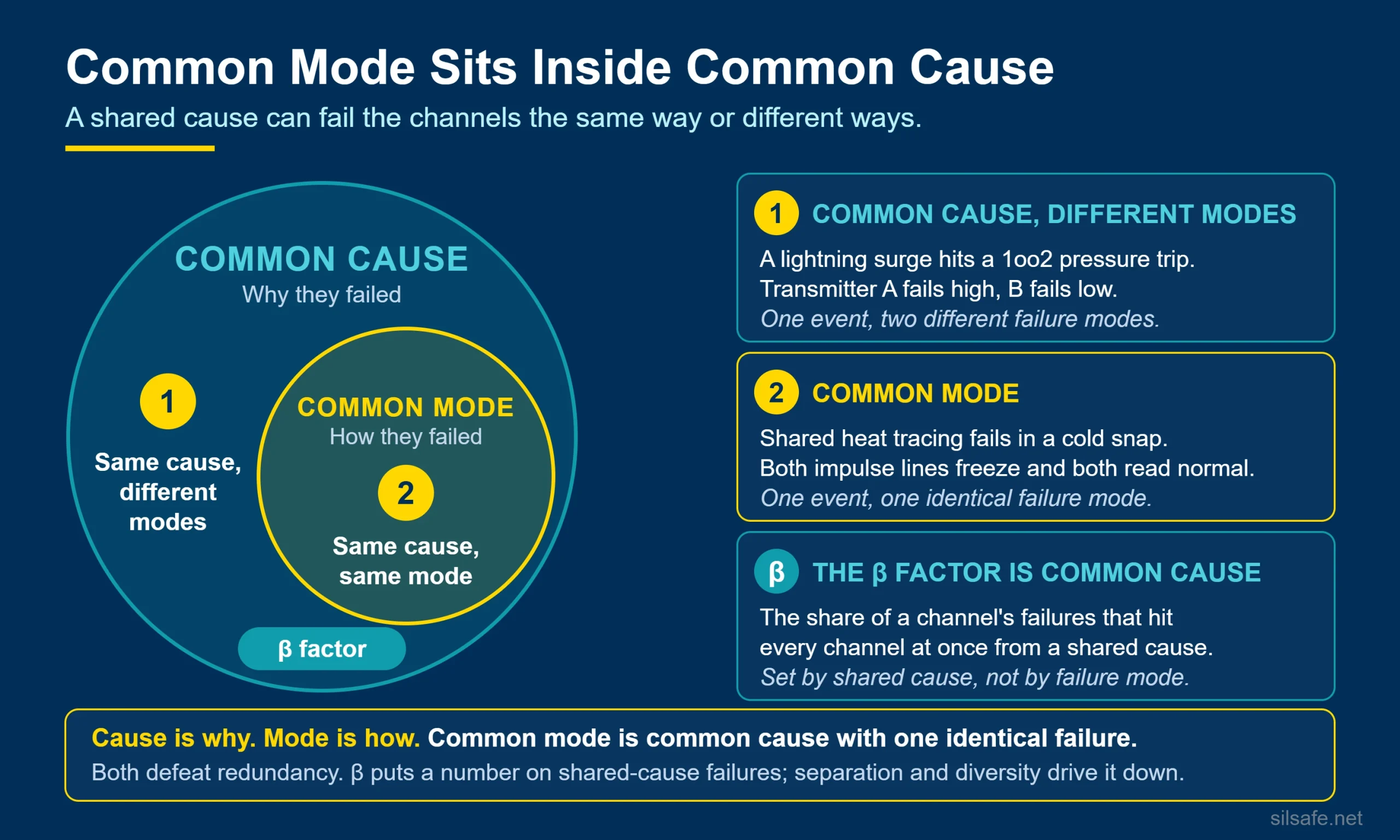
IEC 61511 draws the line differently. Its definition of common mode failures is “concurrent failures of different devices characterized by the same failure mode,” and the note under it says they “may have different causes” (3.2.6.2, Note 1). Taken literally, two transmitters that drift low for unrelated reasons are a CMF with no CCF behind them, which puts part of CMF outside CCF. The diagram follows IEC 61508-6, which calls CMF “a particular case of CCF” (D.1.2), and ISA-TR84.00.02-2022, which calls it “a subset of common cause failure” (5.2.3).
Key Points
- CMF is about the failure mode and CCF is about the shared cause. Nearly every CMF is also a CCF, but plenty of CCFs are not CMFs.
- Either one undercuts redundancy: a 1oo2 pair whose channels fail the same way at the same time protects no better than a single device.
- The beta factor (β) belongs to CCF. IEC 61508-6 defines it as “the fraction of single-channel failures that affect all channels” (D.4), so it is set by shared cause, and same-mode failures from unrelated causes fall in the independent 1−β share instead. ISA-TR84.00.02-2022 labels β “Common Mode Failure (Beta Factor)” in its symbol list, which feeds the mix-up.
Example
- Common mode – One run of heat tracing serves both impulse lines on a 1oo2 high-pressure trip. It fails during a cold snap, both lines freeze, and both transmitters hold a normal reading while the real pressure climbs. One shared cause, one identical failure. This is the kind of failure β is there to count.
- Common cause, not common mode – A lightning surge hits the same trip. Transmitter A fails high and transmitter B fails low. One event took out both, but they failed in different ways, so the transmitter that failed high still trips the unit. You get a spurious trip, not a missed one.
See Also: CCF, beta factor, diversity
Cited Sources
- IEC 61511-1:2016, Clauses 3.2.6.1 and 3.2.6.2
- IEC 61508-6:2010, Annex D (D.1.2 and D.4)
- ISA-TR84.00.02-2022, Clause 5.2.3 and Annex A