
Definition:
Relay logic is a design approach on how to do controls for a process. With relays one can create a fairly complex control for process systems. It can, with some clever design, recreate what a logic diagram can do (AND, NAND, OR, NOR gates, alarming, latching, time delays…). It is reliable, effective, and inexpensive. In the author’s opinion it should be used more than it is. This is the antithesis of a Programmable Electronic System (PES) which only has programmable elements.
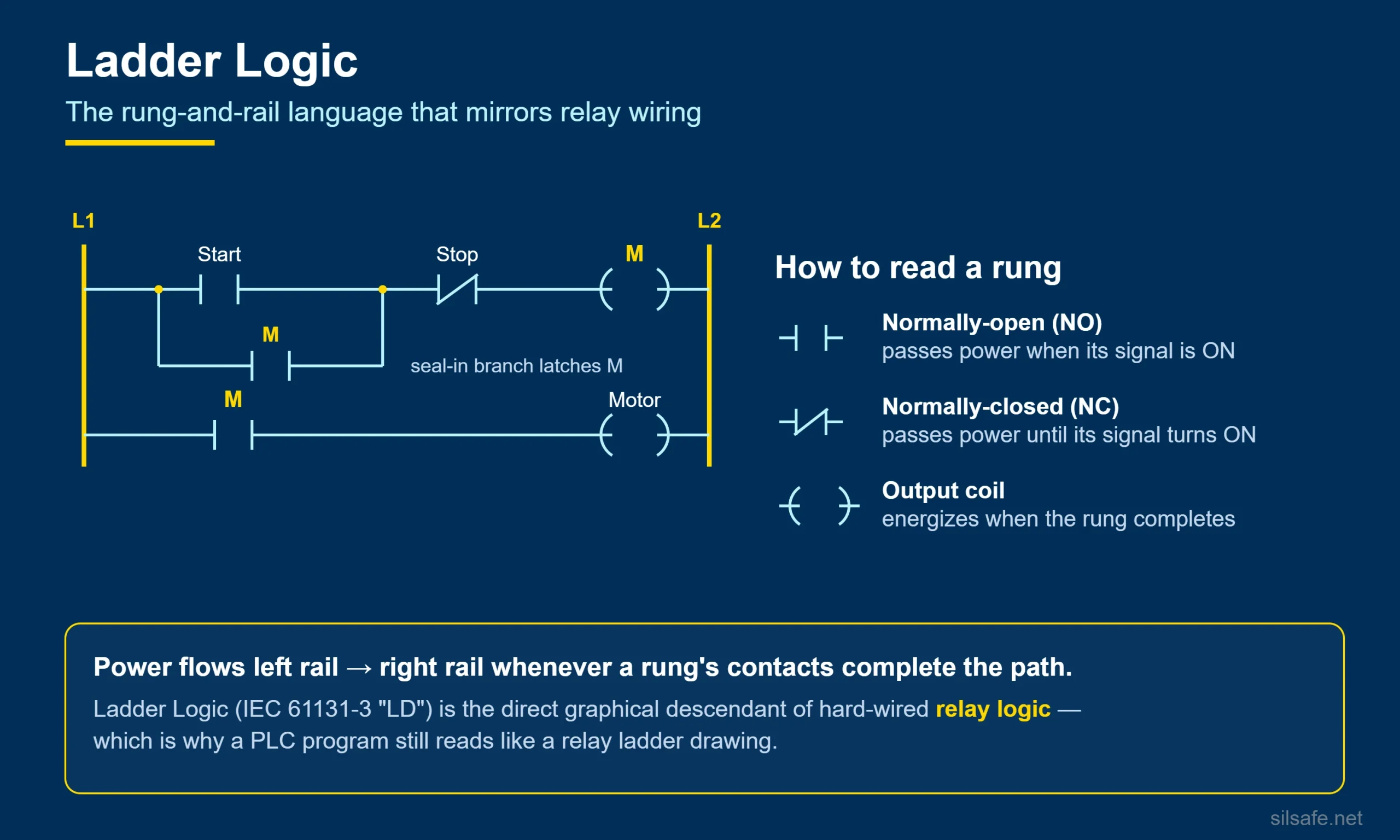
A heavy user of relay logic is the US nuclear industry. They lean away from software for fear of (a) cyber security threats and (b) common cause failure due to software. So nuclear plants in the US use a LOT of relay logic, for even fairly complex systems. This includes systems that need to pass seismic and EMC testing. Quality relays from manufacturers like IDEC are extremely reliable and heavily tested. It has amazed the author how resilient these items are.
Advantages of relay logic
- Cheap
- Less design decisions, making engineering easier and cheaper
- Better and lower cost cyber security
- Better EMC resiliency
Disadvantages of relay logic
- Self diagnostics are not possible – arguably the biggest advantage of a smart logic module or a safety PLC
- More difficult interface with transmitters as relays work in ON/OFF states. Note that there are analog to relay converters that can be used to trigger alarm states.
- More difficult calculating of PFDavg as there are multiple relays involved. But the equation method can still be used (not a more complex Markov Model).
- Larger physical footprint
- Harder to make changes (re-programming software is easier than re-designing a panel for more relays)
- Less sophisticated communications and alarming
- No built in testing tools for the SIF, such as a command to cycle a valve
- Difficulty in achieving SIL 3 or 4
Due to the various requirements in IEC 61511-1 and IEC 61508 it can be difficult to meet the requirements for a SIL 3 application, but is possible. Meeting a SIL 1 or SIL 2 is very achievable.
Key Points:
- Should be considered for a SIS with a small number of SIFs and SIL 1 or SIL 2
- Cheaper than a PES (material and engineering time)
- Not as good at diagnostics and instrument interface.
- Carefully consider the advantages / disadvantages.
- In the US, often built to UL 508A
See Also: PES, logic diagram, logic solver, smart logic module, application program
Example:
A small biogas facility has a SIS with two SIFs, both SIL 1. They decide that a safety PLC is overkill. They consider a smart logic module or a relay logic control panel and ultimately decide on the simplicity and low cost of relay logic.
Cited Source:
- Wikipedia – Relay Logic
- See logic.ly which is an excellent and simple software package