
Definition:
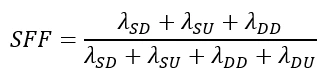
Safe Failure Fraction (SFF) represents how good a device is at avoiding undetected dangerous failures by showing the percentage of failures that are either safe or detected. SFF is a math term that recognizes dangerous undetected as the worst case type of failure. It is the ratio of safe (SD and SU) and detected dangerous (DD) failures to total failures (SD+SU+DD+DU). This is part of the analysis and intertwines with route 1H.
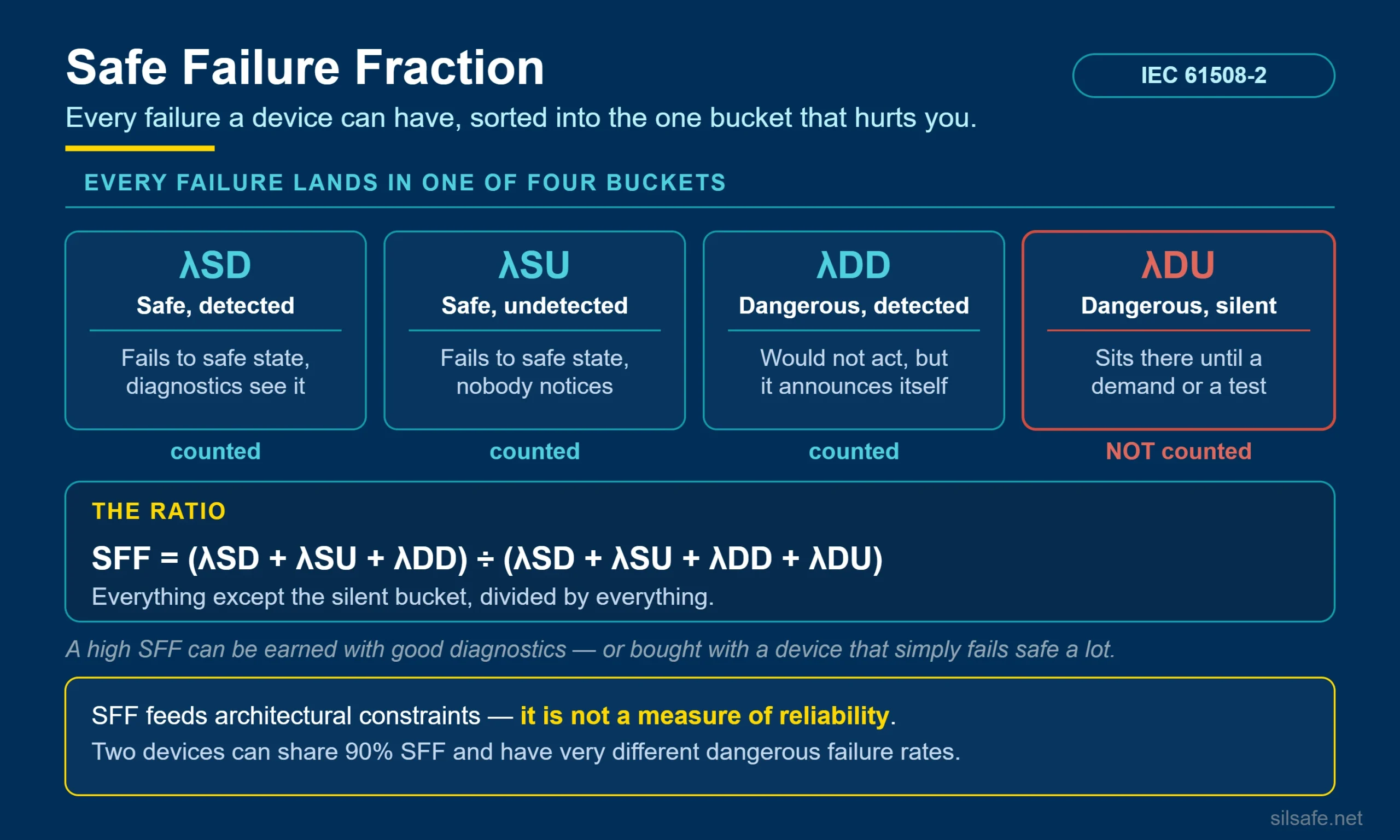
The core purpose of SFF is to determine, along with HFT and Type A vs. Type B classification, the maximum SIL of a device under the Route 1H architectural constraint tables in IEC 61508-2.
Some practitioners say SFF only applies to things with diagnostics, but that is not technically true. Without diagnostics, SFF would usually be lower, at times < 60%. But think of a spring return solenoid valve – very simple and fails safe. Common SFF thresholds in SFF and HFT tables used in IEC 61508 are 60%, 90%, and 99%.
SFF is very tied to route 1H. It is not needed in other routes but is often calculated as supporting data.
This can also be confusing as SFF is similar to DCdang.
- DC focuses on the dangerous portion of failures
- SFF focuses on the entire portion of failures
- SFF is always >= DCdang
This can also be confusing with % Safe Failures which is still used. The two ratios share the same denominator and differ by a single term in the numerator. SFF adds dangerous-detected failures (λDD), on the logic that diagnostics catch them, so SFF is always at least as large as % Safe Failures and the two are equal only when there are no diagnostics. The well-known Kenexis SIS Engineering Handbook prints an explicit warning about this. Put the two formulas side by side and that λDD in the numerator is the entire difference.

Key Points:
- Higher SFF reduces the required hardware fault tolerance.
- Important for achieving higher SIL levels via route 1H.
- SFF is meaningful in the context of Type A vs. Type B classification — the same SFF value yields different SIL caps for the two types.
- It is the FMEDA that is the engine that produces the information to calculate the SFF.
- Do not confuse with diagnostic coverage (DC). They are closely related but distinct topics.
- Do not confuse with proof test coverage (Cpt)
- SFF is used in architectural constraint evaluations (Route 1H), while DC is commonly used in analytical modeling.
Example:
If a device has 90 safe or detected failures out of 100 total, its SFF is 90%.
See also: FMEDA, DC, routes, hardware fault tolerance (HFT), Cpt, Types, safe failure percent
Cited Source:
- IEC 61508-2:2010, Clause 7.4.4.