Two explosions tore through a facility owned by Brent Industries in Toledo, Ohio in August 2026. They came during a shift change, with twelve workers in the building. Two of them were killed.
The roof was largely gone and the walls were blown out. Tanks of mineral spirits stood on the site, and the fire drew a three-alarm response.
Eleven years earlier, a fatal explosion at another similar facility, in Alabama, killed one operator and burned a second. Same solvent washing operation, same material, different building.
The cause of the Toledo explosion is undetermined and the investigation is open. Nothing here is a root cause analysis. Same company, same solvent, same process, and a hazard that never triggered a process safety regime.
What Brent Industries does
Brent Industries reconditions industrial textiles. Shop towels, work gloves, wipers, absorbents, and filter media come back dirty from industrial customers, get cleaned, and go back out rather than to a landfill. The Alabama and Toledo plants run the same operation.
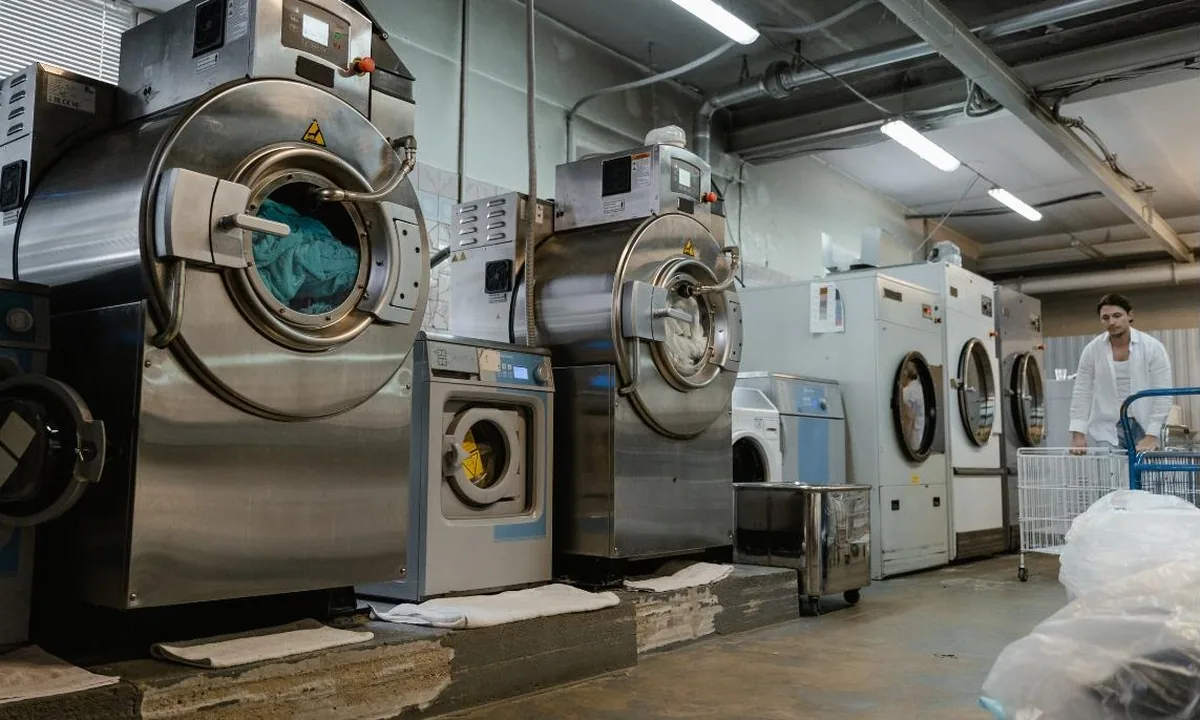
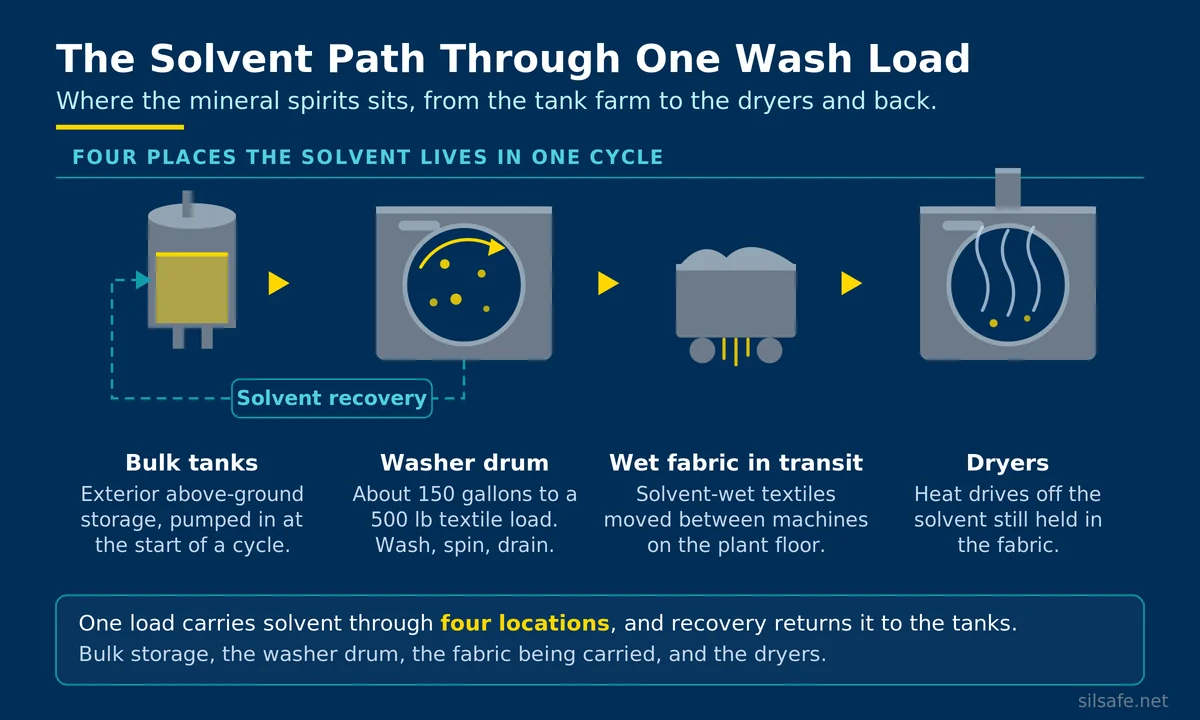
A textile load of roughly 500 lb goes into a washer, and about 150 gallons of mineral spirits are pumped in from exterior storage tanks. The drum agitates, spins at high speed to extract the solvent, then drains. The solvent-wet fabric transfers to separate dryers.
The solvent is kept in four places at once:
- Bulk exterior storage tanks
- The washer drum during wash, spin, and drain
- Wet fabric in transit between machines
- The dryers
That is a process by any engineering definition. A hazardous liquid inventory moves through vessels under mechanical energy. The paperwork says service industry.
What happened in Toledo
An initial explosion was followed by a secondary blast. The building partially collapsed and flames were reported over a hundred feet. Further explosions occurred while crews were fighting the fire.
Two employees were found dead inside the building hours after the fire began. Others were treated at the scene for minor injuries.
The mineral spirits tanks drove the responders’ hazard picture, and search and rescue had to proceed against the possibility of further explosions.

Air monitoring by the US Environmental Protection Agency (EPA) showed no offsite hazard. Ohio EPA and US EPA have required the owner to submit cleanup plans.
Fire investigators are working cause and origin, with no cause established and no preliminary indication offered. The Occupational Safety and Health Administration (OSHA) is investigating and has up to six months to complete, with no interim information released. No US Chemical Safety Board (CSB) investigation has opened, and none is listed on the agency’s docket at the time of writing.
What happened in Alabama in 2015
Two operators were working three washers at the Brent, Alabama plant. Vapor ignited inside one washer, most likely while the machines were draining, and the pressure blew the exterior doors off the machine. Fire and overpressure followed at the other washers within seconds, and the fire eventually engulfed the facility.
One operator was killed at the machine. The second was hospitalized with burns.
OSHA’s stated ignition source was an electrical spark generated when a sling with metal grommets was inadvertently loaded into the washer. A conductive object dropped into a drum full of solvent-wet fabric was the entire causal chain. No equipment failure, no procedural violation, no unusual condition.
What OSHA cited in 2015

A fatality and catastrophe investigation opened the day after the explosion. Citations were issued in September 2015, contested by the company, and the case was closed by an administrative law judge in 2016. Seven serious violations were issued initially at $32,200, reduced to six at $27,300.
The six that stood were:
- No sprinkler protection in the dry cleaning room, 1910.106(e)(5)
- Hazard communication program, 1910.1200(h)(1)
- Hazard communication training, 1910.1200(h)(3)(ii)
- Exit routes, 1910.37(a)(4)
- Personal protective equipment and hand protection, 1910.132 and 1910.138
- Floor openings, 1910.23
Sprinklers, training, gloves, and housekeeping were the complete federal response to a fatal vapor explosion. Nothing addressed the process: no hazard analysis, no ignition source control inside the equipment, no vapor detection.
Hazardous area assessment does not appear anywhere in the public record either. No citation was issued under the electrical standards, and nothing in OSHA’s investigation summary addresses whether the processing area was ever assessed or what electrical equipment was installed in it. Engineers may well have looked at this equipment and worked the question properly. It is not known either way.
How much of this is actually the same
Confirmed shared: the corporate entity, the solvent, and the core process of solvent washing and spin extraction of industrial textiles. Confirmed different: Alabama has a documented ignition mechanism and Toledo has none, and the casualty count.
The two events match on hazard rather than on cause. Toledo’s cause could land somewhere entirely different without changing the fact that a plant handling this material in this way produced a fatal explosion twice.
What makes mineral spirits explode in a washer
Mineral spirits, also called Stoddard solvent or white spirit, is a petroleum distillate mixture with a flash point of roughly 102 to 110°F. That number comes off a bench test, and it describes the lowest temperature at which a still, undisturbed liquid surface gives off enough vapor to flash under standard conditions.
A washer is built to defeat every one of those conditions. Agitation and high-speed extraction spread the solvent as film and mist across an enormous fabric surface area inside a closed drum, and nothing dilutes what comes off.
Spin friction, residual heat, and a warm building raise the drum headspace temperature while the bulk liquid never reaches its bench flash point.
Where the regulatory lines actually fall
OSHA dropped the term combustible liquid in 2012. This solvent is now a Category 3 flammable liquid that happens to flash above 100°F, and the rules draw their line at 100°F.
OSHA PSM
Process safety management (PSM) coverage under 1910.119(a)(1) has two independent triggers: a listed chemical in Appendix A at its threshold quantity, or 10,000 lb or more of a flammable gas or liquid in one location.
Mineral spirits is absent from Appendix A. The flammable liquid trigger has its own flash point test written into the rule text at below 100°F, and mineral spirits does not meet it.
The result holds regardless of inventory. A plant can hold any quantity of this solvent and never become a PSM covered process.
EPA RMP
Table 3 of 40 CFR 68.130 lists 63 regulated flammable substances, covering flammable gases and volatile flammable liquids alike, every one of them at the same 10,000 lb threshold. Mineral spirits is absent from that list, consistent with a flammable category built around light hydrocarbons and very low flash points.
The result holds regardless of inventory. A plant can hold any quantity of this solvent and never become a Risk Management Program (RMP) covered process.
Seveso and COMAH (Europe and the UK)
A different mechanism produces the same outcome outside the United States.
Europe’s CLP Regulation, the EU system for the classification, labelling and packaging of chemicals and the source of the hazard classes that Seveso and the Control of Major Accident Hazards (COMAH) regulations are built on, places mineral spirits in flammable liquid Category 3. That classification puts the solvent inside the Seveso and COMAH scheme rather than outside it, under category P5c.
The qualifying inventory for a lower-tier site is 5,000 tonnes, roughly 11 million pounds, with upper tier at ten times that. An entire plant of this type does not come close to the lower-tier figure.
The chemistry excludes it in the United States and the scale excludes it in Europe, so no major hazard regime anywhere reaches a plant like this.
What regulations apply
Fire code and the local authority having jurisdiction (AHJ) govern tank permitting, spacing, and building fire protection.
OSHA’s flammable liquid storage and handling rules at 1910.106 apply outside the PSM framework, and that is where the 2015 sprinkler citation came from. Those rules also tighten once the solvent is heated near its flash point.
Hazard communication, personal protective equipment, and the general duty clause are the residual federal reach. Environmental and emergency planning rules cover the waste stream and the chemical inventory. Neither asks how the process is protected.
The patchwork addresses the building, the paperwork, and the worker, and never the process.
Should this solvent trigger a hazardous area?
It is possible, but we cannot know for sure.
Four documents carry the guidance on how an engineer is to do a hazardous area assessment:
- NFPA 497, typically for chemical process areas
- API RP 500, typically for petroleum facilities
- NFPA 70, the National Electrical Code, Articles 500 and 505, which OSHA makes enforceable at 1910.307
- IEC 60079-10-1 internationally, working in zones rather than divisions
All of them share a key threshold: a flash point of 100°F. A liquid with a flash point under 100°F gives off ignitable vapor at normal ambient temperature, and the space around it is assessed on that basis. A liquid with a higher flash point is not expected to form an ignitable mixture until it is heated to that flash point, which NFPA 497 Section 4.2.7 states directly. Mineral spirits has a flash point of 102 to 110°F, a few degrees clear of the threshold.
The process itself does not run hot. Petroleum solvent cleans best around 77°F, and NFPA 32 requires coolers on the circulation loop to hold it 30°F below its flash point, so the liquid in the drum sits near room temperature and is never deliberately taken to 100°F. The dryers are the exception: the drying air runs hotter than the flash point, which is why petroleum dryers are built closed-loop through a condenser and carry LEL monitoring.
NEC 500.5 asks a broader question than the threshold: whether ignitable vapor can credibly be present. Three conditions at a plant like this make it credible.
- Heat. NFPA 30 and OSHA 1910.106 apply a 30°F proximity rule: a liquid heated to within 30°F of its flash point has to be handled as though it flashed below 100°F. For this solvent that trips around 72 to 80°F, which a warm building with spin friction and dryer heat can reach.
- Atomization. A liquid released as a fine spray forms a flammable atmosphere well below its flash point, which IEC 60079-10-1 recognizes. High-speed extraction of solvent out of fabric is a mist generator by design.
- Release and accumulation. Solvent leaves the drum on wet fabric and at the drain, and vapor collects in an enclosed space without dedicated ventilation.
So a plant like this warrants a formal assessment covering the washers, solvent transfer, the dryers, and the reclamation train. Whether any given space then comes out Class I Div 1, Div 2, or unclassified is a release and dispersion question, and NEC 500.4(A) requires the answer to be documented either way. What that assessment would have concluded here is not something we at SIL Safe can speak to.
NFPA 32, the drycleaning standard, gets there by a shorter route: a solvent flashing between 100 and 140°F makes this a Type II facility, and Clause 7.3.2 requires the electrical wiring and utilization equipment in a Type II facility to comply with NFPA 70 for Class I Div 2 locations. It is not known whether NFPA 32 was enforced at either plant, though OSHA’s own investigation called Brent a commercial petroleum dry cleaning facility.
All of this is a useful exercise and arguably misses the point for the original event! The ignition was triggered by a spark off a sling with metal grommets loaded into the drum, a source inside the machine rather than in the room around it. A hazardous area triggers the rules that the fixed electrical installation would have followed. So even with hazardous areas established and every piece of fixed equipment rated for them, this explosion could still have happened.
Does IEC 61511 reach a plant like this?
No legal requirement points a facility like this toward the standard
IEC 61511 is not law anywhere. It becomes binding when an AHJ pulls it in, most often through a process safety regulation citing recognized and generally accepted good engineering practice, and none of the regimes above reaches this facility. The standard does not reach out for it either: Clause 1 of IEC 61511 scopes the document to the process industry sector and names chemicals, oil and gas, pulp and paper, pharmaceuticals, food and beverage, and non-nuclear power generation. Industrial laundering is not on the list.
What could a SIF look like here?
Five safety instrumented functions (SIFs) would likely cover most of the demonstrated hazard:
- An in-drum vapor concentration monitor that halts the drain and purges the headspace before the mixture enters the flammable range
- Combustible gas detection in the solvent area that stops the washers and starts forced ventilation on rising vapor
- A high-temperature trip on each dryer that cuts heat and keeps the drum turning
- A high-level cutoff on the solvent fill that closes the valve and stops the transfer pump
- A door interlock that keeps the drum shut until the drain and purge cycle has finished
What we do not know at the time of writing (August 2026)
- What ignited the vapor in Toledo, and whether it resembles the Alabama mechanism in any way
- Where in the process the Toledo explosion started, and whether the washers, the dryers, the tanks, or the solvent recovery train were involved first
- Whether the solvent areas at either plant were ever assessed for hazardous area, and what electrical equipment was installed in them
- Whether OSHA will issue citations, and under which standards
- What the Toledo plant’s equipment was, and whether it carried gas detection, ventilation interlocks, or temperature trips of any kind
- Whether either site had ever performed a hazard study of any description
Frequently Asked Questions
How is this process similar to a dry cleaner for clothes?
Mechanically it’s almost identical: load, immerse in solvent, agitate, spin out, dry. The difference is the solvent class and the scale. A clothes dry cleaner runs perchloroethylene, which does not burn at all, or a high-flash hydrocarbon like DF-2000, which flashes around 142 to 145°F. Mineral spirits flashes around 102 to 110°F, a full solvent class more volatile and the class the dry cleaning trade moved away from decades ago. On top of that, a dry cleaning machine holds a few dozen gallons, against 150 gallons per load plus bulk exterior tanks here.
How common are these facilities around the world?
More common than you’d guess, though nobody publishes a count. Industrial laundering is a large global sector and most of it is water-based, but water does not get hydrocarbon out of fabric, so solvent reconditioning of oily shop towels, gloves, and filter media is a standing niche inside it. The equipment looks much the same in North America, Europe, and Asia. What changes is the regulatory regime the plant lands in.
Shouldn’t this have triggered a hazardous area, and shouldn’t that have protected it?
Maybe. The write-up above lays out why the assessment is warranted and why nobody outside the plant can say how it would have come out. Even a correctly established hazardous area, with every piece of fixed electrical equipment rated for it, would not have caught this one. The spark came off a metal object loaded into the drum, and hazardous area rules govern the permanent electrical installation.
So you’re telling me two major accidents have happened in recent years and people still aren’t applying IEC 61511? Why aren’t governments getting in front of this, and why aren’t the facilities choosing to do it themselves?
We at SIL Safe don’t have an answer to that. They are good questions, though.
A serious violation penalty seems very low for something that caused a death. Is that typical or atypical in the United States?
Typical. If anything, Brent’s penalty ran high for a fatality case in that era.
The reason is structural. A serious violation is capped per violation by statute, $7,000 in 2015 and $16,550 today, and a worker dying does not raise that ceiling. Only a willful or repeat classification does, at ten times the amount. Civil liability sits outside all of this and is not covered here.
For a facility like this, the fine is likely the smallest number on the page. A destroyed building, destroyed equipment, and lost production punish a business in a way a five-figure penalty does not, insured or otherwise.
Further Reading
From SIL Safe
- Functional Safety Is Not the Same as Occupational Safety
- Houston Recycling Fire: When Is a Recycling Center a Process Facility?
- The Haldia Naphtha Pipeline Fire: What We Know So Far
- Functional Safety for the Process Industry
External resources
- OSHA accident report: fatal explosion at Brent Industries, Inc., March 2015
- OSHA inspection record for the 2015 Brent Industries fatality, with citations and penalties
- 29 CFR 1910.119, Process Safety Management of Highly Hazardous Chemicals
- 29 CFR 1910.106, Flammable liquids
- 40 CFR 68.130, List of substances
- Directive 2012/18/EU, the Seveso III Directive
- HSE: introduction to the Seveso III Directive and COMAH
- OSHA Chemical Sampling Information: Stoddard solvent
Functional safety is complex, and the stakes are high. If you have questions about your SIS design, SIL verification, or where to start with IEC 61511, the team at SIL Safe is here to help. Reach out to us today.