Suppose a facility realizes functional safety applies to them. Maybe an auditor flagged it. Maybe a corporate directive came down. Maybe a near-miss made it impossible to ignore. The reaction is predictable: the Health, Safety, and Environment (HSE) team will handle it. It sounds reasonable on the face of it. Both have “safety” in the name. Both involve hazards. Both involve compliance. It is also wrong.
The Disciplines Are Not the Same
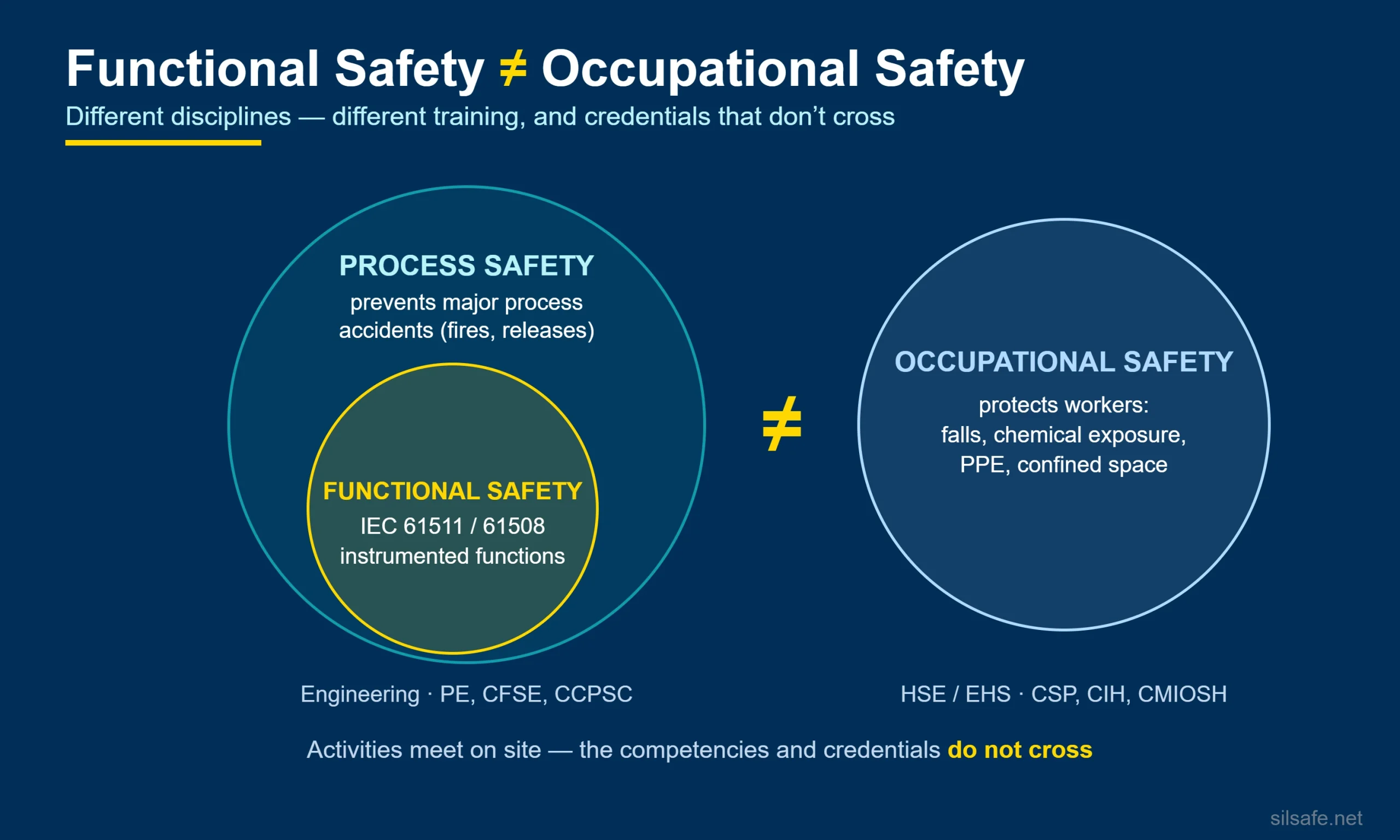
Occupational safety is a discipline and a professional track. Process safety is an engineering discipline. Functional safety is an engineering discipline that follows a specific set of standards (IEC 61511 and IEC 61508) to implement risk reduction within process safety.
- Occupational safety protects workers from workplace hazards: falls, struck-by, chemical exposure, ergonomics, noise, confined spaces, electrical contact.
- Process safety is the engineering discipline for preventing major accidents from the process itself, such as releases, fires, explosions, and runaway reactions.
- Functional safety sits inside process safety as the standards-based engineering discipline (IEC 61511 and IEC 61508) for reducing process risk through instrumented protective functions.
A Venn diagram makes the relationship clear. Occupational safety is a separate circle. Process safety is a larger circle. Functional safety is a circle inside process safety.
Functional safety does not overlap with occupational safety as disciplines, though the two are adjacent and several site activities bring them together. They differ at the technical level, and skill sets do not transfer between them.
The Professionals and Their Backgrounds
The discipline distinction shows up cleanly in who does the work, where they train, and what credentials or certifications they hold.
Occupational safety professionals
The job type or discipline goes by several names depending on company and region: HSE (Health, Safety, and Environment), EHS (Environment, Health, and Safety), SHE (Safety, Health, and Environment), and HSSE (with Security added). The people doing the work carry an even longer list of job titles:
- Safety Manager
- Safety Engineer
- Safety Specialist
- Safety Coordinator
- HSE / EHS Manager
- Health and Safety Officer
- Industrial Hygienist
- Occupational Health Specialist
- Director of EHS / HSE
At SIL Safe, we refer to all of these roles collectively as occupational safety. Backgrounds run through occupational health and safety, industrial hygiene, environmental health, and sometimes engineering or kinesiology. Industrial hygiene is the field that figures out what workers are being exposed to on the job (chemicals, dust, noise, heat) and gets the exposure down to safe levels.
Professional bodies include the Board of Certified Safety Professionals (BCSP), the American Industrial Hygiene Association (AIHA), the UK Institution of Occupational Safety and Health (IOSH), the British Occupational Hygiene Society (BOHS), and the International Occupational Hygiene Association (IOHA) as the global umbrella.
Credentials include the Certified Safety Professional (CSP), the Certified Industrial Hygienist (CIH), and the Chartered Member of IOSH (CMIOSH).
Day-to-day work is workplace chemical exposure monitoring (airborne contaminants, dust, vapors), Personal Protective Equipment (PPE) programs, ergonomic assessments, incident investigation for personnel injuries, and regulatory compliance for worker protection.
Process safety professionals
Backgrounds are typically chemical engineering, though mechanical, electrical and controls, and other engineering disciplines with relevant process experience are also represented.
Professional bodies include the Center for Chemical Process Safety (CCPS, part of the American Institute of Chemical Engineers, AIChE), the Institution of Chemical Engineers (IChemE) in the UK, and the Mary Kay O’Connor Process Safety Center on the academic side.
Credentials include the Certified Process Safety Professional (CCPSC) via CCPS, IChemE professional registration, and often a Professional Engineer license (PE in the United States, P.Eng in Canada, CEng in the UK) in chemical, electrical, or other relevant engineering field.
Day-to-day work is Hazard and Operability (HAZOP) and Layer of Protection Analysis (LOPA) facilitation, mechanical integrity programs, management of change, and Process Hazard Analysis (PHA) revalidation.
Functional safety professionals
Functional safety professionals come from the same engineering backgrounds as process safety professionals, with deeper instrumentation, controls, and reliability engineering experience. The same professional bodies apply (AIChE, IChemE, and equivalents cover functional safety to a degree), with additional bodies that focus directly on it: TÜV Rheinland, TÜV SÜD, Exida, and the CFSE Governance Board.
The directly relevant credentials are the Certified Functional Safety Expert (CFSE) and Certified Functional Safety Professional (CFSP) from Exida, and TÜV FS Eng. Additionally, the International Society of Automation (ISA) and Underwriters Laboratories (UL) offer certifications.
Day-to-day work spans the full life-cycle: Safety Instrumented System (SIS) design and verification, proof testing oversight, functional safety audits, training, procedure maintenance, and competency matrix management, all governed by IEC 61511.
Occupational safety credentials and process / functional safety credentials do not cross. A CIH is not on a track to become a CFSE. The training, the math, and the body of standards are different worlds. Process safety and functional safety credentials, on the other hand, do cross. The underlying engineering background is the same, and many practitioners hold both. A CCPSC who is also a CFSE is a common and useful profile.
Where Functional Safety Meets Occupational Safety
The disciplines are not sealed off from each other.
- Hazardous area classification. Process safety defines the zones (Class I Div 1/2, Zone 0/1/2) based on the flammable inventory and release sources. Occupational safety enforces the consequences in the field: no uncertified tools, no non-intrinsically-safe radios, no work without the right PPE and procedures. A worker cannot walk into a Zone 1 area with an off-the-shelf iPad or their phone in their pocket. The classification is a process safety output. The daily enforcement is an occupational discipline.
- Personal gas monitors (flammable gas / Lower Explosive Limit, hydrogen sulfide, oxygen). A worker wearing a personal monitor is an occupational control protecting that worker from a process hazard. The hazard originated in the process. The control is occupational. Both disciplines have a stake.
- Confined space entry. Occupational program (permits, attendants, retrieval), but the atmosphere being tested exists because of process residues and the equipment being entered is process equipment. The entry decision depends on understanding the process chemistry: what was last in the vessel, what reactions are possible, what residual hazards remain after isolation.
Overlap at the activity level is real and common practice in a healthy organization. Overlap at the competency level is minimal. The HSE professional running the confined space program is not qualified to verify a Safety Integrity Level 2 (SIL 2) Safety Instrumented Function (SIF). The functional safety engineer verifying that SIF is not qualified to write the confined space program. The activities cross. The competencies do not.
Common Mistakes
Strong personnel safety record interpreted as process safety health. A facility logs years without a recordable injury, leadership concludes the safety program is working, and a major release blindsides them six months later. Texas City, Buncefield, and Jaipur all happened at facilities with strong personnel safety records. The Baker Panel report after Texas City made this pattern explicit: BP had been managing personal safety while neglecting process safety. Personnel injury rate measures slips, trips, hand cuts, and ergonomic strains. None of those metrics tell you anything about whether the SIS will work on demand or whether the relief valves are adequately sized.
- Leadership asking for process safety KPIs and getting handed occupational ones. Boards and executives ask “how safe are we?” and HSE shows them Total Recordable Incident Rate (TRIR), Lost Time Incident Rate (LTIR), and Days Away, Restricted, or Transferred (DART) trending down. The metrics are real and the trend may be real, but they answer a different question. Process safety health is measured by leading indicators tied to Process Safety Management (PSM) and Risk-Based Process Safety (RBPS) elements: management of change (MOC) backlog, PHA action items overdue, proof test completion rate, SIF demand rate. Personnel injury statistics are not those indicators.
- Putting functional safety under the HSE function. Org chart logic (“safety is safety, put it under the safety guy”) or cost pressure pushes functional safety, the Safety Requirements Specification (SRS), and the Hazard and Risk Assessment (H&RA) under HSE ownership. The work either gets skipped or gets done badly by someone with the wrong training, and the deliverables end up in the wrong hands organizationally.
Frequently Asked Questions
My boss says our safety manager can handle the SIL stuff. What do I tell him?
Tell him that your safety manager is properly an Occupational Safety Manager by role, even though the actual title varies (Safety Manager, HSE Manager, EHS Director, and so on). An occupational safety professional is fundamentally a different animal than a functional safety engineer. The safety manager probably runs PPE programs, exposure monitoring, ergonomic assessments, and injury investigations. SIL work is a different domain: IEC 61511, SIS architecture, failure modes, reliability mathematics, proof testing. The training does not transfer, and the credentials do not overlap. A CSP is not on a track to a CFSE, and a few hours of online refresher will not bridge the gap.
In the safety manager’s defense, occupational safety professionals carry a confusing array of job titles, and the word “safety” appearing in both disciplines does not help. The conflation is understandable. The substitution is not. The two roles can sit in the same organization and respect each other, but one cannot substitute for the other.
Isn’t process safety just functional safety at a bigger scale?
It is the other way around. Process safety is the broader engineering discipline. Functional safety is a subset of process safety, tied to the standards (IEC 61511 and IEC 61508) that govern instrumented protective functions. HAZOP, LOPA, mechanical integrity, management of change, and Pre-Startup Safety Review are all process safety activities that are not functional safety.
We have an excellent TRIR. Doesn’t that mean our process safety program is working?
No, but there is some overlap. A process safety incident with injuries does show up in TRIR. The metric itself is dominated by occupational events, though: slips, trips, hand cuts, strains. A facility can drive TRIR to industry-leading levels while its SIS portfolio is overdue for proof testing, its MOC backlog is unmanaged, and its layers of protection have eroded. The Baker Panel report after Texas City documented exactly that pattern at BP. TRIR is a useful occupational metric. It is not a leading indicator of functional safety or process safety health.
If a personal gas monitor protects a worker from a process release, why isn’t it a LOPA credit?
A personal gas monitor can sometimes meet IPL (Independent Protection Layer) criteria within a functional safety LOPA, but the claim is often made without testing them. An IPL must satisfy three requirements:
- Independence. The protection layer cannot share failure modes with the initiating cause or with other claimed layers.
- Specificity to the scenario. The monitor must detect the specific release and give the wearer enough time to act before harm.
- Auditability. Calibration records, bump test records, and battery and gas check records must be in place and reviewable.
Take two scenarios:
- Slow flange leak detected on a routine round. The wearer has time to back away, and an audited monitor program can credibly support an IPL claim for that scenario.
- Line rupture that puts the wearer in a vapor cloud within seconds. The same monitor cannot stand as an IPL, because the detection-to-action time is not there.
The other common failures are claiming credit against the wrong consequence type (the monitor does nothing about equipment damage, fire escalation, or fence-line population) and double-counting the same monitor across multiple scenarios where independence does not hold. A personal gas monitor is a real occupational control that saves lives. It is not, by default, a LOPA credit, and the judgment can be tricky.
Does the functional safety person need to work with and talk to the HSE / occupational safety team?
Absolutely, they should be considered colleagues. Hazardous area classification needs both sides aligned: process safety defines the zones, and HSE enforces the field consequences. Personal gas monitor programs cross both disciplines, with the monitor itself an occupational control protecting against a process hazard. Confined space work that involves SIS equipment needs functional safety input on bypass and recovery procedures, while the HSE program owns the entry permit itself. The relationship is collaborative, not hierarchical. Each side owns its discipline.
Further Reading
From SIL Safe
- Hazard and Risk Assessment (H&RA): The Foundation of Functional Safety
- Layer of Protection Analysis (LOPA): The Engineer’s Guide to SIL Selection
- SIL Verification: The Three Gates Every SIF Must Clear
- The Same Explosion, Eleven Years Apart
- The History of Functional Safety
External resources
- IEC 61511 standard page (IEC)
- UK Health and Safety Executive: Control of Major Accident Hazards (COMAH)
- American Industrial Hygiene Association: Discover Industrial Hygiene
- International Occupational Hygiene Association (IOHA)
Functional safety is complex, and the stakes are high. If you have questions about your SIS design, SIL verification, or where to start with IEC 61511, the team at SIL Safe is here to help. Reach out to us today.