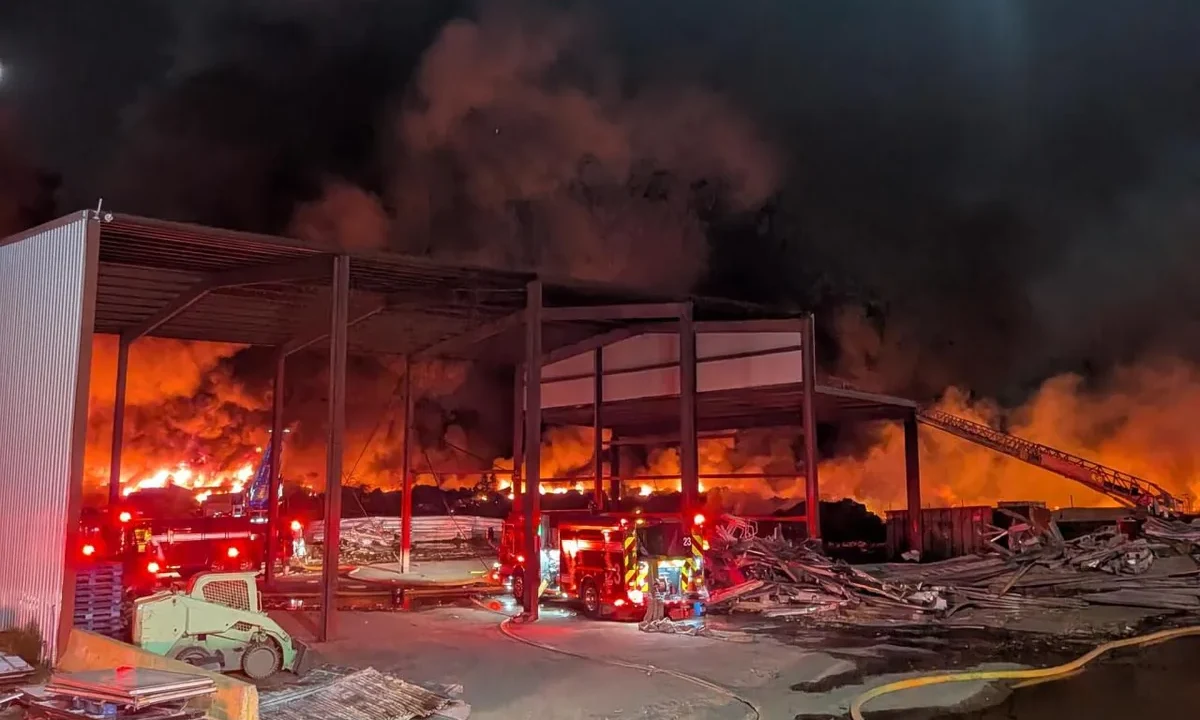
On June 22, 2026, a fire tore through a pile of scrap tires and debris at Mammoth Metal Recycling in Houston. It drew roughly 200 firefighters, pushed black smoke across the city for miles, and burned close enough to a neighborhood that crews worked to keep it from jumping a tree line into homes. No one was hurt, and no structures were lost. The Houston Fire Department (HFD), HazMat teams, and air-quality monitors from city and state agencies responded, with early official readings below the National Ambient Air Quality Standard (NAAQS) level of concern.
The cause is still under investigation, so what follows is based on publicly available information and is not a root cause analysis. For functional safety practitioners, the fire raises three cleaner questions:
- Is a place like this a process facility?
- Was the fire a process safety event?
- Would IEC 61511, OSHA’s Process Safety Management (PSM) standard, or the EPA’s Risk Management Program (RMP) ever reach it?
A scrap tire and metal yard is almost certainly none of those things, and walking through why draws a clean line around what functional safety actually governs.
What happened at the Mammoth Metal Recycling fire
The fire was reported in the early afternoon of June 22, 2026, burning in a debris field roughly the size of a football field behind a warehouse. Scrap tires were the primary fuel, and the rubber made the fire slow to extinguish, so HFD escalated to a multi-alarm response of about 200 firefighters. No injuries were reported, and no evacuations were ordered, though the fire burned close to homes and crews worked to keep it from spreading past a tree line into the neighborhood.

The cause remained under investigation by HFD arson investigators at the time of writing, with no determination of accidental or intentional origin. Early official air monitoring by the Houston Health Department and the Texas Commission on Environmental Quality (TCEQ) reported particulate levels below the NAAQS level of concern, though a local air-quality group disputed how fully the plume was captured. The EPA was notified the same day and opened an on-scene coordinator response for the fire, with no report made to the National Response Center. EPA later confirmed no offsite air detections and no impact to Brays Bayou.
Is a recycling center a process facility?
“Recycling” names an end goal, material recovery, not a process type. It covers everything from a shredder yard to a chemical plant, so the label by itself says nothing about whether a site is a process facility.
A process facility continuously or in batches transforms, separates, or reacts materials. It usually holds hazardous inventories under pressure or temperature and relies on instrumented systems, including a safety instrumented system (SIS), to keep the process inside safe limits. That is the world IEC 61511, PSM, and RMP were written for. Whether a given recycling center belongs in it depends entirely on what happens on the pad.
Recycling that is not a process facility
The everyday picture of recycling, aluminum cans, cardboard, and bottles sorted and baled at a material recovery facility, is mechanical and optical separation with no chemical process anywhere in it. Scrap tire operations sit in the same category: collection, shredding, and crumb rubber production, where the hazard is a large combustible solid pile rather than a contained chemical reaction. So does scrap metal shredding, shearing, and baling, the smasher-and-cutter operation driven by hydraulics and motors with no hazardous chemical inventory.
The common thread across all of these is mechanical size reduction and sorting. There is no process holding a hazardous inventory, and nothing a safety instrumented function (SIF) would protect.
Recycling that is a process facility
Other recycling operations are process plants in every meaningful sense. Solvent recovery and reclamation distills and re-separates spent solvents in a continuous chemical process, holding flammable and toxic inventories. Used-oil re-refining runs distillation and hydrotreating steps that put it closer to a small refinery than a scrap yard. Plastics pyrolysis and other advanced, or chemical, recycling thermally crack feedstock into oils and gases under heat and pressure. Lithium-ion battery recycling pairs shredding with chemical leaching, solvent extraction, and thermal steps, and the cell chemistry itself adds fire and toxic-release hazards.
These operations run reactors and separation equipment on hazardous inventories and can carry SIFs, which puts them squarely inside the process facility definition. The same word on the sign, a completely different regulatory world. What decides it is the chemistry on site, not the “recycling” label.
Was the Houston recycling fire a process safety event?
A process safety event, in the API RP 754 and Center for Chemical Process Safety (CCPS) sense, is a loss of primary containment of a hazardous material from a process. It is structured into Tier 1 through Tier 4 indicators used at refining, petrochemical, and similar process facilities.
The Houston fire falls outside that definition on two independent counts:
- The site was not a process facility, so there was no process for a hazardous material to be released from.
- Even if it had been, nothing was lost from primary containment; the tires burned as an open-air stored pile, not a contained inventory.
The event is better classified as an industrial or waste fire with an air-quality dimension, which is why the responders were fire, environmental, and public-health bodies rather than process safety regulators.
Do process safety regulations apply to recycling centers?
Yes, but only when the recycling center is a process facility. The trigger is the chemicals a site holds, not the word “recycling,” so the same question has different answers for a shredder yard and a solvent recovery plant.
OSHA PSM and EPA RMP in the United States
OSHA’s PSM standard is triggered by threshold quantities of listed highly hazardous chemicals, including flammable gases and liquids above 10,000 lb. The EPA’s RMP applies the same threshold logic to regulated substances tied to offsite consequence. A recycling operation can hold enough regulated inventory to cross these thresholds when it does real chemistry: solvent recovery, used-oil re-refining, or chemical recycling with significant flammable or toxic storage are the usual candidates.
Seveso and COMAH in Europe and the United Kingdom
The Seveso III Directive across the EU and the Control of Major Accident Hazards (COMAH) Regulations in the UK apply the same establishment-and-threshold logic, catching any site, recycling included, that holds dangerous substances above listed quantities. Chemical recycling, solvent handling, or large flammable storage can put a recycling site into a lower or upper tier under these regimes. The framework names and thresholds change by jurisdiction, but the underlying test, a hazardous chemical inventory versus mechanical handling, travels unchanged.
Where IEC 61511 fits
A recycling operation that is a process facility, pyrolysis, re-refining, battery reprocessing, runs the kind of process IEC 61511 was written for.
The rules that applied to the Mammoth site
TCEQ’s scrap tire program required registration, the City of Houston’s scrap tire ordinance required a permit, and open-burning prohibitions, Clean Air Act air-quality standards, and the fire code covered the rest. Reporting indicated the operator held neither a TCEQ scrap tire registration nor a city scrap tire permit, and had been cited for illegal burning in the weeks before the fire.
The company carried a broader run of recent trouble as well: a delinquent property-tax suit and a federal fraud case tied to affiliated recycling companies, unrelated to the fire but part of the operator’s recent record. Emergency response ran through HFD, HazMat, and the EPA on-scene coordinator, with cleanup coordinated by the City rather than any process safety authority. A site can pose a real hazard to a neighboring community and still sit entirely outside process safety law.
What we do not know at the time of writing (July 2026)
Several things were still open at the time of writing:
- What ignited the pile: HFD arson investigators had not established a cause, and no accidental-versus-intentional determination had been made.
- Any longer-term or independent assessment of neighborhood exposure, beyond the response-phase monitoring that reported no significant detections.
- Any residual soil contamination at the site from the pyrolytic oil that tire fires generate; EPA reported no impact to Brays Bayou.
- The site’s regulatory and cleanup path forward, with the TCEQ investigation open and the permit and property status unresolved.
Frequently Asked Questions
What’s the formal definition of a process facility, and what says it?
No single standard defines “process facility” as a stand-alone term, which trips people up. The load-bearing definitions come from three places:
- OSHA’s PSM rule defines a “process” as any activity involving a highly hazardous chemical: its use, storage, manufacturing, handling, or on-site movement.
- API RP 754 and CCPS define the process safety event, anchored to loss of primary containment from a process.
- IEC 61511 frames the “process industry” for functional safety.
So when you ask for the definition of a process facility, you’re really asking whether there’s a process handling hazardous chemicals, and each framework answers that in its own way.
There’s a municipal recycling center near me that only takes glass, cardboard, and plastic. Do you think that’s a process facility?
Almost certainly not. Sorting and baling glass, cardboard, and plastic is mechanical and optical separation with no chemical process and no hazardous inventory. There’s nothing a SIF would protect, so it sits outside PSM, RMP, and IEC 61511.
I dropped off a pile of old lithium-ion batteries for recycling. Is wherever they end up likely a “process facility”?
More likely than the glass-and-cardboard center, yes. Lithium-ion recycling usually pairs shredding with chemical steps: leaching, solvent extraction, and sometimes thermal processing. Add the cell chemistry’s own fire and toxic-release hazards, and a full-scale battery recycler can hold enough regulated material to look and behave like a process facility. A simple collection point that only stages batteries for shipment somewhere else would not.
Our recycling site handles solvents and we’re in Europe. Should we be looking at Seveso?
Possibly, and it’s worth checking rather than assuming. Seveso, and COMAH in the UK, turns on how much dangerous substance you hold at once, not on whether you call yourself a recycler. If your solvent inventory crosses the lower-tier threshold, you’re a Seveso establishment with notification and major-accident-prevention duties, and the upper-tier threshold pulls in a full safety report. Add up your maximum on-site inventory, including what’s in process and sitting in pipework, and compare it against the Annex thresholds.
Further Reading
From SIL Safe
- Functional Safety for the Process Industry
- Functional Safety Is Not the Same as Occupational Safety
- Longview Chemical Tank Implosion
- Garden Grove Chemical Incident
- The Same Explosion, Eleven Years Apart
External resources
- EPA Emergency Response site for the Houston tire fire
- US EPA: Tire Fires (hazards, cleanup, why they are hard to fight)
- FOX 26 Houston: background on the company behind the fire
- API guide to reporting process safety events (API RP 754 definition)
Functional safety is complex, and the stakes are high. If you have questions about your SIS design, SIL verification, or where to start with IEC 61511, the team at SIL Safe is here to help. Reach out to us today.