
B10D is the number of operating cycles at which 10% of a tested population has failed dangerously. It is the safety-relevant sibling of B10, which counts every failure in either direction, and you convert between them with B10D = B10 / RDF (rate of dangerous failures). Where the split is unknown, ISO 13849-1 says assume 50% dangerous, so B10D = 2 × B10. That D subscript is the whole difference, and it is why B10D, unlike B10, is a defined functional safety parameter.
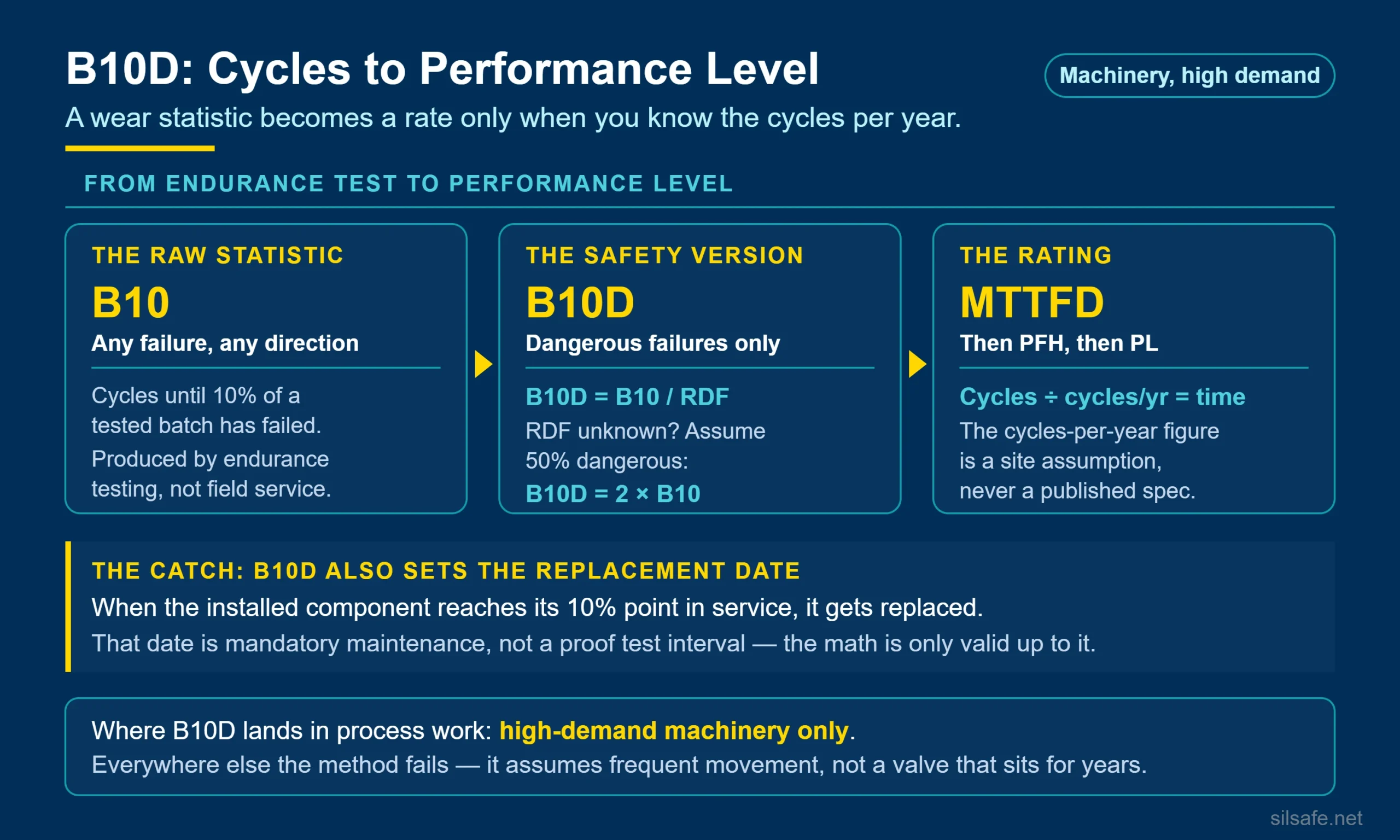
How does this relate to a functional safety engineer in the process industry? Mostly it tells you when to reject the data on a component you are assessing. Vendors of pneumatic and electromechanical parts often publish a B10D instead of a dangerous failure rate, and it is tempting to convert it and move on. Resist that. The B10 method assumes every useful-life failure is premature wear-out, so corrosion, binding, cold welding and stiction are treated as negligible. Those are exactly the mechanisms that take out a final element sitting idle for years, which is why a B10D-derived rate does not belong in a low-demand PFDavg. If B10D is the only number the vendor offers, that is a sourcing problem to solve, not a number to convert.
Key Points
- B10D feeds MTTFD (mean time to fail dangerous), which then gives the average frequency of dangerous failure per hour (PFH) and the performance level (PL). Turning cycles into time takes the expected operations per year, always a site assumption, and it must count process-driven actuations, not just safety demands.
- MTTF and MTTFD are not interchangeable. MTTF is the mean time to failure counting every failure mode, while the D narrows it to dangerous failures only, exactly the restriction B10D applies to B10. ISO 13849-1 quantifies each channel in MTTFD; plain MTTF does not enter the PL calculation.
- It is a high-demand machinery parameter. ISO 13849-1 stops at demands more frequent than once a year and sends low-demand users, the processing industry named outright, to IEC 61508.
Example
A pneumatic solenoid on a packaging-line guard interlock carries a published B10D of 20,000,000 cycles. The machine strokes it every six seconds across 6,000 operating hours a year, about 3.6 million cycles annually. Divide the two and the valve statistically reaches its 10% dangerous-failure point in under six years. That is the replacement date, whether or not the valve has ever misbehaved.
See Also: B10, failure rate, high demand mode, useful life
Cited Sources
- ISO 13849-1:2023, Safety of machinery – Safety-related parts of control systems – Part 1: General principles for design (the standard that defines B10D)
- IEC 62061, Safety of machinery – Functional safety of safety-related control systems
- IFA / DGUV, “Fourth edition of EN ISO 13849-1” – publikationen.dguv.de