
Definition:
B10 is the statistic and the endurance testing that is a statistical method that determines the time or number of operations until 10% of a population of mechanical components have failed, providing reliability data used for functional safety calculations. Alternatively, it can be thought of as the 90% reliability at a point in time.
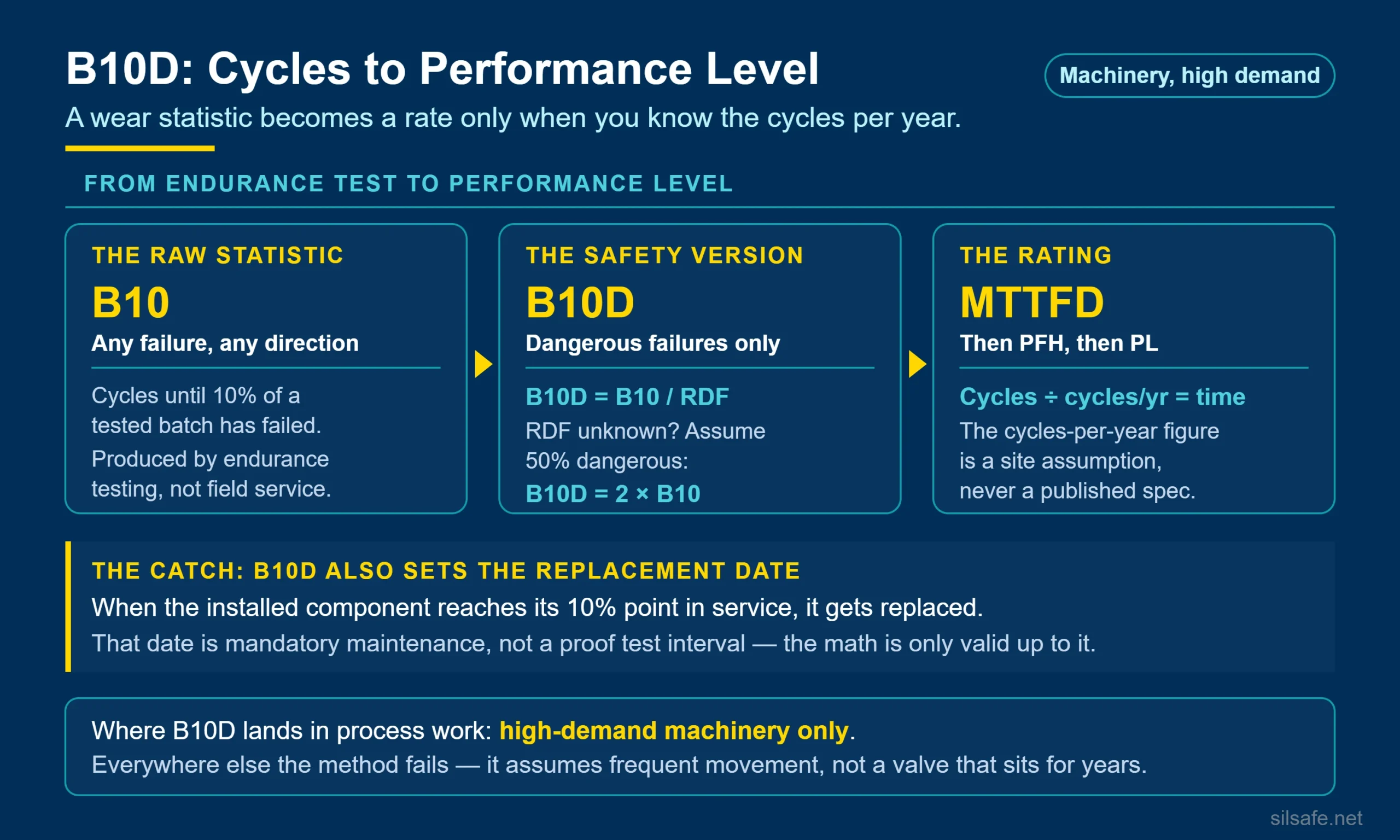
This is a term that pre-dates functional safety. B10D is the functional safety specific term defined in ISO 13849-1
B10 testing is almost always done by or on behalf of the manufacturer of a component. This data can feed into the very central failure rate which then feeds into calculations.
Key Points:
- A single aggregate endurance statistic
- Could help in determining useful life in final elements like valves and actuators.
Example:
A pneumatic valve tested to a B10 life of 1,000,000 cycles means that after 1 million operations, 10% of the tested valves are expected to fail.
See Also: B10D, HFT, SFF, failure rate
Cited Source: