
When engineers perform SIL verification, most of the attention goes toward failure rates, proof test intervals, or diagnostics. But one input that carries enormous influence is beta factor (β) — the number that represents how much of your redundancy can be trusted to behave independently. Misunderstanding it can make even a perfect SIL calculation look better on paper than it really is in the field. This article walks through what β is, how it links to common cause failure (CCF), and how to apply it correctly with practical math and examples.
What Is It? (CCF vs. Beta Factor and Why It Matters)
Common cause failure (CCF) is a concept of multiple things failing for the same core reason. It is a concept in various industries and practices. In a Safety Instrumented System (SIS) it means multiple channels in redundant architectures fail together because of a shared cause. For example:
- Instruments: Two pressure transmitters mounted side‑by‑side exposed to the same vibration or plugged impulse lines.
- Logic solver: Both processor cards affected by the same unknown software bug.
- Final element: Two solenoids sharing the same instrument air header that fail simultaneously.
The beta factor (β) is the fraction of all dangerous failures that occur from a CCF. It is the mathematical representation of the CCF concept. It converts the qualitative idea of “common cause” into a quantifiable term used in equations. Ignoring β will almost always make your average probability of failure on demand (PFDavg) appear lower than it really is — giving a false sense of security.
Where to Get Beta Factor Values
There are two primary sources:
- SIL certificates or FMEDA reports from manufacturers. These often include β values based on test data and modeling assumptions.
- IEC 61508‑6 Annex D – the formal method for determining β using dependent failure analysis. This process is complex and beyond the scope of this article, but it is the standard reference.
Other useful references include ISA TR84.00.02, OREDA, and CCPS reliability publications. Some companies maintain internal databases based on field performance.
A practical approach:
- Start with the β from the SIL certificate.
- Review Annex D factors to see if your installation justifies adjustment.
- Document and justify the final value in your Safety Requirements Specification (SRS).
How Architecture Affects β
The β‑factor is not constant; it changes with architecture. This is a common point of confusion within Functional Safety. Think of redundancy as a team of security guards protecting a building:
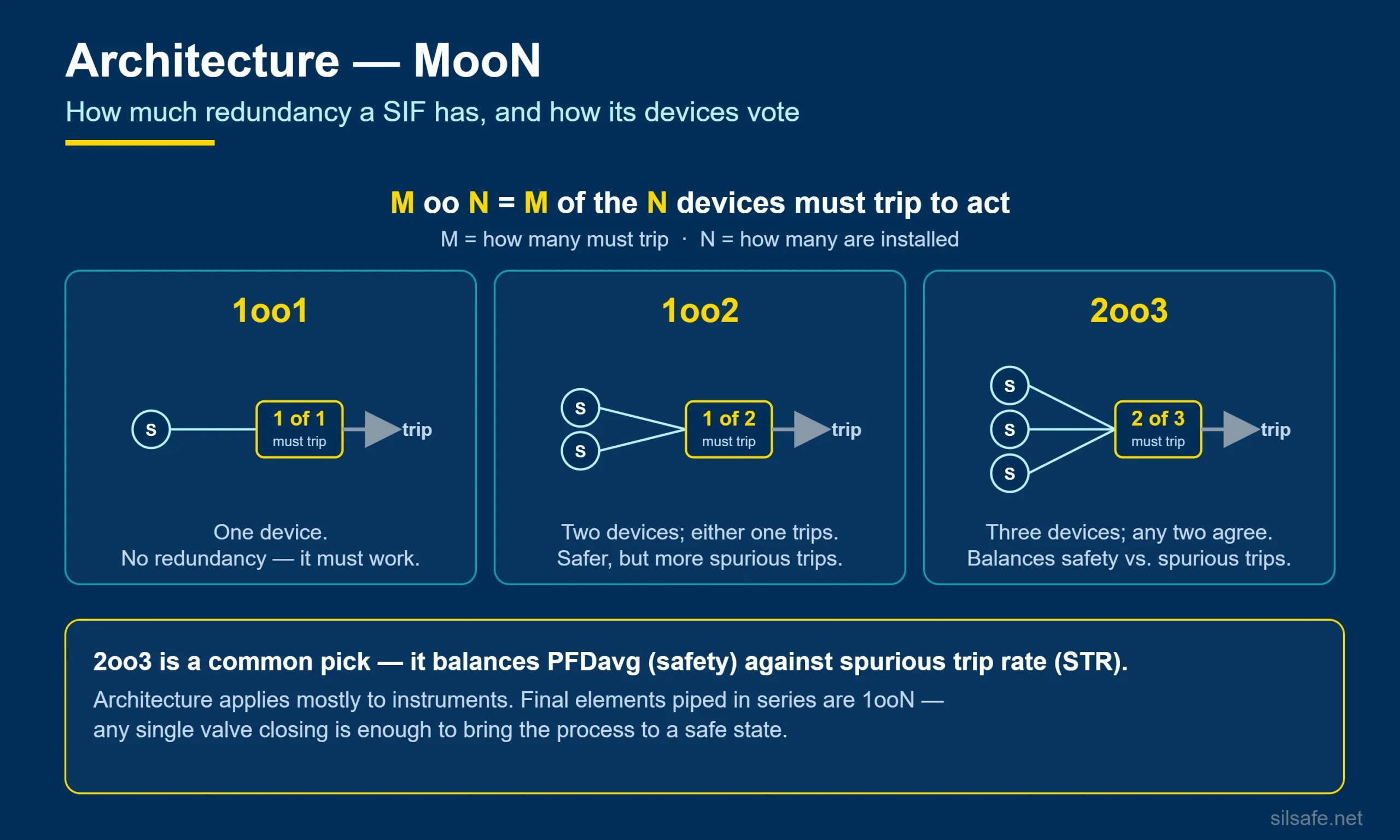
- In a 1oo2 architecture, either guard can respond to stop a robbery. If both guards eat the same lunch and get food poisoning, that’s a CCF — a shared vulnerability.
- In a 1oo4 architecture, four guards must all get sick for the robbery to succeed. The common cause event would have to be much stronger or more universal, or “more common,” to take them all down. Think of a really widespread case of food poisoning. Therefore, the effective β is lower.
This creates a feedback loop: changing architecture alters the PFDavg equation, but it also justifies a new β — which again changes the PFDavg. It is a bit odd, but it is correct. IEC 61508‑6 Annex D Table D.5 gives architectural correction factors (roughly 0.3 – 1.74) that help account for this effect. Most β values published in SIL certificates are assumed for 1oo2 configurations.
NooN Architectures and Why β Is Not Present
For NooN architectures (e.g., 2oo2 or 3oo3), β is normally not present in the mathematics. Any single channel failure will cause the function to fail because all channels must work. The total λDU (dangerous undetected failfailure rate) already includes both independent and common‑cause contributions. Applying a separate β term would double‑count the effect.
Returning to the guard analogy: if three guards must all respond correctly and any one failure causes system failure, it doesn’t matter if their failures were independent or shared — the result is the same. For this reason, modeling tools and standards do not include β for NooN designs.
Note that this can be thought of as “β is set to 0 for NooN,” but that is not how we at SIL Safe think of this. Yes, you can use the MooN PFDavg equations, set β = 0, and get the same results. But as we discussed above, β is accounted for in λDU.
Typical Values and Influencing Factors
| Subsystem | Typical β Range |
|---|---|
| Instruments | 0.02 – 0.10 |
| Logic Solvers | 0.01 – 0.05 |
| Final Elements | 0.05 – 0.15 |
Factors that increase β:
- Common environment (same enclosure, same power, same impulse lines)
- Identical design and firmware
- Shared maintenance procedures or simultaneous testing
Factors that decrease β:
- Physical separation and shielding
- Vendor or technology diversity
- Independent power and utilities
- Separate calibration schedules
- Staggered proof testing
PFDavg Equation Discussion
In a 1oo2 system, the total PFDavg is made up of independent and common‑cause terms. Using a simplified version of the equation:

Where:
- λDU = dangerous undetected failure rate (per hour)
- TI = proof test interval (hours)
- β = fraction of failures due to common causes
The first term (squared) represents two independent latent failures. The second (linear) term represents the probability that both channels fail from a shared cause. Because the independent term is squared, it becomes much smaller — making β a powerful driver in redundant designs.
PFDavg Calculation Examples (1oo2)
Case A – Good β Factor (Target: SIL 2)
Given: β = 0.03, λDU = 2E-6/hr, TI = 8,760 hr (1 year)
- Independent term:
(1/3) × [(1 − 0.03) × 2E-6 × 8,760]² = 9.63E-5 - Common‑cause term:
(1/2) × 0.03 × 2E-6 × 8,760 = 2.63E-4 - Total PFDavg = 3.59E-4
- RRF = 1 / PFDavg = 2,785 → SIL 3
STR (spurious trip rate): assume λSP = 1E-5/hr per channel. For 1oo2 (trip on any channel):
STR ≈ 2 × λSP = 2E-5/hr → 0.175 trips per year ≈ a trip every 5.7 years.
Case B – Poor β Factor (Target: SIL 1)
Given: β = 0.15, λDU = 2E-6/hr, TI = 8,760 hr (same assumptions)
- Independent term:
(1/3) × [(1 − 0.15) × 2E-6 × 8,760]² = 7.4E-5 - Common‑cause term:
(1/2) × 0.15 × 2E-6 × 8,760 = 1.31E-3 - Total PFDavg = 1.38E-3
- RRF = 1 / PFDavg = 725 → SIL 2
STR (same λSP): 2E-5/hr → 0.175 trips/year or one trip every 5.7 years (same as Case A).
Comparison: Raising β from 0.03 to 0.15 increased total PFDavg by ≈ 4×, dropping the SIL from 3 to 2.
PFDavg for 2oo3 (Majority Voting)
A 2oo3 (two-out-of-three) voted group is the architecture engineers ask about most after 1oo2, because it buys spurious-trip immunity without giving up much on the safety side. The simplified PFDavg keeps the same two-term shape — an independent term plus a common-cause term — but the independent coefficient changes from ⅓ to 1:

The common-cause term is identical to the 1oo2 case. The independent term, though, is three times larger — and that is the “summation vs. average” point that trips people up. A 2oo3 group fails dangerously when any two of its three channels fail, and there are three such pairs, so you sum three pairwise coincidences instead of one. Each coincidence time-averages to ⅓[(1 − β) λDU TI]², and 3 × ⅓ = 1, which is why the coefficient lands at 1 rather than the ⅓ you saw for 1oo2.
2oo3 Worked Example (Same Inputs as Case A)
Given: β = 0.03, λDU = 2E-6/hr, TI = 8,760 hr (1 year)
Independent term: [(1 − 0.03) × 2E-6 × 8,760]² = 2.89E-4
Common-cause term: (1/2) × 0.03 × 2E-6 × 8,760 = 2.63E-4
Total PFDavg = 5.52E-4
RRF = 1 / PFDavg = 1,812
Compared with the 1oo2 Case A above (PFDavg 3.59E-4, RRF 2,785), the 2oo3 result is actually slightly worse on paper — its larger independent term dominates. So why pick it? Spurious trips. A 2oo3 group only trips when two of its three channels trip at once, whereas 1oo2 trips on any single channel, so its spurious-trip rate is far lower. In short, 2oo3 trades a small amount of PFD performance for a large gain in availability — which is exactly why it dominates on critical, trip-sensitive services.
Impact of Common Cause Portions of PFDavg for 1oo2
Because the independent term is squared, it diminishes as reliability increases, while the common‑cause term remains linear. The result: CCF often dominates total PFDavg in redundant architectures.
- Case A (β = 0.03): PFDavg_ind = 9.63E-5, PFDavg = 2.63E-4 → CCF ≈ 73% of total.
- Case B (β = 0.15): PFDavg_ind = 7.4E-5, PFDavg = 1.31E-3 → CCF ≈ 95% of total.
Even at modest β values, most of the total unavailability stems from common causes — which is why reducing β through independence and diversity is far more effective than upgrading the architecture. The same pattern holds true for higher architectures like 2oo3.
Common Mistakes
- Applying the same β to every subsystem without justification.
- Assuming diagnostics lower β (they don’t; they reduce λDU).
- Forgetting to justify β selection in the SRS.
- Focusing only on adding redundancy instead of lowering β.
Summary
The β‑factor is what connects real‑world dependencies to your math. A small change in β can shift a design from SIL 3 to SIL 2 — even when every other parameter is identical. Real independence, not just redundancy, drives reliability.
Document your β assumptions, revisit them throughout the SIS life‑cycle, and when in doubt, verify them against IEC 61508‑6 Annex D or manufacturer data.
If you’d like a second set of eyes on your β assumptions or SIL verification model, contact SIL Safe for a practical review or training session.
Frequently Asked Questions
Does beta factor (β) apply only to 1oo2 architectures?
No. The concept applies to any redundant system where channels can fail together, though it’s most visible in 1oo2.
Can β ever be zero?
Not realistically. There’s always some shared factor — environment, maintenance, or design — that introduces correlation. For NooN scenarios, β does not appear in the mathematics, so some say β is zero, but it is still included in the λDU term. This is a point of confusion even with seasoned professionals.
What does β actually represent?
It’s the percentage of dangerous failures that are shared between channels rather than truly independent.
How often should β be revisited?
Any time design, environment, or procedures change — typically during periodic review or FSA Stage 4. It is common for β to change over the safety life-cycle.
Can one simply apply the β in the SIL certificate?
Use it as a starting point. Then compare against Annex D’s checklist and justify any adjustment.
What portion can common cause contribute to total PFDavg?
Often the majority. For 1oo2 with β ≈ 0.1–0.2, common cause failures can make up 70–95 % of total PFDavg — the same trend appears in higher architectures.
I’ve heard that for NooN architectures, β is set to 0, but I thought that is not possible?
β is involved in NooN, but it is already included in the λDU term. Meaning we don’t want to double count. The NooN equations will not have any β terms. Thus, it can be thought of as they were set to zero, but that is not technically correct.
Further Reading
From SIL Safe
External resources