
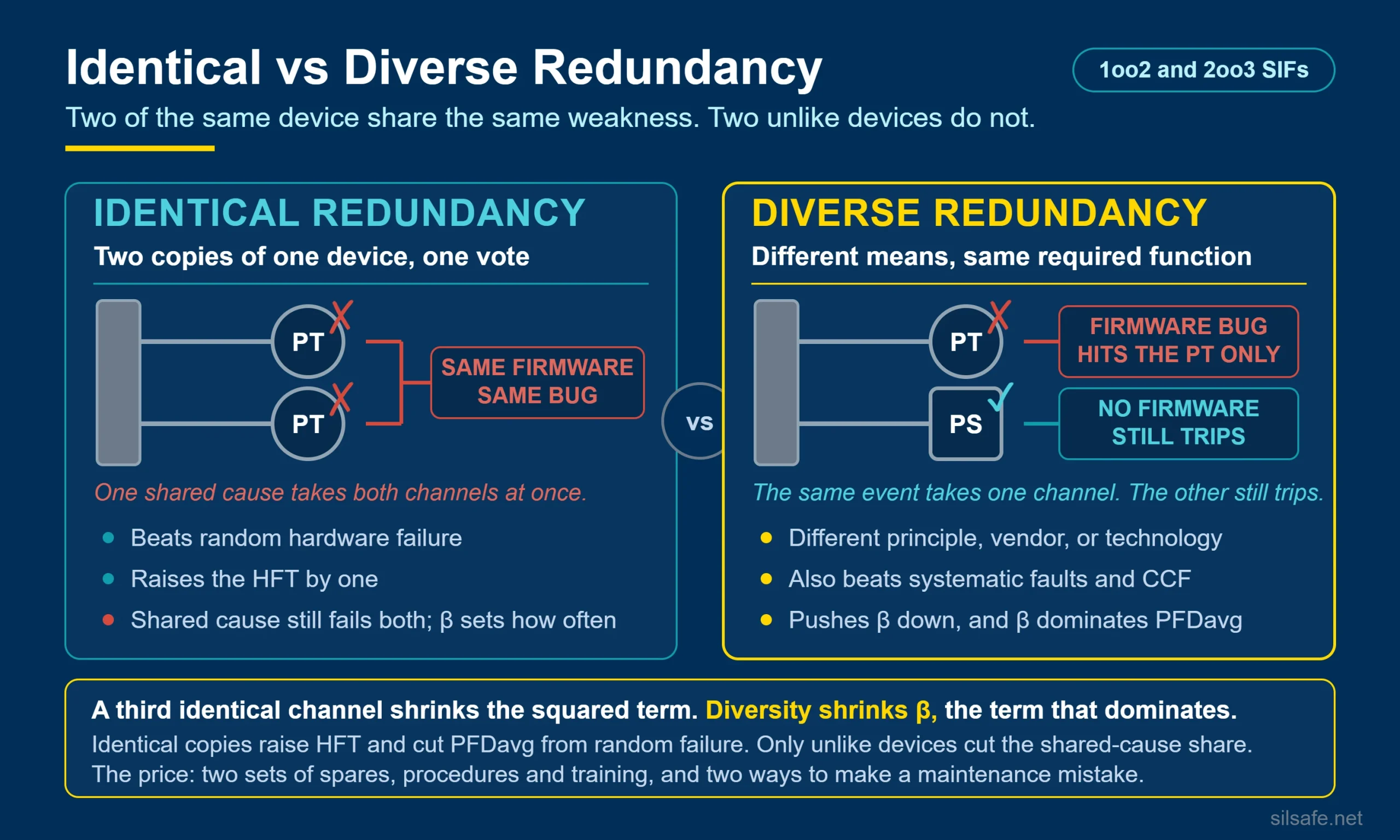
Diversity means using different means to perform the same required function: two transmitters on different measurement principles, valves from different manufacturers, or a relay trip backing up a programmable logic solver. Redundancy on its own gives you two copies of the same weakness. Diversity is the defense against that, because a design flaw, a bad firmware release, or a plugged impulse line rarely takes out two unlike devices at the same time. In β factor terms, diversity is one of the strongest things you can do to push β down, and pushing β down does more for PFDavg than adding another identical channel.
Key Points
- Diversity can be physical (different technology or vendor), in the design approach, or in software, such as different programming techniques.
- It pushes against systematic faults and common cause failure (CCF), the failures that identical redundancy cannot touch.
- It has a price: two unlike devices mean two sets of spares, procedures, and training, and two ways to make a maintenance mistake.
Example
A reactor high-temperature SIF uses one thermocouple and one RTD from different manufacturers instead of two identical thermocouples. A batch defect in one sensing element type cannot fail both, so the β factor applied in the PFDavg calculation comes down.
Go deeper: How to Apply the Beta Factor: A Practical Guide to Common Cause Failures in SIL Verification
See Also: CCF, beta factor, architecture
Cited Sources
- IEC 61511-1:2016, Clause 3.2.16