
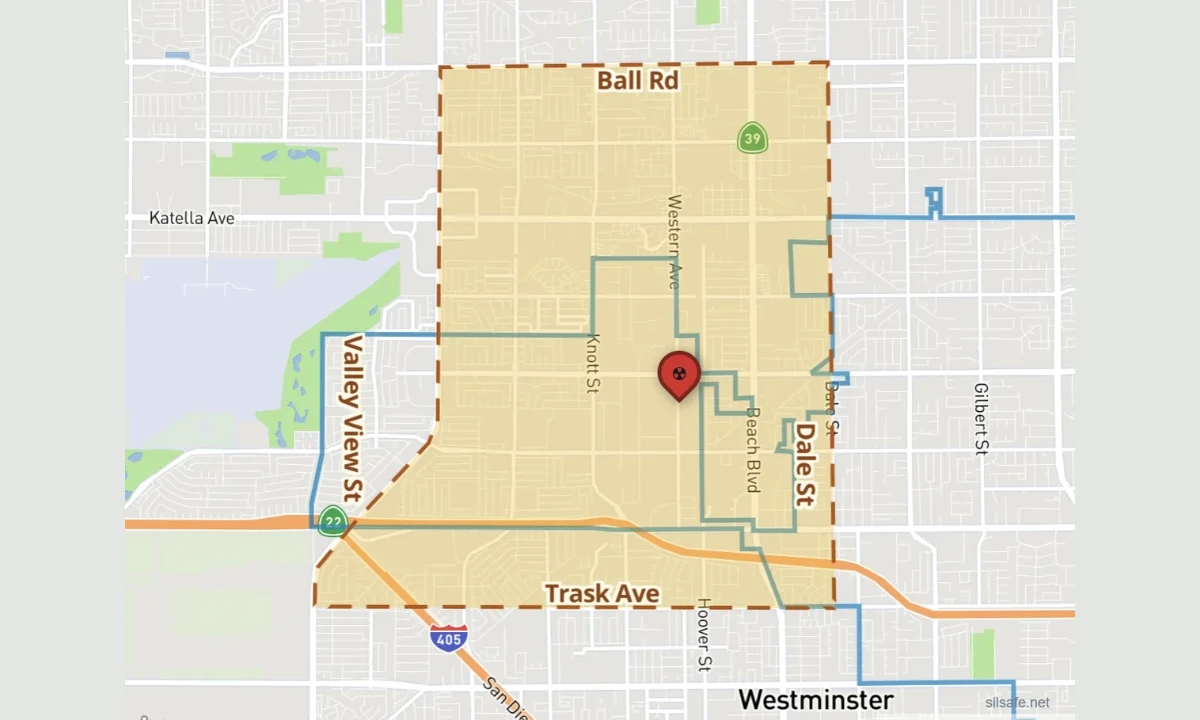
A tank of methyl methacrylate (MMA) at a GKN Aerospace facility in Garden Grove, California has been the center of a multi-day chemical emergency that displaced tens of thousands of residents and put roughly nine square miles of Orange County under evacuation. The situation is active as of writing, and what follows is a US regulatory and functional safety perspective, not a root cause analysis.
What is the GKN Aerospace facility?
The site is operated by GKN Aerospace Transparency Systems Inc., a subsidiary of GKN Aerospace, and sits on roughly 15.5 acres in Garden Grove, California. GKN has been at this location since 2004.
The facility makes the windows and canopies of major aircraft. The Garden Grove site designs and produces cockpit canopies, fighter canopies, and passenger windows, including the F-35 canopy and transparencies for the Boeing 787 and 737, the Airbus A350, HondaJet, and the Bombardier C-Series. Those transparencies are made from polymethyl methacrylate (PMMA, also known as acrylic, Plexiglas, or Lucite), and that is why a substantial inventory of MMA is on site. MMA is the monomer feedstock for making the polymer.
The tank and the chemical
Methyl methacrylate is a colorless flammable liquid monomer with a fruity odor. Its flash point is 36°F (2°C), which puts it in the same general “ignites at room temperature” category as gasoline (flash point roughly -45°F). For context on the other end of the common fuels, diesel sits around 125°F. The boiling point of MMA is 214°F (101°C), so it stays liquid through any realistic ambient condition.
The tank has a capacity of approximately 34,000 gallons; reporting indicates an MMA inventory of 6,000 to 7,000 gallons at the time of the incident. From photos circulating in news coverage, the tank appears to be fully enclosed, fixed-roof construction with external insulation that has since been removed by responders to aid cooling. Enclosure alone does not determine whether the tank is “atmospheric” in the regulatory sense, which has a specific technical meaning that matters for the PSM analysis.
The reason MMA is stored with care is that it is a reactive monomer. If temperature control is lost or if the inhibitor (typically methyl ether of hydroquinone, MEHQ, at low ppm) is depleted, MMA can undergo exothermic polymerization, where the chemical reacts with itself to form the polymer. That reaction releases heat, which accelerates the reaction, which releases more heat. That is the runaway pattern, and once it starts there is no easy way to stop it. It is the central hazard of bulk MMA storage and the reason a tank of this material is taken so seriously.
What occurred in May 2026
The incident began on May 21, 2026, when the storage tank started overheating and venting vapors. Orange County Fire Authority responded that afternoon, and over the next several days the Garden Grove chemical incident escalated. The evacuation zone started as a roughly one-mile radius around the facility, then expanded to cover approximately nine square miles, ultimately displacing somewhere between 44,000 and 50,000 residents. The Governor of California declared a state of emergency.
As of writing, stabilization efforts are ongoing. Reports indicate that a crack in the tank may have vented pressure and reduced the immediate explosion risk, but the data is preliminary. The Orange County District Attorney has opened a tip line for information related to GKN’s operations.
The cause of the temperature excursion has not been publicly established, and we do not speculate.
What regulations apply?
The Garden Grove chemical incident plays out under three US frameworks: OSHA’s Process Safety Management (PSM) standard, EPA’s Risk Management Program (RMP), and California’s CalARP. International readers will be familiar with frameworks like Seveso (EU) and COMAH (UK), which operate on a different basis and are not within scope here.
Does OSHA PSM apply?
PSM (29 CFR 1910.119) has two pathways for coverage. One is the list of specifically named highly hazardous chemicals in Appendix A. MMA is not on that list. The other pathway, in 1910.119(a)(1)(ii), covers any process involving a flammable liquid with a flash point below 100°F in quantities of 10,000 lb or more at one location.
MMA clears both criteria easily:
- Flash point of 36°F is well below the 100°F threshold.
- At a density of 0.94 g/cm³, even the lower-end reported inventory of 6,000 gallons is roughly 47,000 lb.
The MMA storage at GKN satisfies the PSM flammable liquid trigger. The standard has an important exemption.
The atmospheric tank exemption in 1910.119(a)(1)(ii)(B) excludes flammable liquids stored in atmospheric tanks kept below their normal boiling point without chilling or refrigeration. Two things to get right here:
- “Atmospheric tank” is a pressure-rating definition, not a description of the lid. Many atmospheric tanks have fixed roofs, vents, and conservation devices. A tank can be fully enclosed and still be atmospheric.
- The “below normal boiling point without chilling” condition is satisfied by ordinary ambient storage of MMA. MMA boils at 214°F and an unrefrigerated tank at typical ambient temperature is well below that.
On the pressure-rating side, the GKN tank is almost certainly atmospheric. Bulk MMA storage in industry is standard atmospheric tank service. The vapor pressure of MMA at typical storage temperature is low, and there is no operational reason to put MMA in a pressure-rated vessel. The major MMA producers describe atmospheric storage practice on their technical data sheets. So the pressure-rating element of the test is not the issue. The issue, as covered further below, is the chilling and refrigeration clause.
The atmospheric tank exemption is the reason every gas station in the US is not subject to PSM and RMP. OSHA’s view was that ordinary atmospheric storage of flammable liquids is adequately covered by NFPA 30, API 650, OSHA’s own 1910.106 flammable liquids standard, and local fire code.
Interconnection cuts the other direction. If something else on the GKN site triggers PSM (a covered process, a covered chemical inventory elsewhere), and the MMA tank is interconnected to it through piping, the MMA tank gets pulled into scope by virtue of that connection. So even if the MMA tank by itself qualifies for the atmospheric tank exemption, the tank may still be PSM-covered through the rest of the facility. Whether that is the case at GKN depends on facility details that are not public.
Regulatory uncertainty of a chiller
One more wrinkle, and this is where engineering ends and law begins. According to OCFA statements during the response, the MMA tank had an active cooling system designed to keep the contents at around 50°F, and the failure of that cooling system was central to the incident. The atmospheric tank exemption requires storage “kept below their normal boiling point without benefit of chilling or refrigeration.” That clause supports two reads:
- “No chilling of any kind.” Any chilling on the tank disqualifies the exemption.
- “No chilling needed to keep below boiling.” Only chilling that exists to manage boiling point disqualifies the exemption. Chilling for other purposes (polymerization control, viscosity control) does not.
MMA boils at 214°F and would stay well below boiling at any reasonable ambient temperature with no cooling at all. The cooling system at GKN was almost certainly there to suppress the polymerization reaction, not to keep the liquid below boiling. So a refrigerated MMA tank sits squarely in the gap between those two readings. This is the kind of question engineers end up handing to lawyers, because regulatory interpretation isn’t an engineering call.
Does EPA RMP apply?
EPA’s Risk Management Program (RMP, 40 CFR Part 68) works differently from PSM. Rather than a generic flammable-liquid trigger, RMP applies only to a curated list of regulated substances in 40 CFR 68.130. MMA is not on that list.
The reason MMA is not on the list comes down to chemistry. EPA built Table 3 (the flammable substances portion) using the criteria for a flammability rating of 4 on the NFPA 704 fire diamond, which require flash point below 73°F AND boiling point below 100°F. MMA’s flash point of 36°F clears the first hurdle, but its boiling point of 214°F fails the second by a wide margin. The substances that did make Table 3 are predominantly gases or near-gases at ambient: propane, ethylene, butadiene, methane. These are the materials that flash to vapor on release and produce expanding vapor clouds. MMA does not fit that profile.
Therefore, RMP does not apply to MMA storage at GKN.
California regulation: CalARP
California has a state-level analog called CalARP (California Accidental Release Prevention Program, Title 19 CCR §5130.6). MMA is not on any CalARP table, so CalARP does not apply either.
Even if any of these regulations did apply, none of them directly require IEC 61511. They require “recognized and generally accepted good engineering practices” (RAGAGEP) for safety-critical systems, and IEC 61511 is the RAGAGEP for safety instrumented systems in the process industry. The hook into functional safety is by reference, not by name.
Was OSHA PSM actually being applied at GKN?
There is no way to know with certainty from outside the fence line.
OSHA does not maintain a public registry of PSM-covered facilities. Coverage is self-determining; an operator evaluates its own processes against the standard, and verification happens through inspections.
Prior OSHA inspections and worker complaints at the Garden Grove site have been reported in recent coverage, along with a 2018 California Department of Industrial Relations penalty involving machinery and fabrication concerns. None of that confirms whether PSM applied to the MMA storage. Those inspections may have addressed occupational safety topics like machine guarding, lockout-tagout, and fall protection rather than process safety. The two are distinct disciplines, often handled by different teams inside a facility and inspected against different standards.
GKN’s public statement says the company “follows all standard safety protocols and processes and is regularly audited by numerous state and federal agencies.” The statement does not specifically address PSM coverage of the MMA storage.
Is there evidence GKN has a functional safety program?
Not publicly. Functional safety programs (IEC 61511 SIS implementations, SIL verifications, safety requirements specifications) are not typically disclosed publicly by operators. They live in internal documentation and are reviewed by regulators or third-party assessors, not posted on company websites.
The Orange County DA tip line and ongoing investigations suggest authorities are looking at safety system adequacy, but no findings are public.
Has the CSB said anything?
The US Chemical Safety and Hazard Investigation Board (CSB) is an independent federal agency that investigates industrial chemical accidents. As of writing, the CSB has not publicly announced a deployment to the Garden Grove chemical incident.
What we do not know at the time of writing (May 2026)
- The cause of the temperature excursion. Public reporting has not established what initiated the runaway, and we do not speculate.
- What safety systems were in place at GKN, and how they performed.
- Whether GKN’s specific tank configuration qualifies for the atmospheric tank exemption. That requires facility data not in public reporting.
- Long-term health and environmental impact in the affected zone.
- Anything that would require information held by GKN, OSHA, EPA, or the Orange County Fire Authority but not yet released publicly.
Frequently Asked Questions
What is MMA and why is it stored in tanks like this?
MMA is methyl methacrylate, a flammable liquid organic compound. It is a monomer, meaning a small molecule that chemically links with copies of itself to form a long-chain polymer. The polymer in MMA’s case is polymethyl methacrylate (PMMA, also called acrylic or Plexiglas). Bulk MMA storage is common anywhere PMMA is manufactured.
Is methyl methacrylate covered by OSHA PSM?
Possibly. MMA is not on the OSHA PSM Appendix A list of named highly hazardous chemicals, but PSM has a separate pathway for flammable liquids with flash point below 100°F in quantities of 10,000 lb or more. MMA meets both criteria. The complication is the atmospheric tank exemption, which excludes flammable liquids in atmospheric tanks kept below boiling point without chilling or refrigeration. For an unrefrigerated MMA tank at ordinary ambient conditions, the exemption likely applies. For a refrigerated MMA tank like the one at GKN, applicability is genuinely unsettled and depends on how the chilling clause is interpreted.
The tank at GKN has a lid on it. Doesn’t that mean it’s not an atmospheric tank under PSM?
No. “Atmospheric tank” in 1910.119 is a pressure-rating definition, not a description of whether the tank is open to the air. Most atmospheric tanks have fixed roofs, vents, manways, and conservation devices. A tank can be fully enclosed and still be atmospheric. What disqualifies a tank from being atmospheric is being designed and rated for higher internal pressure than atmospheric service. The presence of a lid is not the deciding factor.
Do engineers ever need lawyers to interpret regulatory language?
More often than people outside the field would guess. Regulations like PSM are written in language that looks straightforward but contains clauses with multiple defensible readings. The atmospheric tank exemption is a good example: the phrase “kept below their normal boiling point without benefit of chilling or refrigeration” can mean “no chilling of any kind” or “no chilling needed for boiling-point control,” and a tank that is refrigerated for a non-boiling-point reason sits squarely in the gap between those two readings. Engineers can describe the tank, the chemistry, and how the system operates. Whether those facts add up to the exemption applying or not is a regulatory interpretation question, and that is lawyer territory. On material questions, engineering and legal teams have to work together — the engineer establishes what the system is, and the lawyer establishes what the regulation says about it.
Further Reading
From SIL Safe
- Hazard and Risk Assessment (H&RA): The Foundation of Functional Safety
- Layer of Protection Analysis (LOPA): The Engineer’s Guide to SIL Selection
- The Qatar Gas Plant Explosion: What We Know So Far
- The Longview Chemical Tank Implosion: What We Know So Far
- The Same Explosion, Eleven Years Apart
- The Amur Gas Chemical Complex Fire: What We Know So Far
- The Basra Ammonia Leak: What We Know So Far
External resources
- Garden Grove chemical leak – Wikipedia
- California chemical tank has cracked, causing state of emergency, thousands to evacuate – NPR
- Live updates: Garden Grove chemical tank emergency – NBC Los Angeles
- CalEPA – California Accidental Release Prevention (CalARP) Program
- US Chemical Safety and Hazard Investigation Board
- CDC/NIOSH Pocket Guide – Methyl Methacrylate