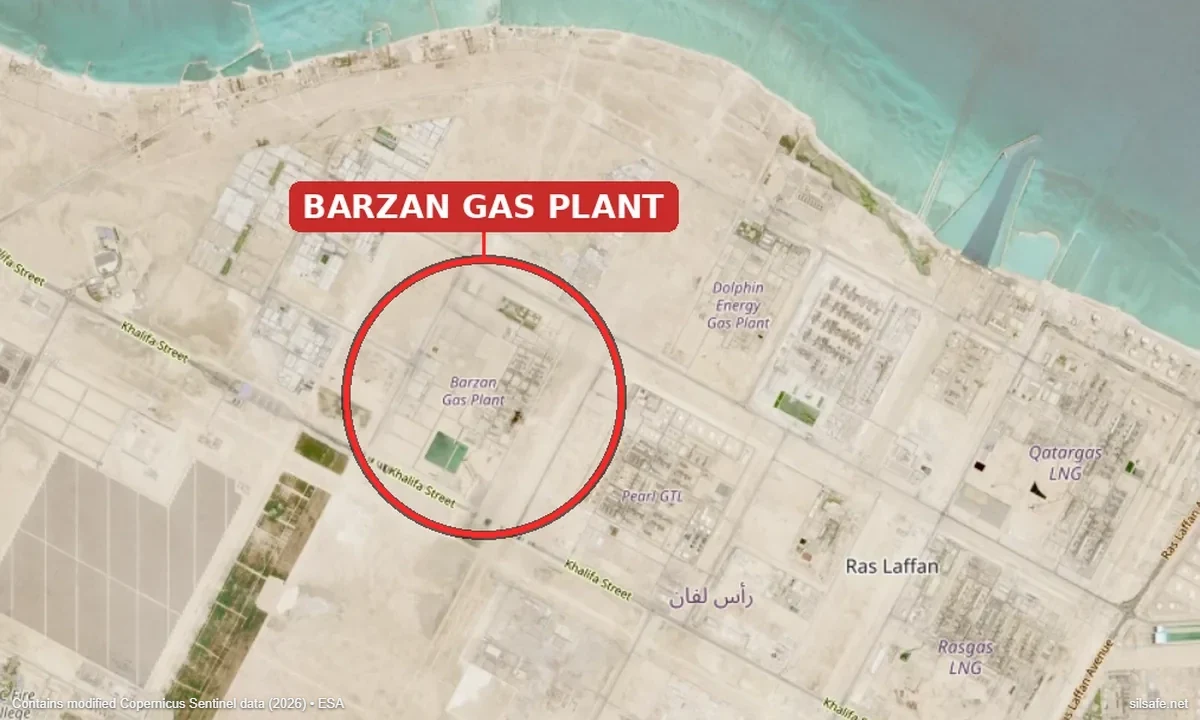
On the evening of June 21, 2026, an explosion and fire tore through the Barzan gas plant inside Qatar’s Ras Laffan Industrial City. Thirteen workers were killed and 66 injured, and the blast was felt across Doha, about 70 km away. It happened during start-up, as crews brought the plant back online after an extended maintenance shutdown.
For anyone who works in process safety, that one detail carries weight. Start-up is the riskiest phase in a plant’s life, and a restart after a long outage is the sharpest test of start-up safety there is. The investigation has only just opened and no cause has been established, so nothing here is a root cause analysis.
What is the Barzan plant, and where does it sit?
Ras Laffan Industrial City, often shortened to Ras Laffan, is a city-sized industrial complex on Qatar’s northeast coast, about 70 km north of Doha, where roughly 115,000 people work. The whole city is owned and managed by QatarEnergy, Qatar’s state-owned national oil company, and the individual plants inside it are run by QatarEnergy-led joint ventures with partners such as ExxonMobil and Shell. The site hosts the LNG (liquefied natural gas) trains that produce Qatar’s LNG for export, gas-to-liquids plants, a refinery, petrochemical units, a port, and the Barzan gas plant.
An LNG train is a single, complete processing line that chills and liquefies natural gas into LNG, and Ras Laffan runs about 14 of them. They are separate facilities from Barzan. They share the same industrial city, and that is the whole of the connection.
Barzan itself is a gas plant that supplies Qatar’s domestic market: roughly 1.4 billion standard cubic feet per day of sales gas (treated, pipeline-ready natural gas) for local power and desalination, plus liquefied petroleum gas (LPG) and condensate, a light hydrocarbon liquid rather than water. It was commissioned in 2022 as a QatarEnergy and ExxonMobil joint venture. It is not an LNG train, and it is not a petrochemical unit.
What does the plant process, and what is the hazard?
Barzan takes raw natural gas from the North Field and turns it into marketable products: sales gas, condensate, LPG, and recovered sulphur. It cleans, separates, and conditions the gas rather than building it into anything new.
The hazard that defines a plant like this is flammable hydrocarbon gas and liquids held under pressure. Lose containment, find an ignition source, and the result is a fire or an explosion. That is what decides where the protection goes.
What occurred on June 21, 2026?
The sequence matters more than any single moment.
- December 2025: Barzan was taken offline for maintenance. Energy Minister and QatarEnergy CEO Saad al-Kaabi has said production was intentionally stopped to meet maintenance requirements.
- March 2026: Iranian missile strikes hit other parts of Ras Laffan, damaging LNG Trains 4 and 6 and Shell’s Pearl gas-to-liquids plant, and cutting roughly 17% of Qatar’s LNG export capacity. Barzan was already down for maintenance and was not the unit struck.
- June 19, 2026: two days before the explosion, crews began restarting Barzan.
- June 21, 2026, about 22:30 local time: an explosion and fire broke out during what QatarEnergy called the start-up of operations. Emergency teams brought the fire under control.
- The toll: 13 killed and 66 injured. The workers who died were foreign nationals, reported as 12 Indian and one Pakistani; the injured spanned several nationalities, with none in life-threatening condition.
- The cause: not established publicly. QatarEnergy ruled out sabotage and hostile action, and a formal investigation is underway. Anything past that is speculation.
Why is start-up the dangerous part?
Start-up is, statistically, the most dangerous mode a plant runs in. A refining or petrochemical facility spends less than 10% of its operating time in transient operations like start-up and shutdown, yet those windows account for more than half of its process safety incidents. The Center for Chemical Process Safety (CCPS) has put the gap more sharply still: incidents are roughly five times more likely during start-up than during normal running. A restart after a months-long outage sits at the worst end of that range.
The reason is not complicated. Protection is thinnest exactly when the plant is least stable. Trips and alarms get bypassed or are not yet reading in their normal ranges, and the process is running outside the steady-state envelope it was designed around.
This is where start-up safety becomes a functional safety problem rather than a general one. Start-up is precisely where IEC 61511 bypass management, management of change (MOC), and the pre-start-up safety review (PSSR) earn their keep.
What regulations apply?
This is a Qatari facility, so the framework is Qatar’s, and it differs structurally from what engineers in the US or Europe are used to, starting with who does the regulating.
Who regulates process safety in Qatar?
In Qatar, the operator is also the regulator. QatarEnergy runs Ras Laffan Industrial City and, at the same time, serves as the petroleum sector’s health, safety and environment (HSE) regulator. A 1977 decree gave Qatar Petroleum, now QatarEnergy, that regulatory mandate, and its HSE Regulations and Enforcement Directorate formalized the role across the sector in 2005.
That arrangement makes more sense once you see the ownership. QatarEnergy is Qatar’s wholly state-owned national oil company, the country’s equivalent of Saudi Aramco. It is a state corporation rather than a government ministry, and it owns and controls essentially all of Qatar’s oil and gas, with international companies such as ExxonMobil, Shell, and TotalEnergies holding minority stakes in joint ventures.
There is no single comprehensive national HSE law. The requirements sit across environmental and labour legislation and are consolidated in QatarEnergy’s own HSE framework, with international good practice filling the gaps. The contrast with the West is clean. In the US, the regulator (OSHA, EPA), and in the UK and EU, the competent authorities under COMAH and Seveso, are independent of the operators they oversee. Qatar’s is not.
Does Qatar have a major-accident regime?
Yes. QatarEnergy’s Major Accident Hazards Management (MAHM) standard requires major hazards to be identified, assessed, and reduced to as low as reasonably practicable (ALARP) across the plant life-cycle, using tools like HAZID, HAZOP, and bow-tie analysis. Tenants in the industrial cities, including Ras Laffan and Mesaieed, have to run formal process safety management (PSM) systems.
Does Qatar require functional safety and IEC 61511?
Yes, but through engineering standards and procurement rather than statute. QatarEnergy mandates compliance with the international standards (IEC, ISA, API, ISO), so a safety instrumented system (SIS) has to be designed and verified to IEC 61508 and IEC 61511 for safety integrity level (SIL), with equipment flowing through approved-vendor lists. The North Field Expansion is driving a wave of new SIS installations on exactly that basis. IEC 61511 therefore plays the same role in Qatar that it plays globally, as the recognized and generally accepted good engineering practice (RAGAGEP) for an SIS. The only difference is how it arrives: through the operator’s standards and contracts rather than a regulation that names it.
Who investigates an incident like this?
The investigation is operator- and state-led. QatarEnergy, whose CEO Saad al-Kaabi confirmed the inquiry, is leading it alongside the Interior Ministry. There is no independent national investigation board the way the US has the Chemical Safety Board (CSB), so the findings will be released at the state’s discretion and on its timeline.
What we do not know at the time of writing (June 2026)
A great deal is still open:
- What actually initiated the explosion during start-up: the specific unit, the operation underway, and the failure that started it.
- Whether any safety instrumented functions (SIFs) or other protection layers were bypassed or overridden for the restart, and how they performed.
- What condition the plant was in after roughly six months down, and whether the restart procedures and MOC accounted for that.
- When the investigation will report, and how much of it will be made public.
- Any longer-term or localized impact.
Frequently Asked Questions
The coverage calls Ras Laffan a petrochemical plant. Is an LNG or gas plant actually petrochemical?
No. The difference is what the plant does to the hydrocarbons. Gas processing and LNG physically clean, separate, and liquefy natural gas; the molecules that go in are the molecules that come out. A petrochemical plant chemically converts those hydrocarbons into new compounds. In industry terms, gas processing and LNG are midstream, petrochemicals are downstream. Ras Laffan does run some petrochemical units, but Barzan is gas processing. It matters because the hazard set, flammable-gas loss of containment and overpressure, is what decides where the SIFs go.
I’m a chemical engineer at a gas plant a lot like this one. What should I take away from this incident?
Not much that is specific to Barzan yet, since the cause has not been released. The durable takeaway is the one that was already true before this explosion: start-up after a long outage is your highest-risk window, so that is where your pre-start-up safety review, your bypass control, and your management of change need to be tightest.
We bypass trips on every start-up just to get the plant running. Is that even allowed?
Yes, within limits. Bypassing a trip to bring a plant up is normal practice, but IEC 61511 expects that bypass to be authorized, time-limited to the window your PFDavg (average probability of failure on demand) calculation assumed, and backed by a compensating measure while it is in place, whether that is an extra watch or a manual safeguard that covers the gap. The problem is never the bypass itself. It is the bypass that becomes routine: open-ended, undocumented, with nobody tracking when it comes back out.
I’m a FuSa engineer in the US, and Qatar’s regulatory setup sounds different from ours. What is their structure?
It is different, in three ways that matter. First, the operator and the regulator are the same body: QatarEnergy runs the plants and regulates the sector. Second, major-hazard control is built on ALARP and a safety-case-style major-hazards report, which is far closer to the UK’s COMAH than to the prescriptive PSM and risk management program (RMP) regime you work under. Third, IEC 61511 is not pulled in by a statute; it is enforced through QatarEnergy’s engineering standards and procurement. The functional safety work itself, the safety requirements specification, the verification, the proof testing, looks the same. What changes is who is checking it and how the requirement reaches you.
I heard the explosion was partly caused by the Iranian missile strikes. Is that true?
No. The March strikes hit the LNG trains and a gas-to-liquids plant, not Barzan. Barzan was down for maintenance at the time, and the explosion happened months later, during its restart. QatarEnergy has ruled out sabotage and any hostile action. The cause has not been established, but there is no established link to the strikes, and that distinction is worth keeping straight while the investigation is open.
Further Reading
From SIL Safe
- Functional Safety for the Process Industry
- The Longview Chemical Tank Implosion: What We Know So Far
- The Garden Grove Chemical Incident: What We Know So Far
- Houston Recycling Fire: When Is a Recycling Center a Process Facility?
- SIL Verification – the Three Gates
- The Amur Gas Chemical Complex Fire: What We Know So Far
External resources
- QatarEnergy: Operational Responsibility
- 2026 Ras Laffan explosion (Wikipedia)
- Al Jazeera: explosion coverage
- CCPS / AIChE: Guidelines for Process Safety During the Transient Operating Mode
- HSE (UK): COMAH
Functional safety is complex, and the stakes are high. If you have questions about your SIS design, SIL verification, or where to start with IEC 61511, the team at SIL Safe is here to help. Reach out to us today.
2 comments
Okere Emmanuel Uwakwe
I want to participate in training in IEC 61511.Let me know how i can get to start
mamerten
Hi Okere. Thanks for engaging. I’ll send an email.