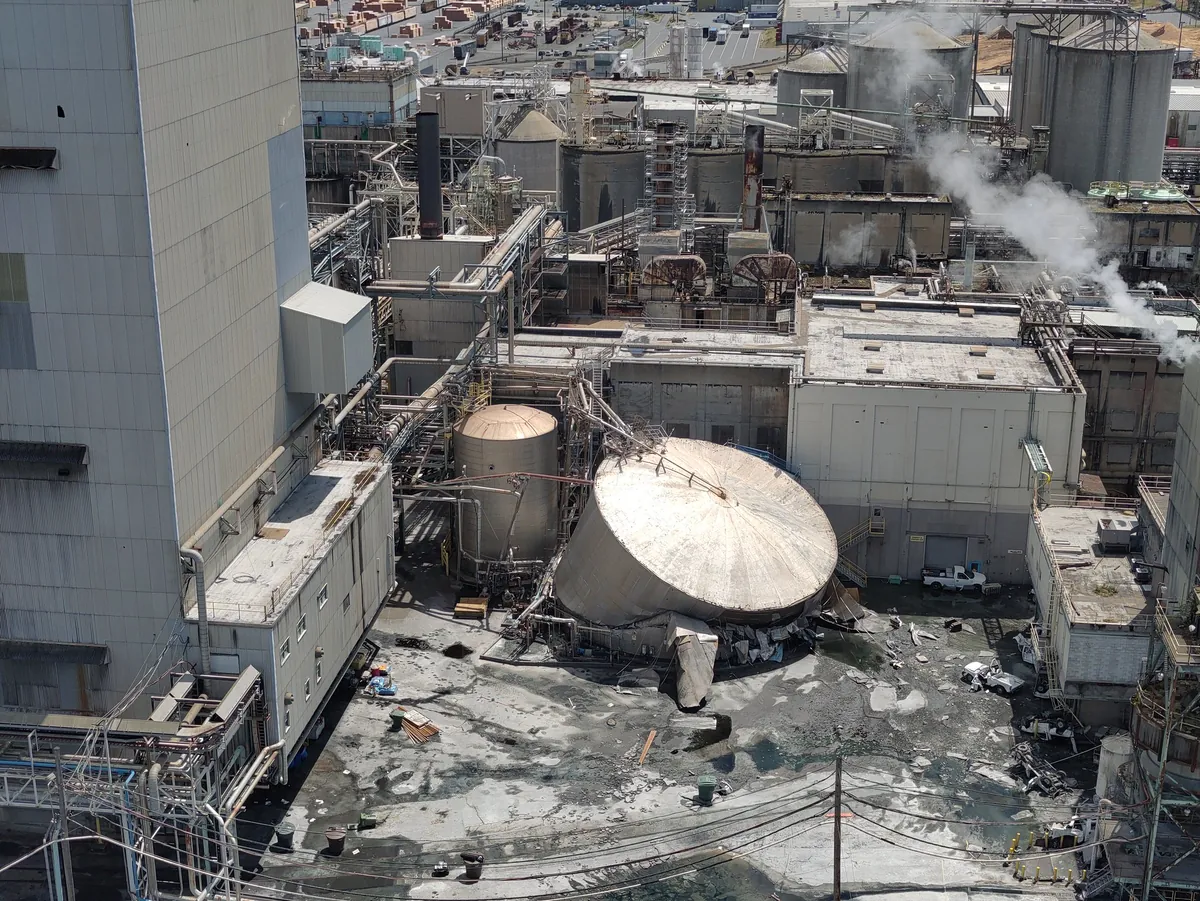
On May 26, 2026, a 1.2-million-gallon tank of white liquor failed at the Nippon Dynawave Packaging mill in Longview, Washington, releasing roughly 900,000 gallons and killing eleven workers. The Longview chemical tank implosion is now under investigation by the US Chemical Safety Board (CSB). It also raises a practical question for anyone running process equipment: how do the major US process safety regulations apply to a tank like this, and what can be said while the investigation is still open? The CSB review is ongoing, its August 2026 update is covered below, and nothing here is a root cause analysis.
What is the Nippon Dynawave facility?
The mill sits in Longview, Washington, in the Columbia River industrial corridor about 50 miles north of Portland, Oregon, sharing that stretch of riverfront with other timber, paper, and chemical operations. This is an industrial area, not a residential one, and no surrounding neighborhood was evacuated after the failure. Longview itself is a city of roughly 38,000.
Nippon Dynawave runs a kraft pulp and paper mill that produces bleached paperboard, the stiff stock used in milk cartons, beverage containers, cups, plates, and food packaging, plus kraft pulp for tissue and printing paper. Around 530 people work at the mill itself. The site is a US subsidiary of Japan-based Nippon Paper, which bought it in 2016.
The Longview site has made pulp since 1931, and this paperboard mill has run since 1953, originally built by Weyerhaeuser. The infrastructure is roughly seven decades old. The tank itself is newer: known on site as “G Tank,” it was built in 1987 to the 1984 edition of API Standard 650, held about 1.2 million gallons, and had no secondary containment.
What is white liquor?
White liquor is the cooking chemical kraft mills pump into their digesters to break wood chips down into pulp. It dissolves lignin, the natural binder that holds wood fibers together, so the cellulose fibers can be freed and turned into paper. The name is standard industry shorthand, one of a set: white liquor is the fresh cooking chemical, black liquor is the spent liquor after cooking, and green liquor is the intermediate in the chemical recovery cycle.
Chemically, it is a water-based solution of sodium hydroxide (NaOH), sodium sulfide (Na2S), and sodium carbonate (Na2CO3). The combination of high temperature and high alkalinity does the cooking work.
White liquor is strongly caustic, meaning basic. It is not a solvent like paint thinner, and it is not flammable: no flash point, no flammable vapor. The danger it carries is corrosivity, severe caustic burns on contact and damage to eyes, skin, and lungs on exposure. At Nippon Dynawave it was also stored at roughly 200°F, hot enough to cause third-degree burns on its own.
What occurred on May 26, 2026?
Around 7:09 AM local time, the tank failed, collapsing in on itself and releasing about 900,000 gallons of white liquor. It did not explode.
That distinction matters, and the early public account struggled with it. In the first day, authorities and reporters reached for three different words: explosion, then implosion, then rupture. It was not an explosion. There was no blast and no overpressure event. Between implosion and rupture, the answer is still open. The CSB opened its investigation in May under the heading “tank implosion,” but by its August 2026 update had shifted to “catastrophic tank failure,” and Nippon Paper described it to investors as a collapse. Which word is right matters, because an implosion points at venting and vacuum while a rupture points at corrosion and loading.
The timing made it worse. A shift was just starting, and crews had gathered for their daily morning meetings, putting seventeen people in the immediate area, across operations, an administrative space, and a break room. It is now the deadliest industrial disaster in Washington state since 1930.
The cause of the failure has not been established publicly, and there is no way to know it with certainty until the investigation runs its course.
Sadly, eleven workers were killed. Three others were seriously injured, and five more employees and a responding firefighter were hurt without needing hospitalization.
Could the tank have imploded?
This was the first explanation offered, and the CSB has not ruled it out. A white liquor storage tank is almost certainly an atmospheric tank. In kraft mills, white liquor is held at close to ambient pressure, in tanks built for the narrow band near atmospheric, not in pressure vessels and not in vacuum vessels. “Atmospheric” is a pressure rating, not a description of the lid. Plenty of atmospheric tanks are fully enclosed, with fixed roofs, vents, and conservation devices. The term describes how much pressure the shell can hold, which is very little.
That last point is the whole story of an implosion. An atmospheric tank is far weaker against vacuum than against pressure. A few inches of water column of underpressure, a trivial amount, can buckle a fixed-roof tank inward. Modest internal pressure it shrugs off; modest vacuum it cannot.
Vacuum builds in a storage tank through ordinary mechanisms: pumping liquid out faster than air can flow back in through the vent, the contents cooling and contracting, condensation after a steam-out, or a vent that is simply blocked or frozen shut.
Tank vacuum protection, the vacuum-relief side of a tank’s venting, is what stands between routine operation and a collapse like this. The consensus standard for sizing it, alongside the pressure side, is API Standard 2000, “Venting Atmospheric and Low-Pressure Storage Tanks.” In practice, the vacuum side tends to get less attention than the overpressure side, both when the venting is first sized and in the maintenance that follows. The standard covers both cases. Field habits often do not.
This is also where process hazard analysis (PHA) could fall short, a gap SIL Safe often sees in hazard study reviews. A hazard and operability study (HAZOP) or a layer of protection analysis (LOPA) could give overpressure scenarios full rigor and treat low pressure as less likely. Vacuum is exactly the low-frequency, high-consequence scenario those studies exist to catch. That all still holds, and it is still worth checking on your own tanks. Whether it is what happened at Longview is now less clear, for reasons the CSB set out in August.
What the CSB found in August 2026
On August 28, the CSB released an investigation update. It points to a second explanation, one that has nothing to do with vacuum.
In July 2025, ten months before the failure, Nippon Dynawave had G Tank inspected by external visual examination and external ultrasonic thickness testing. The results showed significant thinning below the minimum safe thickness across the lower courses of the shell, the rings that carry the head pressure of everything above them. The inspection contractor recommended internal inspection and repair of the bottom three courses, and stated in writing that the tank was “[n]ot fit for continued service” unless repaired, with a “[h]igh likelihood/consequence of failure.”
The tank kept running. The same contractor returned in October 2025 and again in February 2026, both times for external thickness checks, and both times found large portions still under the calculated minimum. Between July 2025 and the failure, the tank was never internally inspected, never repaired, never removed from service, and never derated. API 653 gives a method for cutting the allowable liquid level when a tank falls below minimum thickness, and that option was available the whole time.
The update also described the morning itself. A process upset in the early hours took the digestor out of service, and white liquor flow out of G Tank stopped. The recausticizers kept feeding it at a reduced rate, so the level climbed. By the time the tank failed it was roughly 90 percent full.
So a tank known for ten months to be under its minimum wall thickness was sitting near its maximum liquid head when it let go. That does not settle the failure mode, and the CSB says it is still determining it. It does mean corrosion and loading belong in the explanation alongside venting.
G Tank stood in a courtyard surrounded by buildings holding the maintenance shops, break rooms, and locker rooms, and it had no secondary containment. A former Weyerhaeuser engineer who worked on the original installation told the CSB it went there because “that was the available area.” Facility siting is a protection layer, and it is a large part of why the toll was eleven.
The mill’s radio call for its volunteer medical responders did not say white liquor had been released. One responder waded into a courtyard pool believing it was water and was seriously burned.
Nippon Dynawave has publicly disputed the update, saying the CSB left key facts out. The company has not said which ones.
What regulations apply?
This is a US incident, so the analysis below is US-specific; readers elsewhere operate under their own frameworks. One thread runs through all of it: being regulated and being hazardous are not the same thing.
Does OSHA PSM apply to the white liquor tank?
OSHA’s Process Safety Management (PSM) standard (29 CFR 1910.119) reaches a process through one of two doors: a chemical on its Appendix A list at or above a threshold quantity, or a flammable liquid or gas at or above 10,000 pounds.
White liquor opens neither. Appendix A names 137 highly hazardous chemicals, and white liquor’s constituents, sodium hydroxide, sodium sulfide, and sodium carbonate, are not among them. OSHA has said so directly: its published interpretations confirm that sodium hydroxide is not an Appendix A chemical. The other two are not listed either. And because white liquor is aqueous and non-flammable, the flammable threshold never comes into play.
OSHA PSM does not reach the white liquor tank.
Does EPA RMP apply?
EPA’s Risk Management Program (RMP) rule (40 CFR 68.130) works off its own lists: regulated toxic substances and regulated flammable substances. White liquor’s components appear on neither. The toxic list is built around inhalation hazards, gases and volatile toxics such as chlorine (Cl2), ammonia (NH3), hydrogen sulfide (H2S), and methyl isocyanate. The flammable list covers flammable gases and volatile flammable liquids. A non-volatile, non-flammable aqueous caustic fits none of that.
Do paper mills fall under PSM and RMP?
Often, yes, but not because of white liquor. A kraft mill usually does have PSM-covered and RMP-covered processes, and they sit in the bleach plant and the chlorine dioxide generation area, not on the white liquor side. The chemicals that trigger coverage are chlorine dioxide (ClO2), chlorine, sulfur dioxide (SO2), and methanol. Chlorine dioxide is unstable and is typically generated on-site from sodium chlorate (NaClO3), methanol, and sulfuric acid (H2SO4); methanol is flammable. Those are what put a mill under federal coverage.
The obvious follow-up: if part of the mill is covered, isn’t all of it? Under OSHA’s interpretations, an interconnected process is treated as a single process, and if any part of it holds a listed chemical above the threshold, the whole interconnected process is covered. But in a kraft mill, the white liquor system and the bleach plant are not interconnected in that sense. They are linked by pulp moving from the cook side to the bleach side, not by any PSM-listed chemical flowing between them. So even where the bleach plant is covered, the white liquor tank generally falls outside that covered process. That said, this is an interpretation of federal law, and a lawyer should weigh in on any specific case.
The practical read: it is more likely than not that this part of the plant was not covered by PSM or RMP at all.
Two federal duties still apply regardless. The OSHA General Duty Clause, Section 5(a)(1), requires employers to keep a workplace free of recognized hazards whether or not a chemical is listed. The EPA Clean Air Act General Duty Clause, Section 112(r)(1), requires facilities handling hazardous substances to design and maintain a safe operation, listed or not. Those are the backstop when a tank falls outside both PSM and RMP on a listing technicality. A written inspection report calling a tank unfit for continued service is exactly the kind of record the General Duty Clause turns on.
Any additional requirements in the State of Washington
Washington enforces workplace safety itself, as a state-plan state, through the Department of Labor and Industries (L&I) and its Division of Occupational Safety and Health (DOSH), not federal OSHA. It has its own rule modeled on federal PSM, WAC 296-67, with the same listed-chemical structure and thresholds, but no separate state list of additional regulated chemicals the way California does with CalARP, its accidental-release program. So the state PSM rule pulls the white liquor tank in no further than the federal one does.
Where Washington does reach this facility directly is through WAC 296-79, “Safety standards for pulp, paper, and paperboard mills,” an industry-specific standard that applies regardless of PSM coverage. The Department of Ecology also holds dangerous-waste and spill authority, and is already engaged in the environmental response.
Does this trigger functional safety via IEC 61511?
Likely no, not through regulation. This tank sits outside both PSM and RMP, and its white liquor system most likely isn’t part of any covered process at the mill. Since PSM and RMP are the route by which US regulation pulls in IEC 61511, the recognized and generally accepted good engineering practice (RAGAGEP) for safety instrumented systems (SIS), a tank that neither rule reaches isn’t pulled into IEC 61511 by them either. That is a regulatory point, not an engineering one: if a facility chose to guard a tank like this with a safety instrumented function (SIF) rather than a mechanical relief device, IEC 61511 would still be the standard to design, verify, and proof test it to. It just isn’t compelled here.
What we do not know at the time of writing (September 2026)
Until more comes out, most likely through the CSB investigation, the important questions stay open.
- What actually failed, and how. The CSB is still inspecting the tank to determine the failure mode. Vacuum from a blocked vent, thermal contraction, or condensation after a steam-out remain possible; so does a shell rupture under load.
- Why the tank stayed in service for ten months after an inspection report said it should not, and what the mill’s mechanical integrity and management of change practices looked like.
- Whether the tank vacuum protection was present and working. Whether a pressure and vacuum relief device or vacuum breaker was installed, sized per API 2000, and maintained, and whether the vacuum scenario was ever identified in the facility’s PHA.
- Whether anyone ever revisited the decision to keep a large caustic tank, with no secondary containment, in a courtyard where crews met every morning.
- The longer-term environmental and health impact of the white liquor that escaped into the site’s storm-drain and dike system.
Frequently Asked Questions
I used to work at a paper mill and it definitely had a functional safety program. You’re telling me this tank may not have been covered? Why is that?
Both things can be true. Your mill almost certainly did have a functional safety program, and it was almost certainly built around the bleach plant and chlorine dioxide generation, where the listed chemicals live and where PSM requires it. The white liquor system is a separate process. It is tied to the rest of the mill by pulp, not by any PSM-listed chemical, so it usually sits outside the covered process even at a mill that takes PSM seriously everywhere it applies. The program you remember was real. It just was likely not pointed at this tank, because the rules that drive those programs were not pointed there either.
Why do so many states have extra regulations on top of PSM and RMP? Is that just a US thing?
To a large degree, yes. The US splits authority between federal and state government, and occupational and process safety is one of the areas where states are allowed to run their own show. About half the states operate their own OSHA-approved safety programs instead of deferring to federal OSHA, and they can be stricter than the federal floor, never weaker. On top of that, a few states have built their own chemical-accident programs, California’s CalARP being the best known, that add requirements beyond federal RMP.
Most other countries run process safety through a single national framework, so the patchwork across US states is, in fact, fairly distinctive.
My plant has atmospheric tanks of non-flammable caustic. After reading this, what should I be checking on Monday morning?
Start with the vent path. For each tank, confirm there is a vacuum relief device, that it is sized for your worst-case outflow plus thermal effects per API 2000, and that it is actually maintained, not painted over, corroded shut, or screened off by a bird guard nobody has looked at in years. Then check pump-out rates against that vent capacity, because the fastest way to pull a vacuum is to draw liquid out faster than air can come back in. Last, pull the PHA and see whether vacuum or low pressure shows up as a deviation with a credited safeguard. If the study spent ten pages on overpressure and one line on vacuum, that is your gap. None of this needs the CSB report.
Then pull the inspection file. Find the most recent API 653 thickness data, compare measured wall thickness against the calculated minimum in the bottom courses, and ask what happened after any finding that came up short. A repair, a derate to a reduced fill level, or just another inspection? Repeat inspections are not a corrective action.
I work with safety instrumented systems for a living. Could a SIF have prevented this?
We do not know exactly what triggered the failure. We do know that a significant contributor was a tank shell that had been below its minimum safe thickness for ten months.
A high-level trip that closed the inlet when outflow stopped is a straightforward SIF, and it might have kept the tank off its maximum head that morning. But a SIF is credited as a protection layer on the assumption that the equipment it protects is fit for service. Once three inspections in a row say the shell is under minimum thickness, no instrument on the inlet fixes that, and the risk reduction you calculated no longer means what you thought it meant.
Mechanical integrity is not a layer alongside the SIS. It is the ground the whole stack stands on.
Functional safety is complex, and the stakes are high. If you have questions about your SIS design, SIL verification, or where to start with IEC 61511, the team at SIL Safe is here to help. Reach out to us today.
Further Reading
From SIL Safe
- Hazard and Risk Analysis Methods: How HAZOP, What-If, LOPA, Risk Graph, FTA, ETA, and Bowtie Fit Together
- Layer of Protection Analysis (LOPA): The Engineer’s Guide to SIL Selection
- Hazard and Risk Assessment (H&RA): The Foundation of Functional Safety
- The Qatar Gas Plant Explosion: What We Know So Far
- The Garden Grove Chemical Incident: What We Know So Far
External resources
- US Chemical Safety Board, investigation update, August 28, 2026
- Washington Department of Ecology, Nippon Dynawave Longview incident page
- US Chemical Safety Board, investigation announcement
- Wikipedia, “2026 Longview, Washington paper mill implosion”
- PBS NewsHour (Associated Press), recovery and casualty coverage
- OSHA, OSH Act Section 5 (General Duty Clause)
- Washington L&I, WAC 296-79, “Safety standards for pulp, paper, and paperboard mills”