
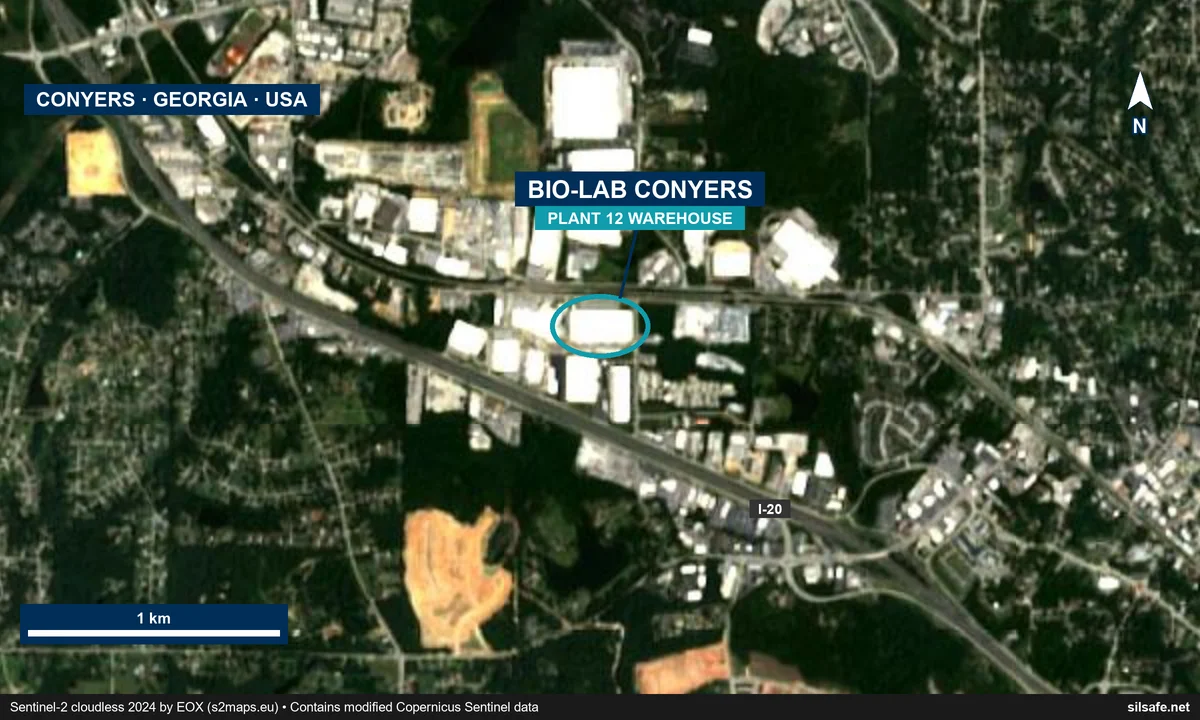
Before dawn one morning in September 2024, water from a corroded sprinkler reached chlorinated pool chemicals in Bio-Lab’s Plant 12 warehouse in Conyers, Georgia. It started a decomposition reaction that spread to fires through the building. The plume of chlorine, hydrogen chloride and bromine compounds forced about 17,000 people to evacuate and put about 90,000 under a county-wide shelter-in-place.
The US Chemical Safety and Hazard Investigation Board (CSB) released its final report in July 2026, and it establishes the cause. The fire protection system started the incident: a protection layer became the initiating event. This article works from the CSB’s findings; the functional safety analysis is SIL Safe’s.
Bio-Lab and the Plant 12 Warehouse
Bio-Lab is the swimming pool and spa water care division of KIK Consumer Products. The CSB’s recommendations address KIK’s Pool Division, which includes Conyers, Lake Charles and a facility in Ontario, California. The Conyers site received bulk pool chemicals, blended them and packaged them into finished pool and spa products.
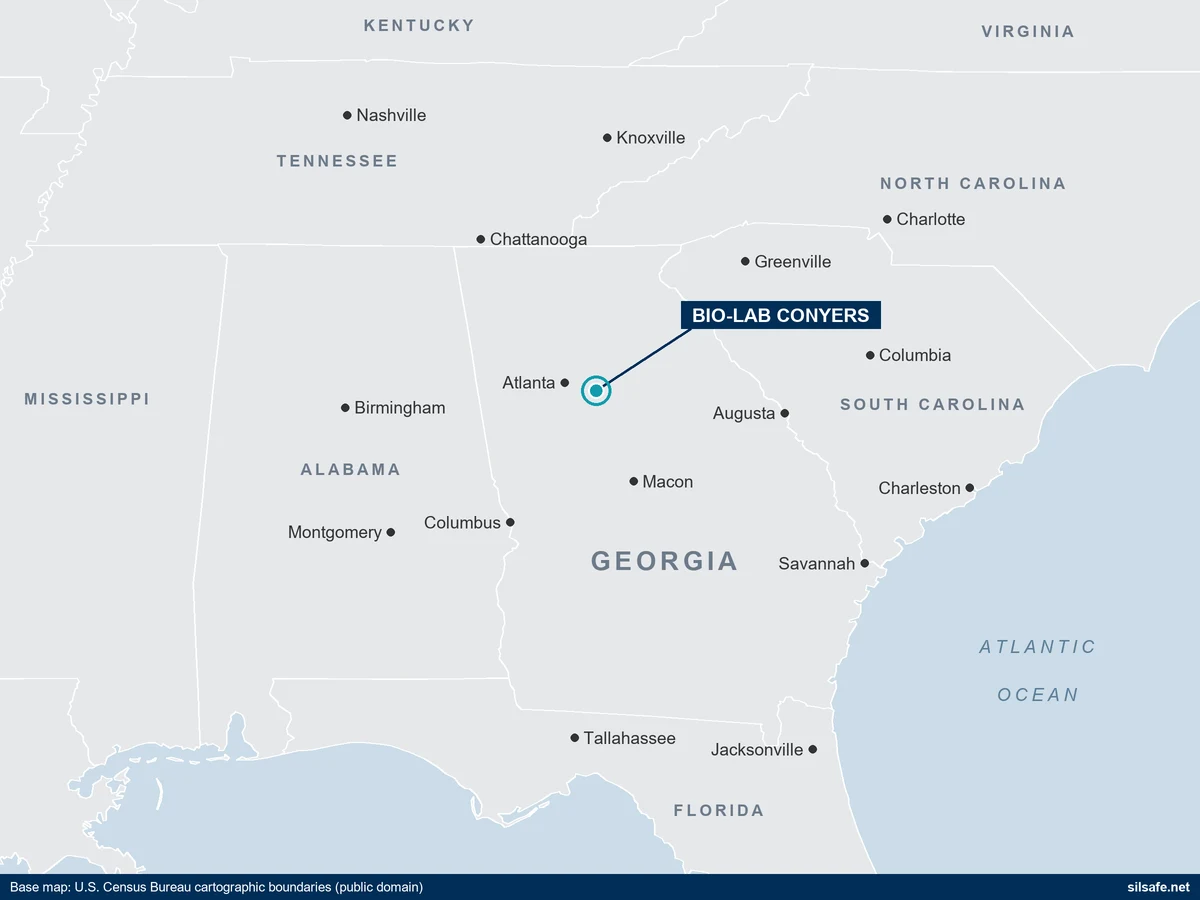
Bio-Lab numbered its buildings as plants, so the name is misleading. Plant 12 was a storage warehouse built in 2019, about 275,000 square feet, with no production in it. In 2019 the company told Rockdale County the warehouse would hold an average of about 6.2 million lb of raw materials. At the time of the incident it held nearly 14 million lb of reactive chemicals, mostly chlorinated isocyanurates.
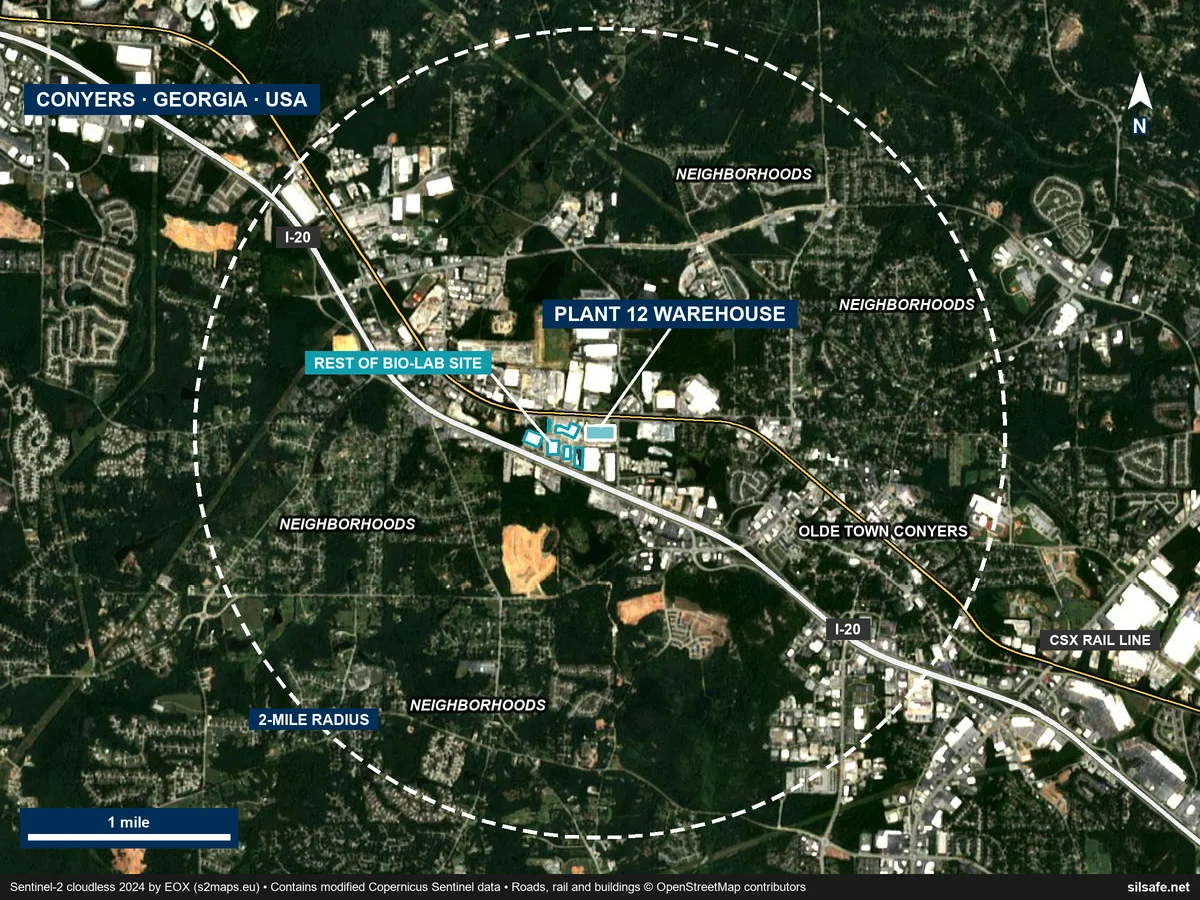
Most of it was in the “bunker,” a section of the warehouse behind a 2-hour fire wall with two 90-minute fire shutters, holding nearly 11 million lb of oxidizers. Neighborhoods adjoin the site, Interstate 20 and a rail line run beside it, and at least five schools are within 2 miles.
The Hazards of Chlorinated Pool Chemicals
The stored chemicals are the active ingredients of household pool products: trichloroisocyanuric acid (TCCA) in chlorine tablets and sticks, sodium dichloroisocyanurate (NaDCC) in granular chlorine, and BCDMH in bromine tablets for spas. At Conyers they were bulk raw material waiting to be blended and packaged.
They carry two separate hazards, and fire codes, including NFPA 400, the Hazardous Materials Code, rate each on its own numbered scale. Both scales call their ratings “Class,” which is a common point of confusion.
| Hazard | What the class rates | Scale | These chemicals |
|---|---|---|---|
| Oxidizer | How much it speeds up the burning of combustibles around it | Class 1 (lowest) to Class 4 | Class 1 oxidizer |
| Water-reactive | How violently it reacts with water | Class 1 (mild) to Class 3 (explosive) | Never classified by Bio-Lab; CSB test results consistent with Class 2 |
Water Reactivity
Water reactivity is a material’s tendency to react with water, releasing heat, toxic gas or both. A Class 2 water-reactive material reacts violently with water or makes it boil.
For TCCA the reaction is a decomposition: the compound breaks down into simpler ones and releases heat, and heat or a small amount of water or moisture can start it. The products are toxic, corrosive gases, chlorine, hydrogen chloride and bromine among them, and can include cyanogen chloride, which the CSB notes is classed as a chemical warfare blood agent. It is nasty stuff.
Counterintuitively, a small amount of water is worse than a flood. Bio-Lab’s own 2021 tests found the strongest reaction at 7.5 to 10% water. The test method NFPA references uses far more water than that, and KIK’s own subject matter expert called it not applicable; the specifics are beyond the scope of this article. CSB testing still found results consistent with Class 2 water-reactive.
Humidity alone releases enough hydrogen chloride to condense as acid on overhead metal, so the same chemistry makes the storage atmosphere corrosive.
Oxidation
An oxidizer feeds a fire with oxygen. TCCA and NaDCC dihydrate are Class 1 oxidizers, the lowest class.
The stored chemicals are not flammable, and neither are the main gases they release. The fires at Conyers came from heat and from the oxidizers driving the burning of pallets, packaging and the building. NFPA 400’s Annex G covers pool oxidizers by name, TCCA, NaDCC and BCDMH included, but not their corrosive or water-reactive behavior.
Classified as an Oxidizer Only
Bio-Lab managed Plant 12 on the Class 1 oxidizer rating alone, represented it that way to the fire code official during construction, and never assigned a water-reactive class.
The site knew water was a hazard. The CSB calls the leaking water a known risk, and NFPA 400’s own guidance notes that TCCA reacts with small amounts of water. The classification never reflected it.
The code made the gap easy to miss. NFPA 400’s water-reactivity criterion sits in an informational annex, and its pool-chemical guidance never calls these materials water-reactive. The consequences were large:
- Class 1 oxidizers carry no building storage limit, so 14 million lb in a moderate-hazard storage building raised no code flag.
- Fire codes treat water-reactive storage differently, with waterproof construction, no water piping other than sprinklers, and limits on pile size. None of it was applied at Plant 12.
How the Sprinkler System Was Supposed to Work
Sprinkler design is a chain of decisions: whether sprinklers are required, what type of system and head, then design density and head count for the commodity and how it is stored. Head selection depends on the environment as well as the commodity. NFPA 13 requires corrosion-resistant heads in corrosive environments and makes the owner responsible for identifying one.
Where Fire Protection Ends and Process Safety Begins
The fire protection engineer designs to code for the commodity class the owner declares, and the code answers the fire scenario. The process safety team owns the hazard and risk assessment (H&RA), which is where the sprinkler gets examined as both a safeguard and a possible initiating event. At Bio-Lab, no hazard analysis of the warehouse was done, so the question was never assigned to either discipline.
2019 to 2024 – Five Years of Warning Signs
2019 – A Warehouse Built for an Oxidizer Fire
Plant 12 opened with an early suppression fast response (ESFR) wet-pipe sprinkler system and an electric fire pump, judged adequate by a consultant for solid-piled Class 1 oxidizers. Most heads were standard brass. The CSB concluded the 2019 design did not comply with NFPA standards, and that a compliant design with mechanical ventilation and smoke detection may have addressed the corrosive vapors and allowed earlier detection.
The warehouse had mechanical ventilation at two air changes an hour but no air conditioning, and the CSB found it inadequate to control humidity or remove the corrosive vapors. Where the air is drawn from may matter as much as how much. Chlorine is heavier than air, Plant 12’s exhaust fans were on the roof, and On-Cal, Bio-Lab’s Ontario, California facility, draws its fumes from floor level.
2020 – Two Sites, Three Decompositions
- Lake Charles, August 2020. After Hurricane Laura, water reached stored TCCA at Bio-Lab’s Lake Charles facility in Westlake, Louisiana, and caused a decomposition, fire and toxic release.
- Conyers Plant 6, September 2020. A leaking water heater line flooded Plant 6, a different building on the Conyers site. The decomposition exposed employees and nine firefighters and closed I-20 for about six hours.
- Conyers Plant 6, four days later. The Plant 6 inventory, moved into trailers where it got wet, decomposed again.
The CSB covered both 2020 sites in one report in April 2023. Rockdale County Fire Rescue answered at least four incidents at the Conyers site before 2024, and the 2020 Plant 6 decompositions shaped how it would fight the next one.
2019 to 2023 – Corrosion and Run to Failure
Sprinkler corrosion began within two months of storage starting in 2019. Bio-Lab repaired or replaced heads only after they leaked, which the CSB calls run to failure.
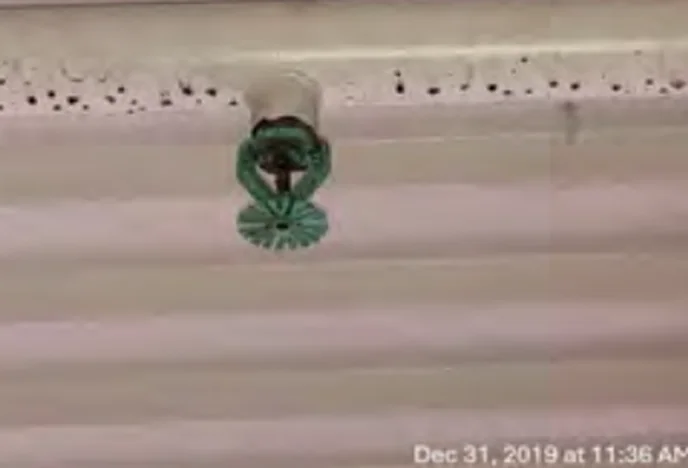
NFPA 25 requires replacing any sprinkler with corrosion severe enough to affect its performance. Three annual inspections in a row flagged corrosion, with 1,124 corroded heads in December 2023, and inspection frequency never increased.
The 2021 and 2022 inspections flagged 560 corroded heads in the bunker. Replacing the bunker’s brass heads with wax-coated, corrosion-resistant heads in November 2022 was the right kind of fix, though the new heads did not meet NFPA 400’s high-temperature rating. The fix stopped at the bunker. Oxidizers moved to other parts of the warehouse, failed heads there were replaced with the same brass type, and the corrosion followed the chemicals.
Conyers also had at least three smaller off-gassing events, two of them in November 2023.
2023 to 2024 – Bypassed and Impaired Protection
The fire protection system registered an abnormal status on about 10% of days between January 2023 and the incident. The panel could not detect corrosion; it logged the results:
- Test status during repairs on 27 days
- Deliberate shutdowns on 17 days
- Flow alarms from a failed pipe and a blown coupling
The 17 shutdowns, including the day of the incident, were employees closing riser valves or cutting fire pump power to stop leaks, and management knew and approved. KIK’s Fire Impairment Procedure took effect in March 2024 and required insurer notice for impairments over 4 hours. Conyers had 13 of them before the incident, with no notification records for any, and the longest ran 44 hours.
Closing a riser to stop a leak is a bypass without bypass management: no time limit, no compensating measure and no one outside the site told.
Mid-2024 – A Fire Watch With No Automatic Detection
After strong oxidizer odors, Bio-Lab made a two-person fire watch permanent, walking the warehouse on rotating 12-hour shifts. A dedicated fire watch is unusual for a warehouse and shows the site knew it had a problem. Thermal cameras for Plant 12 were bought in July 2024 and were still on backorder when the incident happened. The report describes no smoke or gas detection in the warehouse.
The CSB concluded that materials that can decompose need continuous automated detection, such as thermal cameras, in addition to manual monitoring. A fire watch is an administrative measure, so it would not qualify for credit as an independent protection layer in a LOPA.
What Happened on September 29, 2024
- About 5:00 a.m. A fire watch employee starting rounds heard popping, concluded product was wet, called the second fire watch and notified offsite management.
- 5:04 a.m. The second employee arrived and shut off the fire pump. The emergency response team tried to close the riser valve to isolate the leaking zone but could not reach it, and the report does not say why. The system was never drained.
- 5:10 a.m. The first employee called 9-1-1 and reported a burst sprinkler head and chemical smoke everywhere. Neither employee saw fire.
- The next half hour. Heat from the reaction opened more sprinkler heads and wet more chemicals, and water was flowing out of the dock doors before firefighters applied any.
- 5:37 a.m. Heat had shorted the fire alarm wiring, and the alarm system failed completely.
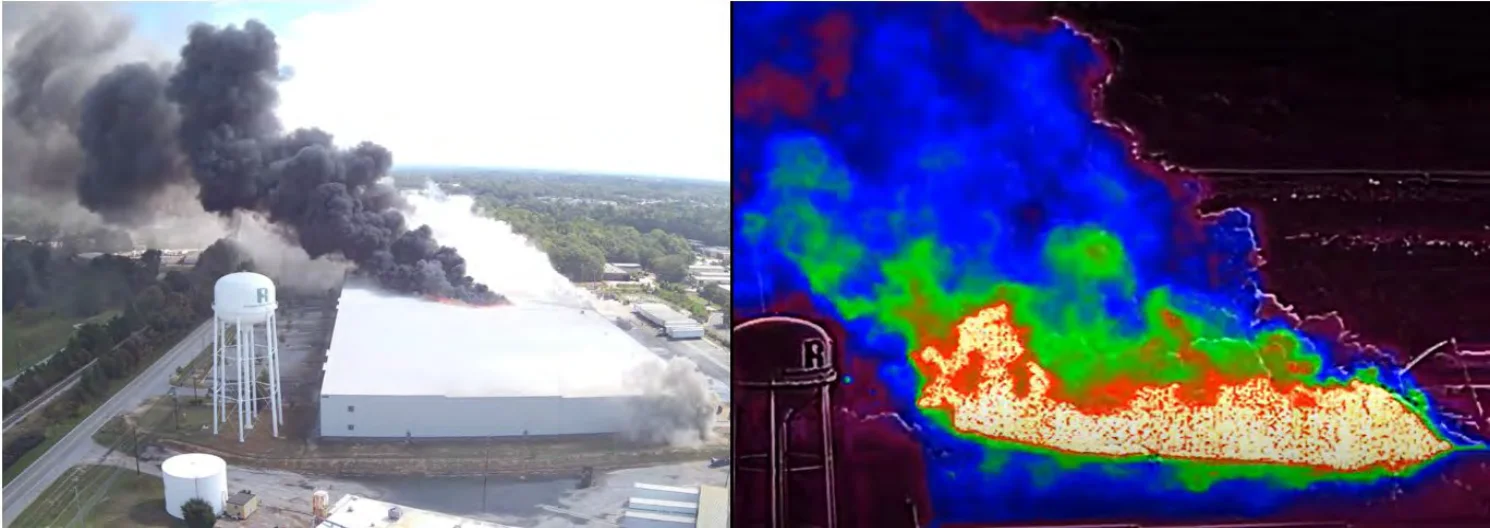
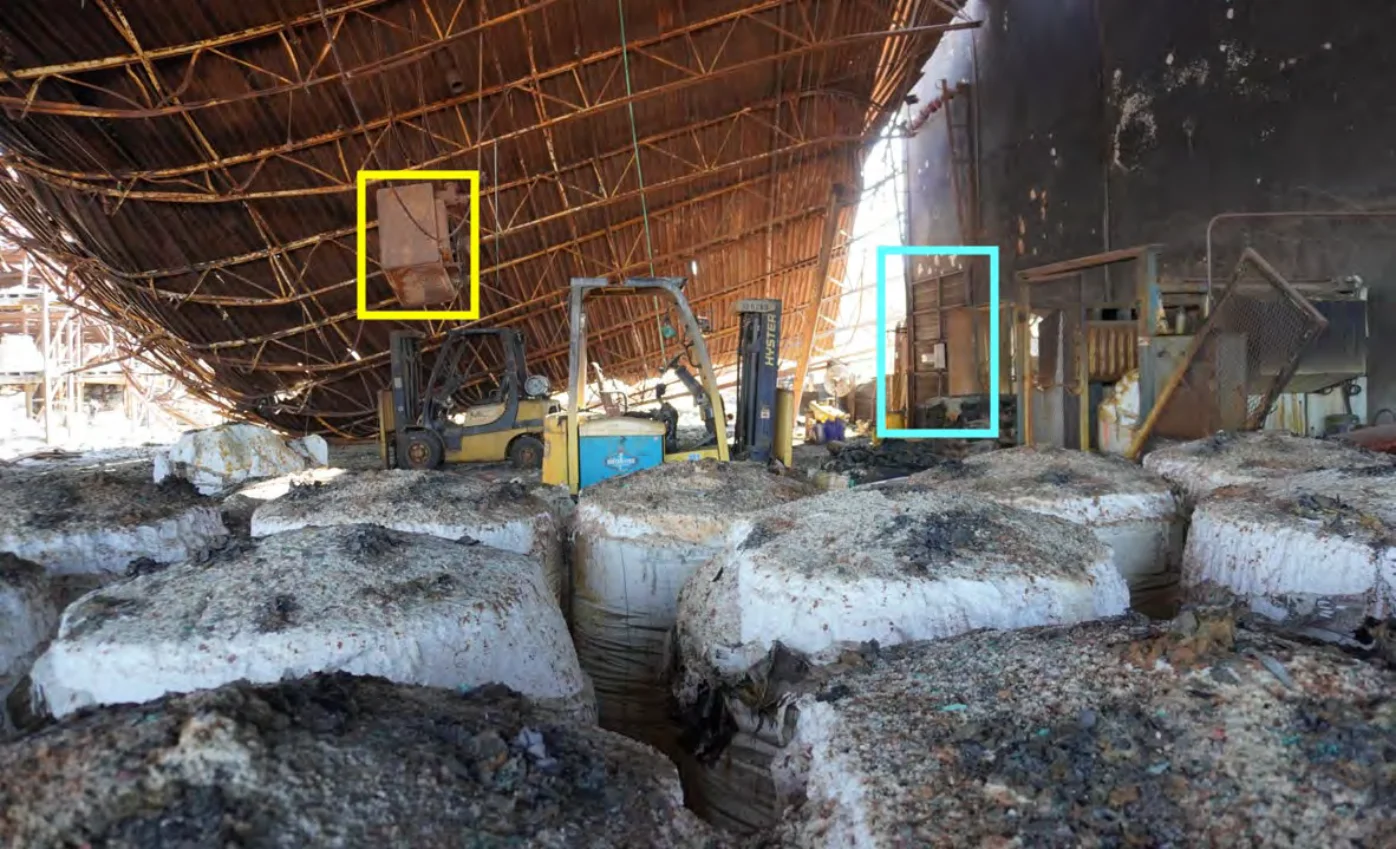
Employees removed 59 of about 4,000 super sacks from the bunker before conditions forced them out. The warehouse was destroyed, I-20 closed for about 18 hours, and KIK ceased operations at Bio-Lab Conyers in May 2025.
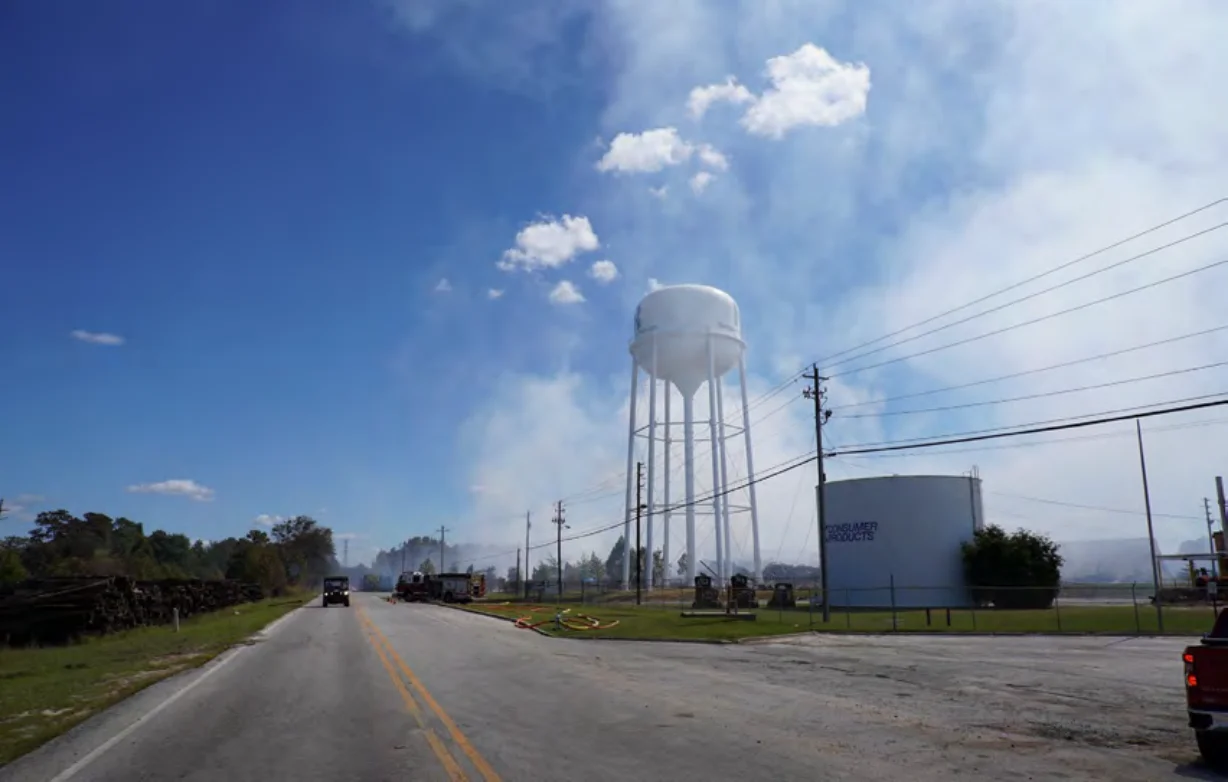
Fighting a Fire When Water Is the Hazard
Water is the firefighter’s main tool, and here it feeds the reaction in small amounts and controls it in large ones. NFPA 400 still calls large quantities of water the best control for an oxidizer fire. Drawing on the 2020 Plant 6 decompositions, Rockdale County Fire Rescue used only a couple of gallons on the first roof fire.
Bio-Lab had an emergency response plan, but the CSB report describes no pre-incident plan with the fire department for this storage. That plan is the owner’s job, worked out with the fire department before an incident: how much water, where to apply it and what happens to the runoff.
Regulations and Functional Safety at Bio-Lab Conyers
PSM and RMP Were Not Triggered
Chlorinated isocyanurates and BCDMH are not on the OSHA Process Safety Management (PSM) or EPA Risk Management Program (RMP) lists, so neither rule required a program at the warehouse. The materials are not flammable, so PSM’s 10,000 lb flammable route did not apply either.
KIK had a voluntary “PSM Lite” procedure requiring a hazard analysis, and a Conyers manager told the CSB the site was “not ready for PSM LITE yet.” The CSB has asked OSHA and EPA to cover reactive hazards since 2002 and reiterated both recommendations in this report. After the incident, OSHA cited Bio-Lab for a total of $61,473 under the General Duty Clause, which OSHA uses for recognized hazards that no specific standard covers.
The Sprinkler System in a LOPA
In a layer of protection analysis (LOPA), a sprinkler system is normally a mitigation layer. Over chlorinated isocyanurates, a sprinkler leak is also a credible initiating event, so the same system appears on both sides of the scenario. A hazard analysis that lists the sprinkler only as a safeguard misses the scenario that actually happened.
The protection layer and the initiating event shared one cause, the corrosive atmosphere. The layer was never independent of the hazard it was there to control.
IEC 61511 Was Almost Certainly Not Applied
The report describes no safety instrumented system (SIS), interlock or automatic shutdown at Plant 12, and a storage warehouse has no process to shut down. No H&RA of the warehouse was done, and without one there is no SIF to identify and no SIL to assign. If the facility believed IEC 61511 was applied, it was applied very poorly: the life-cycle starts with an H&RA, and none was done.
Lessons Learned
On-Cal stores similar chemicals and has never had an off-gassing incident in 13 years, so the hazard can be managed.
- No H&RA was done. KIK’s own PSM Lite procedure required one. Without it, the corrosive hazard was never assessed and the sprinkler was never examined as an initiating event.
- There was a disconnect between operations and the design basis. The operators understood that water was a hazard and treated leaks as one. The engineers who set the design basis for Plant 12 classified the chemicals as Class 1 oxidizers only, and that is how the warehouse was designed, permitted and represented to the fire code official. What the operators knew never made it into the design basis, even after the 2020 decompositions, so every code requirement for water-reactive storage was missed.
- Ventilation did not address the corrosive vapors. Roof exhaust and no air conditioning likely left heavy acid vapor at the level of the product and the sprinklers. On-Cal draws its fumes from floor level, with generator backup.
- Sprinkler leaks were accepted as normal. Five years of buckets and closed risers treated a failing protection system as a maintenance chore. On-Cal epoxy-coats its sprinkler piping every year and wax-coats and bags its heads.
- Fire protection impairments were not reported or escalated. The impairment procedure that would have shown the pattern was not enforced.
- Inventory more than doubled without a design review. Humidity control, ventilation and the sprinkler design stayed as built while the warehouse filled well past what it was permitted for.
- Lessons from earlier incidents did not carry over. The same chemicals had decomposed three times in 2020, each time started by water, and off-gassing records were still open at the time of the incident.
- Process safety and fire protection did not appear to work together. A fire protection engineer designs for the hazard class declared and may not know the chemistry the way a process safety professional does. Carrying it across takes intrusive leadership: walk the warehouse, ask why the riser is closed, and check “it meets code” against the chemistry.
Final Thoughts From SIL Safe
Bio-Lab did several things right:
- A permanent fire watch that caught the event within minutes and called it in
- Corrosion-resistant heads in the bunker
- Annual third-party sprinkler inspections
- Thermal cameras already purchased
- An emergency response plan and team
No injuries were reported at the site, during the incident or in the extended response that followed. For an incident that destroyed the warehouse and moved about 17,000 people out of their homes, that is a significant accomplishment in its own right.
Several of those measures were responses to problems the site already knew about. The fire watch went permanent after strong oxidizer odors, so the site saw the warning signs and treated each one as it came. Few of the individual decisions look unreasonable on the day they were made. The risk built across five years of them, and an H&RA is the tool that looks at all of them together.
Frequently Asked Questions
Are most sprinkler heads corrosion resistant, and if not, when are corrosion-resistant heads required?
No, most are standard brass. NFPA 13 requires corrosion-resistant heads in corrosive environments, and it’s on the owner to recognize one. Bio-Lab said the corrosion-resistant heads available wouldn’t adequately protect its rack storage, so outside the bunker it kept installing brass in an atmosphere that was eating brass.
It looks like they just bypassed their sprinklers. Is that actually a thing that happens? How can they do that if the code requires sprinklers?
Yes, it happens all the time, for maintenance or because something broke, and the code allows it. NFPA 25 Chapter 15 governs it. The owner assigns an impairment coordinator who:
- Authorizes planned impairments
- Determines the extent and expected duration of each one
- Tags the system at the control valves and the fire department connection
- Notifies the fire department, the insurer and the alarm company
- Sets up a fire watch or other mitigation
The system stays code-required the whole time. The program is what keeps an impairment visible, so it doesn’t quietly become the normal state.
What’s a super sack?
It’s a loose industrial term for any large flexible bulk bag of product. The formal name is flexible intermediate bulk container (FIBC), usually woven polypropylene holding 1,000 to 4,000 lb. Bio-Lab’s held about 2,200 to 2,800 lb each and were stacked two high on wood pallets. The outer bag was not waterproof, so moisture protection depended on the liner.
Wait, you’re saying water actually causes the problem? What else does that?
Plenty of materials. Water-reactive materials get their own classes, Class 1 to Class 3, from mild to explosive. Sodium and potassium metal, calcium carbide and metal hydrides are classic examples. On a process site, water doesn’t only come from a fire hose; it arrives from deluge systems, washdown, rain and leaking utilities.
Our warehouse isn’t covered by PSM. Do I really need a HAZOP for storage?
A full HAZOP is usually overkill for storage. A what-if or checklist review that covers every hazard class, the storage environment and the fire protection systems would have caught both hazards Bio-Lab missed. Whatever you call it, a process hazard analysis scaled to the site is the point.
KIK had something called “PSM Lite.” What is that, and should we have one?
It’s a company’s own scaled-down version of OSHA PSM for sites or processes the regulation doesn’t cover. No standard defines it, so it means whatever the company writes into the procedure. KIK’s version required a hazard analysis, which is the piece that would have mattered at Conyers, and a site manager told the CSB the plant was “not ready for PSM LITE yet.” If your site handles hazardous chemicals outside PSM, a program like this is a good idea, as long as the hazard analysis is the part that actually gets done.
Can I take credit for the sprinkler system as an IPL in my LOPA?
Yes, as a mitigation layer, if it’s designed, maintained and tested for the scenario. Bio-Lab shows the catch. First check that the sprinkler can’t also be the initiating event, and that it doesn’t share a cause with the hazard it’s protecting against.
Further Reading
From SIL Safe
- Hazard and Risk Assessment (H&RA): The Foundation of Functional Safety
- Process Hazard Analysis (PHA): One Term, Many Meanings
- Layer of Protection Analysis (LOPA): The Engineer’s Guide to SIL Selection
- Proof Testing of SIFs: Understanding Its 3 Purposes and Its Importance
- The Qatar Gas Plant Explosion: What We Know So Far
External resources
- CSB Final Report Cites Safety Failures in 2024 Bio-Lab Fire
- BioLab fire caused by sprinkler leak was likely avoidable, says final report
- New CSB Report Highlights Reactive Hazards of Pool-Treatment Chemicals
- CSB Releases Bio-Lab Conyers Final Investigation Report
- Bio-Lab Conyers Final Investigation Report (PDF)