
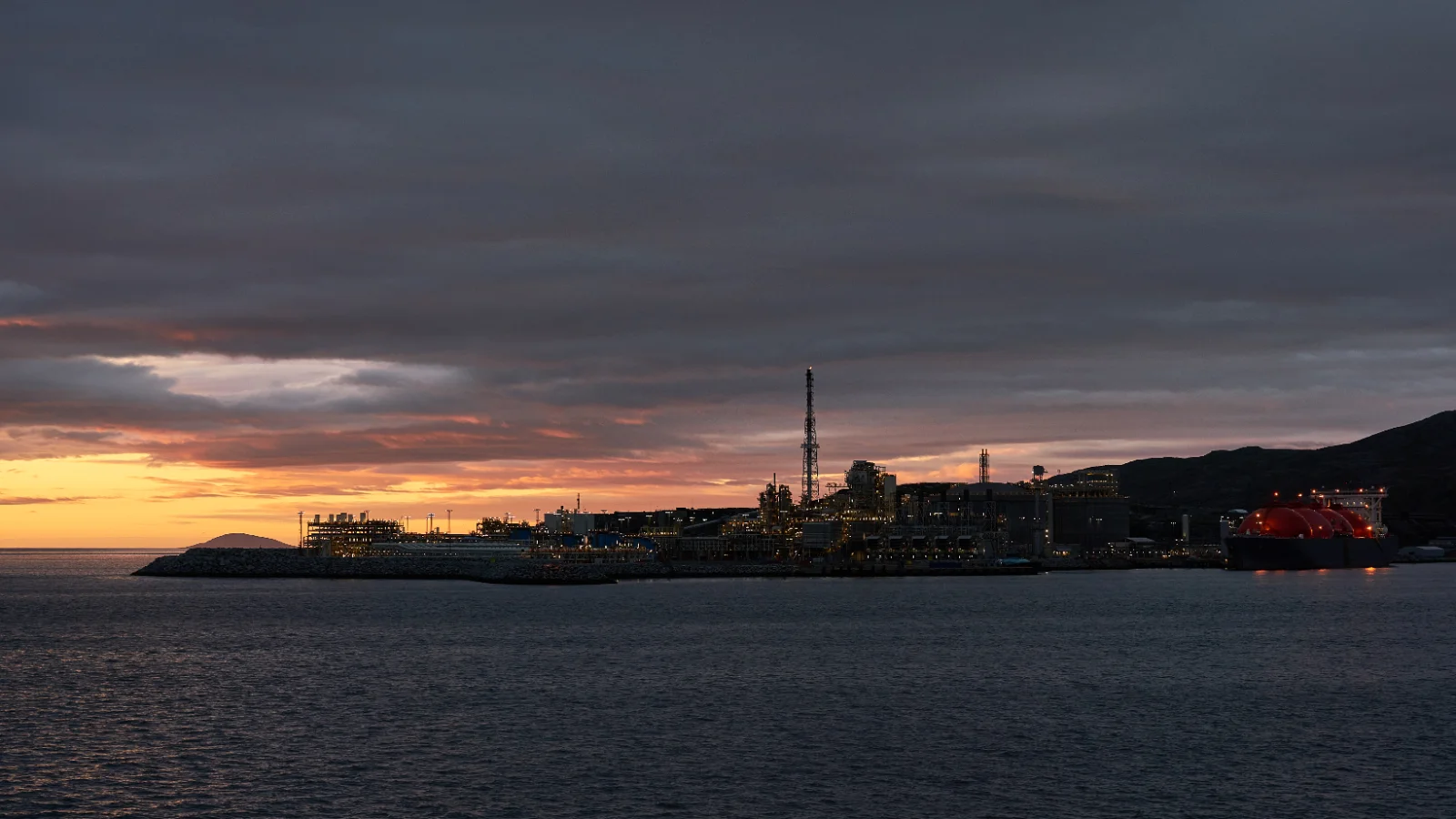
An onshore LNG liquefaction terminal is an export plant. It takes pipeline gas, treats it to remove anything that would freeze, chills it to roughly -162 °C, stores the LNG in large tanks, and loads it onto carriers at a jetty. It is the fixed-ground counterpart to an FLNG, and building on land removes the constraints that make an FLNG hard, so the trains get much bigger. The hazards are cryogenic and dispersion driven rather than pressure driven. A spill of LNG will not burn until it has vaporized and mixed with air, so the plant is laid out around containment, vapour dispersion, and exclusion distances. The instrumented protection leans on low-temperature detection, flammable gas detection, and rapid isolation of transfer lines rather than on relief.
Functional safety relevance: Yes. Cryogenic trains, very large flammable inventories, and jetty transfer all carry instrumented protection, and the fire and gas system is normally assessed alongside them.
Key Points
- Treats, liquefies, stores, and loads LNG for export, in trains far larger than any floating facility can carry.
- Pretreatment has to remove water, carbon dioxide, and heavy hydrocarbons that would freeze and plug the cold box, so those units carry their own protective functions.
- Containment, vapour dispersion, and exclusion distances drive the layout, and the fire and gas design follows from that rather than the other way around.
Example
A two-train export terminal on the US Gulf Coast loads carriers at a jetty. During loading, a linked shutdown between the ship and the shore can stop transfer and close the loading arms in seconds, because the transfer line holds the largest moving inventory of LNG anywhere outside the storage tanks.
See Also: FLNG, onshore LNG regasification terminal, BLEVE
Cited Sources
- NFPA 59A, Standard for the Production, Storage, and Handling of Liquefied Natural Gas
- EN 1473, Installation and equipment for liquefied natural gas — Design of onshore installations