
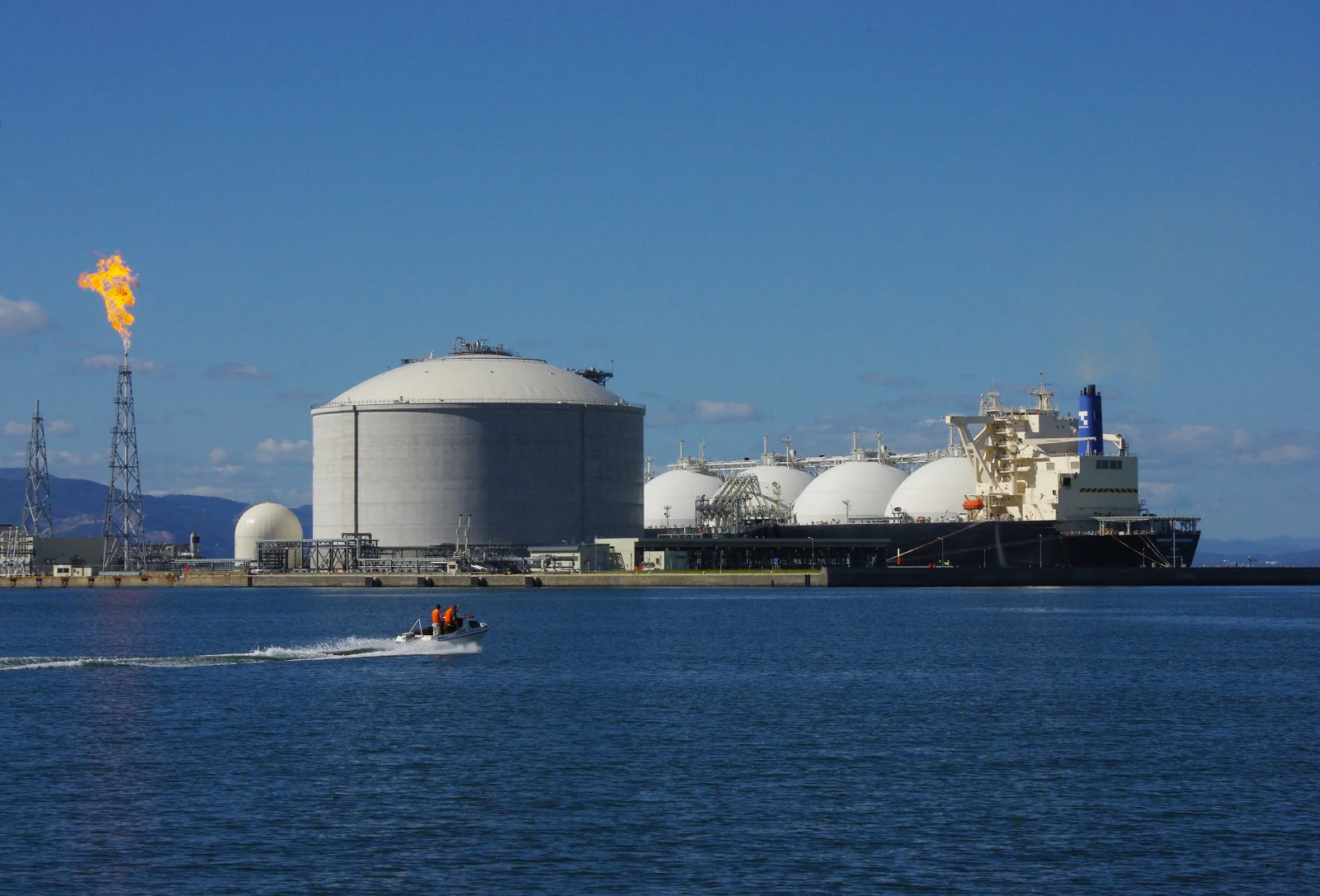
An onshore LNG regasification terminal is an import plant, and it runs a liquefaction terminal backwards. A carrier berths and unloads, the LNG goes into insulated storage tanks, and vaporizers warm it back into gas that is odorized, metered, and sent into the transmission grid. It is the fixed-ground counterpart to an FSRU. With no liquefaction train it is a far simpler plant than an export terminal, and most of what can go wrong sits in three places: the unloading operation, the storage tanks, and the vaporizers. Rollover, where two layers of LNG at different densities suddenly mix and release a large volume of vapour, is the failure mode unique to this end of the chain, and it is the reason tank density and temperature profiling is a protective concern and not just a custody matter.
Functional safety relevance: Yes, though the scope is narrower than an export terminal. Unloading shutdown, tank protection, and vaporizer trips are the functions that end up carrying SIL targets.
Key Points
- Receives, stores, vaporizes, and sends out LNG as pipeline gas. No liquefaction, which makes it much simpler than an export terminal.
- Vaporizers may be open-rack seawater, submerged combustion, or an intermediate fluid loop, and each type brings different protective functions.
- Tank rollover and the unloading transfer are the distinctive hazards, so density and temperature monitoring in the tanks earns its place alongside ordinary level protection.
Example
A carrier berths and unloads over roughly twelve hours. If the incoming cargo differs in density from what is already in the tank, it is filled through a top or bottom nozzle chosen to promote mixing, and the tank temperature and density profile is watched afterward. A stratified tank that rolls over can vent far more vapour than the relief system was sized to take.
See Also: FSRU, onshore LNG liquefaction terminal, BLEVE
Cited Sources
- NFPA 59A, Standard for the Production, Storage, and Handling of Liquefied Natural Gas
- EN 1473, Installation and equipment for liquefied natural gas — Design of onshore installations