
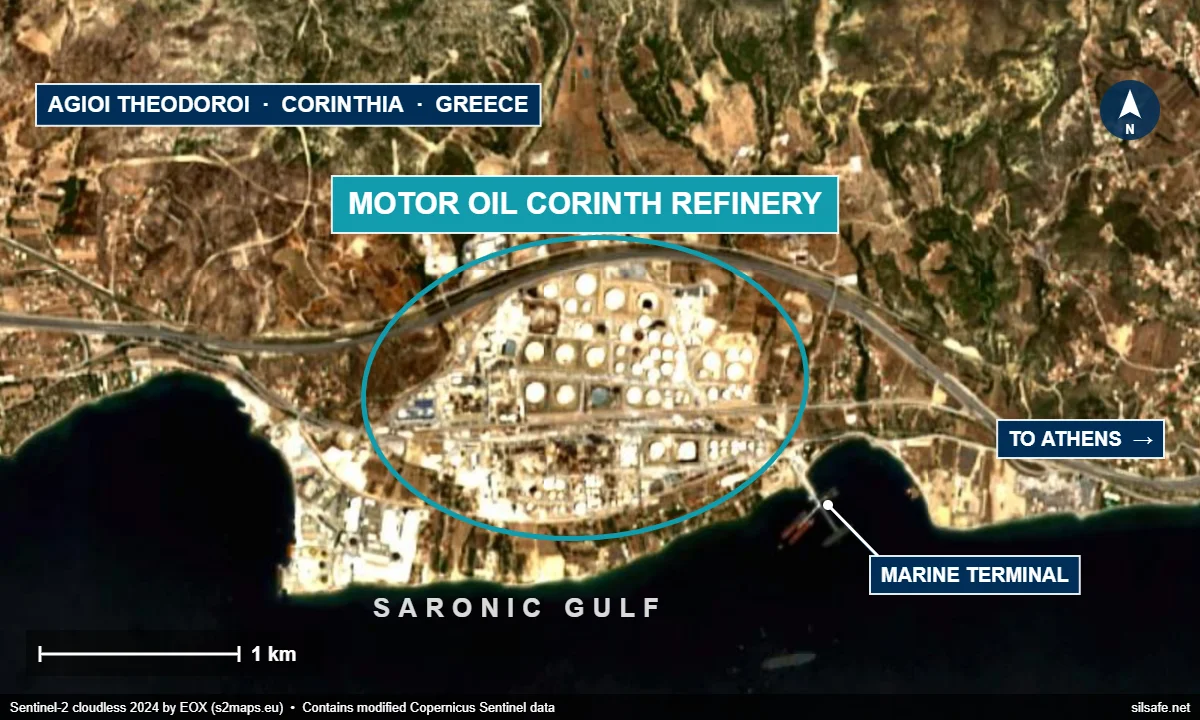
Two explosions hit the Motor Oil Hellas refinery at Agioi Theodoroi, near Corinth, Greece, six days apart in October 2026. Both happened on units that were down for a planned maintenance shutdown, also called a turnaround. The explosion on October 9 killed two contractor workers, and the one on October 15 seriously injured at least two more.
Both units had been taken out of service for maintenance. On equipment like that, isolation and work permits protect the people doing the work. Functional safety reaches the work through the hazard and risk assessment and the handover of the safety instrumented system (SIS) at restart.
No official cause has been established, and nothing in this article is a root cause analysis.
The Motor Oil Hellas Corinth Refinery
The refinery is at Agioi Theodoroi, about 60 km west of Athens. Motor Oil Hellas runs it, and it is Greece’s second-largest refinery, with more than a third of the country’s refining capacity.
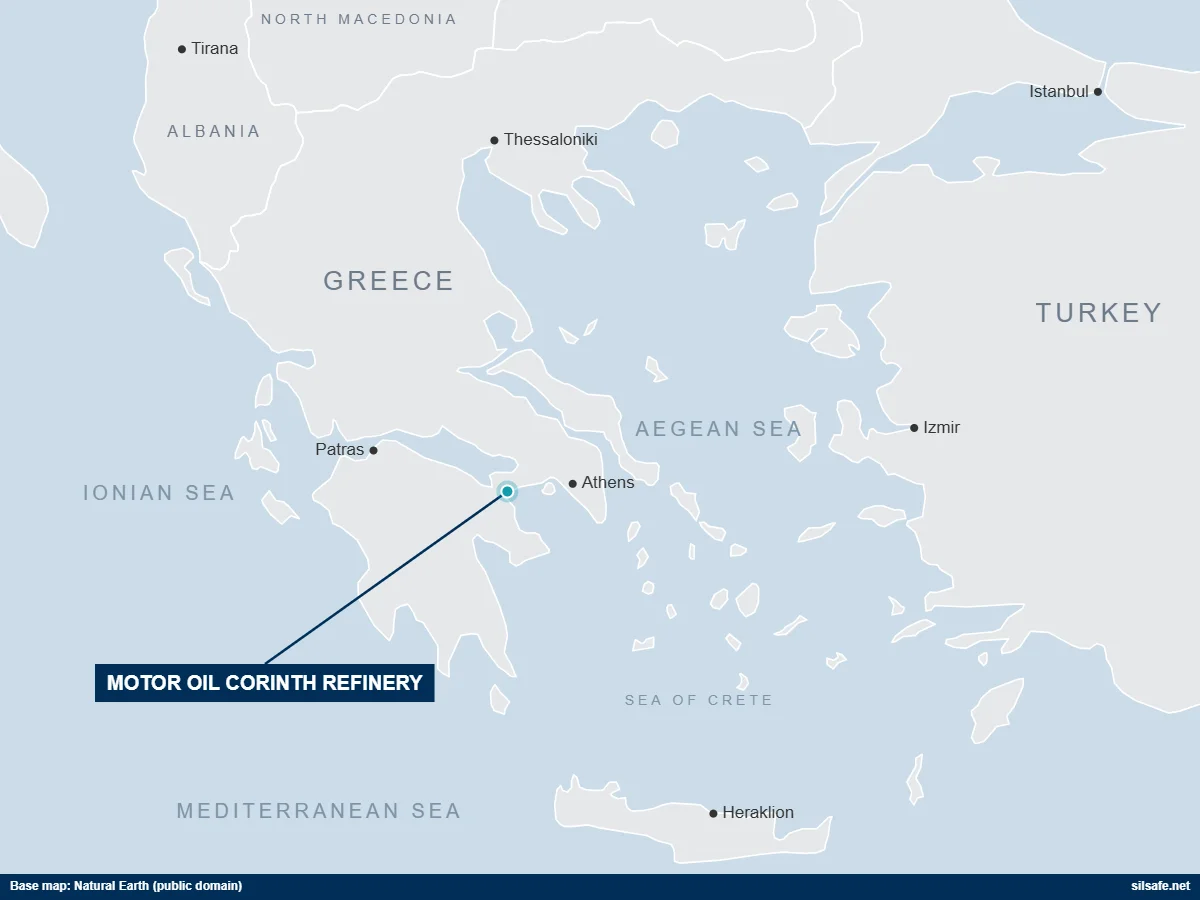
It is a downstream refinery. Crude arrives by tanker at the site’s own oil terminal and jetties, and the refinery turns it into LPG, gasoline, diesel, jet fuel and fuel oil. It also makes lubricants, which no one else in Greece produces. Export and marine-fuel sales make up about three-quarters of the company’s sales volume.
The site is a single self-contained complex, the largest privately held industrial complex in Greece, with crude distillation, catalytic cracking, a hydrocracker and a lubes plant inside one fence. The town of Agioi Theodoroi, about 4,900 people, sits directly against the refinery’s eastern fence.
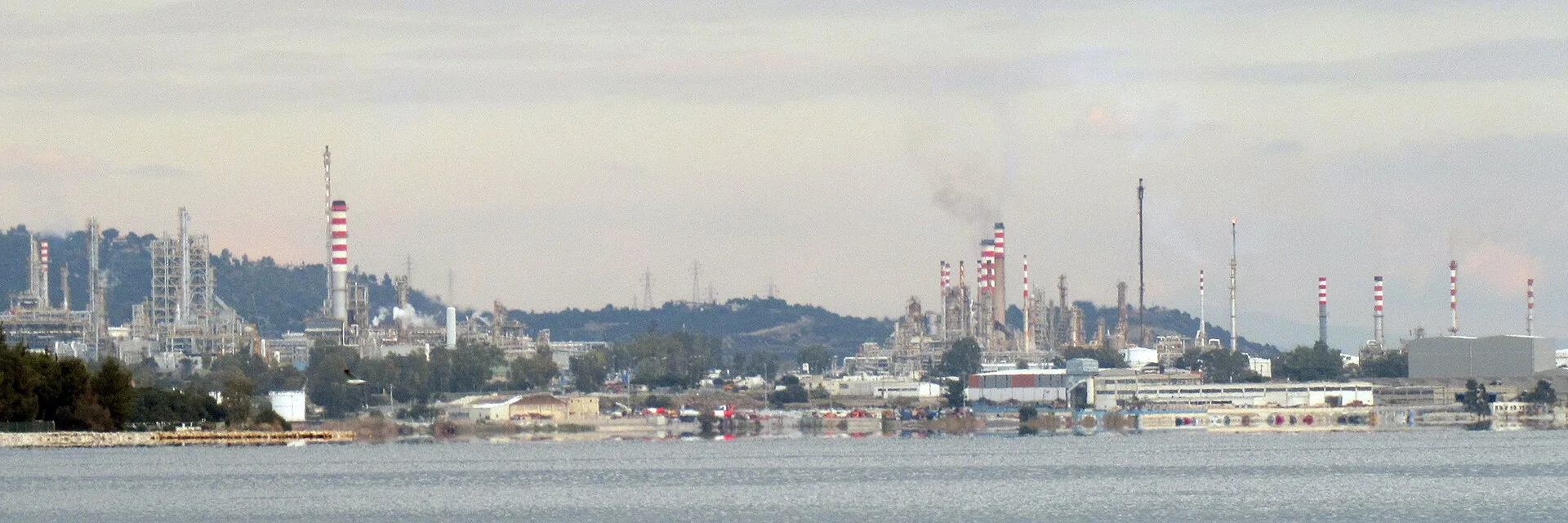
In September 2024, a fire in the southern refinery’s units slightly injured three contractor workers, and the 112 emergency system told nearby residents to evacuate. No cause was ever published.
The October 9 Explosion
The explosion happened at 11 a.m. during extensive preventive maintenance, on heat exchangers in a unit that was down for the shutdown. The two injured men worked for an outside contractor, and both had severe burns even though there was no fire. One died that afternoon and the other two days later.
Motor Oil Hellas reported no fire and no damage to the plant, and the rest of the refinery kept running normally. Reports differ on the unit number: an English-language trade outlet gives U-607, while Greek outlets give U6700.
Police arrested the contractor supervising the work, and four people had been arrested within days.
The October 15 Explosion
Six days later, around 5 p.m., another explosion happened in a different unit that was also down for the shutdown. An outside crew was welding at the time. Press reports describe a sudden, violent gas release with no fire, while Motor Oil Hellas says early assessments point to a steam release.
Two contractor workers were seriously hurt with fractures and burns, and reports put the total injured at four. A union statement places the explosion on an exchanger in the hydrocracking unit, though the company has not confirmed which unit.
Motor Oil Hellas suspended all shutdown work until Monday, October 19. Police arrested six people, two from contracting firms and four Motor Oil Hellas employees.
What Protects Workers When a Unit Is Down for Maintenance
On a unit that is down, the safety instrumented functions (SIFs) are usually bypassed or idle. Unless a SIF was designed for that mode, the SIS protects no one doing the work.
Protection comes from isolation and the steps that follow it:
- Positive isolation, with blinds or double block and bleed
- Draining, purging and gas-freeing the equipment
- Gas testing before and during hot work, which adds an ignition source on purpose
Heat exchangers are a known trap. A leaking tube or a missed isolation on either side can bring hydrocarbon, hydrogen or steam back into equipment people believe is clear.
All of these are procedural safeguards, so they work only if every step is done right, every time, by crews working to a shutdown schedule.
Two Events in One Shutdown Point to the Management System
Two explosions in six days, on two different units in the same shutdown, both with contractor crews, make a shared cause in the work system worth considering as the root cause, more so than two unrelated equipment failures.
A planned shutdown packs hundreds of contractors, simultaneous jobs and compressed schedules into a few weeks, and that is when permit and isolation control is under the most strain. Contractors account for about a quarter of the fatalities in EU major accident reports, and the EU’s Seveso inspectors name maintenance shutdowns as the period of highest contractor risk.
The host site still owns the hazard when the work is contracted out. It controls isolation, issues the permits and decides what equipment is safe to open.
The company’s decision to suspend all shutdown work after the second explosion suggests it suspected a common thread, though it has not said what. The September 2024 fire also injured contractor workers, but nothing public links it to these two events.
Where Functional Safety Management Reaches
IEC 61511 functional safety management covers the SIS life-cycle. Permits and isolation sit outside it, in the site’s wider safety systems, which aren’t the same thing as functional safety, so the functional safety management plan has to state where its scope stops and other procedures take over.
The Hazard and Risk Assessment Has to Reach Shutdown Modes
IEC 61511 requires the hazard and risk assessment (H&RA) to consider startup, shutdown and maintenance modes as well as normal operation (8.2.1). That requirement is where functional safety reaches a planned shutdown most directly.
A poorly done assessment stops at normal operation, or mentions shutdown in a single line without working through any scenarios.
We at SIL Safe routinely see this: facilities do a really great H&RA but never really consider shutdown, because they assume everything is safe. There’s some truth to that, since pressures are often lower, but shutdown still needs to be considered.
The SIS Has to Come Back Intact Before Restart
A planned shutdown is the biggest bypass event of the year. Every bypass needs authorization, a log entry and defined compensating measures (IEC 61511-1, 16.2.3 and 16.2.7).
The plan’s competence requirements cover anyone doing SIS work, contractors included, so the host checks contractor competence rather than assuming it.
Restart is where the SIS gets handed back:
- Bypasses are removed.
- Proof tests and repairs are confirmed.
- Any modification made during the shutdown goes through management of change (MOC) and validation before startup.
The Regulatory Picture in Greece
Greece implements the EU Seveso III Directive through Joint Ministerial Decision 172058/2016, and the refinery is an upper-tier establishment that files a safety report. An upper-tier safety management system has to cover maintenance, temporary stoppages, the involvement of subcontracted personnel and the planning of modifications.
The Labour Inspectorate (SEPE) investigates workplace accidents, and prosecutors ordered it on site after both explosions.
Seveso III does not name IEC 61511, but the EU’s Seveso inspection criteria for SIFs point operators to it, and Greece adopts EN 61511 as a national standard. IEC 61511 was likely applied at this refinery, though no public statement says so.
Arrests Within Hours Are Standard Greek Procedure
Greek law allows police to arrest without a warrant only while an offence counts as flagrante, or autoforo in Greek, and that window closes at midnight on the day after the event (Code of Criminal Procedure, arts. 242 and 275). After a fatal workplace accident, police use that window to arrest the people responsible for the work and bring them before a prosecutor on charges such as negligent homicide or causing an explosion.
The arrest opens the case. It is not a finding of fault, and the summary trial is usually adjourned with the suspects released.
The same pattern followed the July 2026 vinegar plant explosion at Examilia, near Corinth, where the owner, the safety officer and an operations supervisor were arrested.
Flagrante arrest is not unique to Greece. France has flagrant délit, Italy arresto in flagranza and Spain delito flagrante, and much of Latin America has the same concept. In the US, by contrast, a fatal workplace accident goes to OSHA as a civil matter, and criminal referrals are rare.
What We Do Not Know at the Time of Writing (November 2026)
- What released on each unit, whether hydrocarbon, hydrogen or steam, and what ignited it or caused the overpressure
- Which units were involved, since the reported unit numbers conflict
- What isolation and gas testing were done before each job, and under what permits
- Who the contractors were: no report names either firm, so whether the two events share a contractor, a procedure or a supervisor is unknown
- Whether the shutdown has restarted since October 19, and whether the Labour Inspectorate or the prosecutors have released findings
Frequently Asked Questions
I heard someone got arrested almost immediately. That seems really strange. What is that about?
It’s routine in Greece. Police can only arrest without a warrant while an offence is still flagrante, and that window closes at midnight the day after the event. So after a fatal accident, they detain whoever was responsible for the work within hours and bring them to a prosecutor. The arrest isn’t a finding of fault, and suspects are usually released while the case goes on.
Is it correct that we’re not even certain this facility used functional safety?
Yes. No public statement says IEC 61511 was applied, and Motor Oil Hellas doesn’t mention it in its sustainability reporting. It’s still likely. EU Seveso inspectors point operators to IEC 61511 for SIFs, Greece adopts EN 61511 as a national standard, and a refinery this size almost certainly has an SIS. Either way, the SIS wasn’t what protected these crews. On a unit that’s down, isolation and permits do that job.
Our HAZOP never covered our shutdown work. Do I really need to go back and add it?
Yes. IEC 61511 requires the H&RA to consider startup, shutdown and maintenance modes as well as normal operation. You don’t have to redo the whole study. Run a focused session on the modes it skipped: how equipment gets isolated and freed of hydrocarbon, what can come back in through an exchanger or a passing valve, and which SIFs are bypassed while the unit is down. Then carry what you find into your restart plan.
If contractors do the work, who’s responsible when something goes wrong during a shutdown, us or them?
Both of you, and neither can hand it off. The contractor owns its people’s competence and how they do the task. You own the site hazard: you isolate the equipment, issue the permit and decide it’s safe to open. Seveso III writes subcontracted personnel into an upper-tier site’s safety management system, and in Corinth police arrested people from the contracting firms and from Motor Oil Hellas. How liability splits in court depends on your jurisdiction.
We’ve got a planned shutdown coming up. What should I check on the SIS before we restart?
Treat restart as handing the SIS back to operations. Before startup, confirm that:
- Every bypass and force in the log is cleared, and the SIS shows it.
- Every proof test scheduled for the outage is done and recorded, with failures repaired.
- Any replacement that isn’t like-for-like went through MOC, and modified SIFs are validated.
- Instrument root valves and impulse line isolations are back open, and final elements are lined up for service.
- Trip setpoints and logic match the safety requirements specification (SRS).
A closed impulse line isolation left over from maintenance can leave a transmitter reading normal while the process isn’t.
How can a steam release cause an explosion with no fire?
Steam doesn’t have to burn to explode. Steam or hot water under pressure stores a lot of energy, and when containment fails suddenly, it expands violently. Superheated water flashes to steam as the pressure drops, which adds to the blast. You get a pressure wave, flying debris and severe scalds with no combustion at all. That fits burns with no fire, though nobody has confirmed what released at Corinth.
Further Reading
From SIL Safe
- Hazard and Risk Assessment (H&RA): The Foundation of Functional Safety
- Functional Safety Is Not the Same as Occupational Safety
- Proof Testing of SIFs: Understanding Its 3 Purposes and Its Importance
- The Basra Ammonia Leak: What We Know So Far
External resources
- Reuters (via The Star): One person dies, one in serious condition after Greek refinery incident
- GreekReporter: Second Explosion at Greece’s Motor Oil Refinery Leaves Two Seriously Injured Days After Two Deaths
- GreekReporter: Six Arrested After Second Motor Oil Refinery Accident in Greece Injures Four Workers
- HazardEx: Two workers die after explosion during maintenance at Greek refinery
- European Commission JRC: Common Inspection Criteria No. 13 – Management of Contractors
- HSE: Guidance on permit-to-work systems (HSG250)