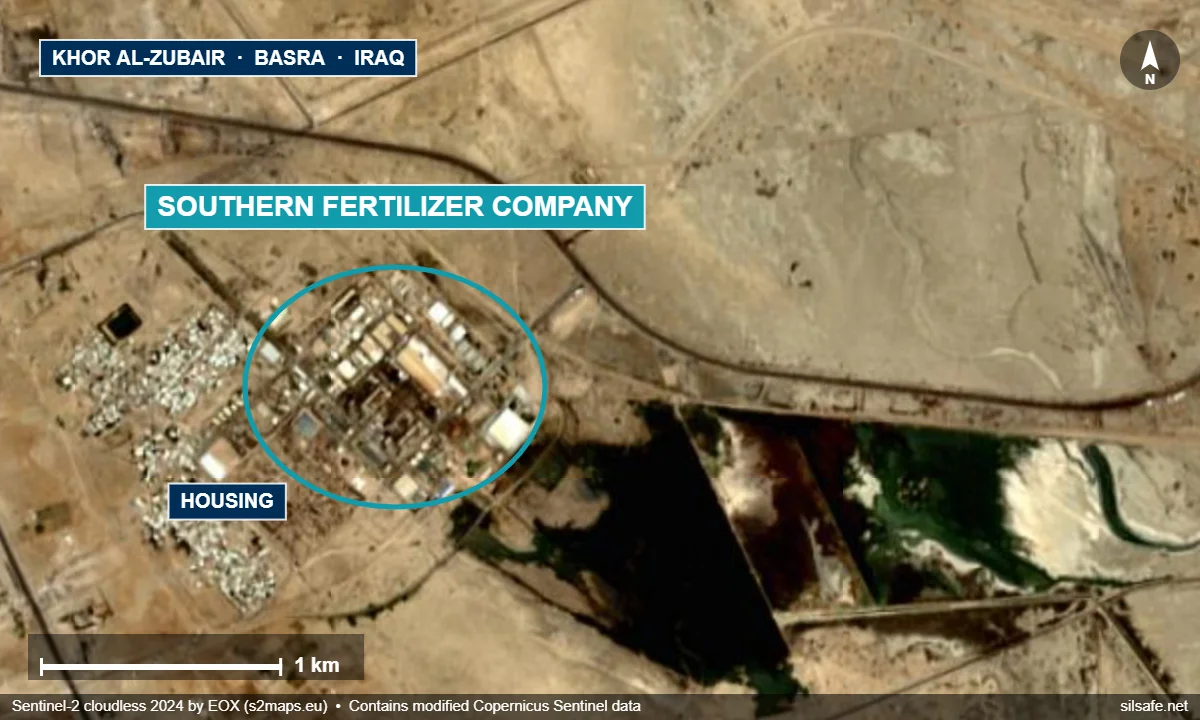
On September 13, 2026, a pump failure on one of the production lines at the Southern Fertilizer Company in Khor al-Zubair, Basra, released ammonia, killing two workers and injuring 114 people, including residents of neighboring homes. Workers who were seriously injured stayed to shut the pumps down, and the release stopped when the plant was shut down. One report places a fatal ammonia leak on the same line in February 2025.
No official cause has been established, and nothing in this article is a root cause analysis.
What is the Southern Fertilizer Company?
The Southern Fertilizer Company is a state-owned manufacturer under Iraq’s Ministry of Industry and Minerals, and it supplies about 60% of Iraq’s domestic fertilizer demand. Its Khor al-Zubair complex makes ammonia and urea. Mitsubishi Heavy Industries built it in the late 1970s.
The plant was built with two production lines. A line, or train, is a complete chain of units that makes product on its own, so one line can run while the other is down. One is a state-run “government line.” The other, the first line, operates in partnership with a private investor, which says it has been rehabilitating that line since 2022, including replacing its pneumatic controls with a distributed control system (DCS).
Where does the plant sit?
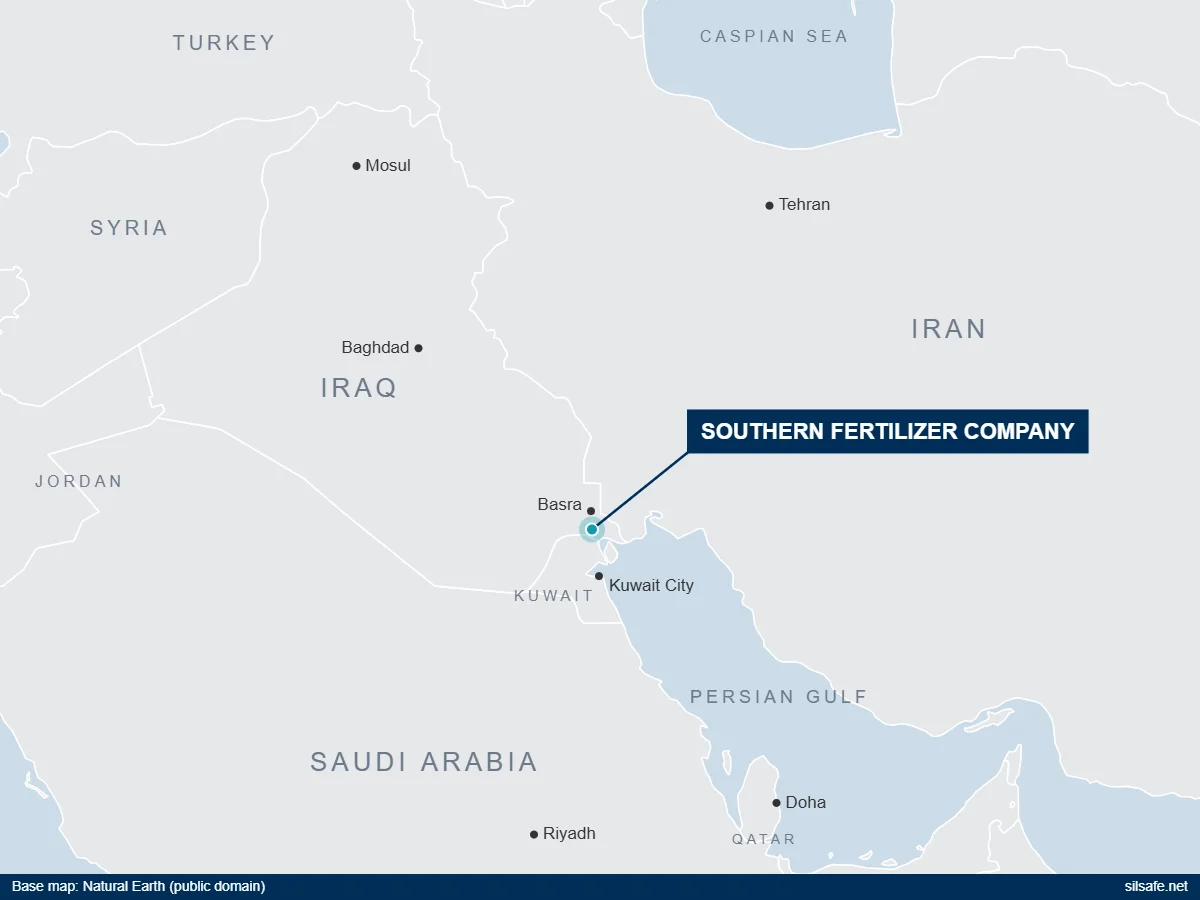
The complex is in Khor al-Zubair, an industrial port area in southwest Basra province. Homes stand adjacent to the plant.
What happened on September 13, 2026?
During the evening shift, a sudden leak from one of the first line’s pumps released ammonia. Local officials also reported an explosion. The ammonia spread across the plant and into nearby homes, and workers and residents were evacuated.
Injured workers stayed on site to shut the pumps down, which the governor said prevented a further blast. The release stopped when the plant was shut down.
Civil Defense teams, including a chemical, biological, radiological and nuclear (CBRN) unit, rescued ten trapped workers, and the Health Ministry sent more than 50 ambulances. Two workers died, one from the instrument department and one from the compressor section. Of the 114 people injured, 21 were still in hospital the next day.
Has this line leaked before?
On February 2, 2025, an ammonia leak that one report places on the first line killed one person and injured five. A company source blamed a technical malfunction during production. No investigation findings were published.
What is the hazard at a plant like this?
Ammonia (NH3) is made by reacting hydrogen with nitrogen, and about 80% of the world’s ammonia goes into fertilizers such as urea. It is a gas at room temperature. Plants handle it as a liquid, either refrigerated to its boiling point of about −33°C (−28°F) or held near ambient temperature under pressure.
Pumps move liquids and compressors move gases, so the leaking pump was most likely handling liquid ammonia or an ammonia-rich solution under pressure. Pumps and compressors are among the most frequent leak sources in a process plant, because their seals and moving parts fail more often than static equipment.
What happens after the leak drives the consequences:
- The liquid flashes. Part of it boils off at once and chills the rest toward −33°C.
- The cloud hugs the ground. The cold mix of vapor and droplets is heavier than air and spreads along the ground, even though ammonia gas on its own is lighter than air.
- The cloud attacks tissue. Ammonia dissolves in the moisture of the eyes, throat and lungs to form ammonium hydroxide, a caustic alkali. High exposures kill through a swollen throat or chemical burns to the lungs.
A cloud like that can cross the fence line and reach people with no training or protective equipment.
Why does it matter that workers shut the pumps down by hand?
On what has been reported, stopping this release depended on people inside the ammonia cloud. A safeguard that works only if someone can stand in the release is a safeguard the release can defeat.
Human response earns credit as a protection layer only when four conditions hold:
- Clear indication that action is needed
- Enough time to act
- Trained people
- Authority to act
None of those holds if the operator is overcome on the way to the valve.
UK guidance on emergency isolation treats the exposure of the people doing the isolating as one of the factors in choosing between manual valves and remotely operated shutoff valves (ROSOVs). Remotely operated isolation valves on pumps in toxic service let a release be stopped from the control room or another safe location. IEC 61511 requires a manual means of actuating safety instrumented system (SIS) final elements that works independently of the logic solver (11.2.8), and that means only helps if someone can reach it during the release.
This has happened before. The Health and Safety Executive (HSE) investigated the 1994 Associated Octel release at Ellesmere Port, in the UK. That release came from a recirculating pump, and people in protective suits entered the white cloud to close manual valves, which did not stop it. HSE concluded that remotely operated valves operable from a safer location would have greatly reduced the risk to those people. It also found they might have prevented the fire that broke out about 90 minutes later.
What could a SIF look like here?
If the risk at the pump needs reducing, a safety instrumented function (SIF) here takes one of two forms. Each one is an instrument, a logic solver and a final element, and no part of it depends on hand operation.
The final elements are the same in both: the isolation valves on the pump’s suction and discharge, and the motor contactor that stops the pump. The instrument and the job differ:
- Mitigation: a gas detector array around the pump closes the valves and stops the pump once ammonia reaches the air.
- Prevention: a level or flow transmitter on the pump’s suction stops the pump before loss of suction damages it and opens a leak path.
How much do the two releases have in common?
The two releases share the plant, the material, and a fatal outcome. Whether they share the equipment, the failure, or the cause is unknown, because the cause of the 2025 release was never published.
What regulations apply?
Who regulates industrial safety in Iraq?
Iraq has no major-hazards law comparable to these frameworks:
- The Control of Major Accident Hazards (COMAH) Regulations in the UK
- The Seveso Directive in the EU
- OSHA’s Process Safety Management (PSM) standard in the US
Worker safety rests on Labour Law No. 37 of 2015 and the Occupational Safety and Health Requirements Instructions No. 12 of 2016. Both are run through the National Center for Occupational Health and Safety under the Ministry of Labour and Social Affairs, and both address occupational hazards in general. The Environment Law of 2009 requires an environmental impact assessment for new projects, which is the closest thing on the books to a process hazard requirement.
Iraq has not ratified the International Labour Organization (ILO) Prevention of Major Industrial Accidents Convention (C174). Saudi Arabia and Lebanon are among the few parties in the region.
Does Iraqi law require functional safety?
No functional safety requirement can be found in Iraqi law or national standards. English- and Arabic-language searches of legislation and the national standards catalog make it likely there is none.
IEC 61511 is not law anywhere. It becomes binding when a regulator or a contract calls it up, and an ammonia and urea plant falls squarely within its process-industry scope. Iraq has been a full IEC member since 2009, with its national committee at the Central Organization for Standardization and Quality Control (COSQC), so it could adopt IEC 61511 as an Iraqi standard. An Iraqi standard becomes mandatory once published in the Official Gazette, and no Iraqi adoption of IEC 61511 or IEC 61508 appears in the catalog.
Where is IEC 61511 used in Iraq?
IEC 61511 reaches Iraq through contracts. Internationally engineered oil-sector projects carry out hazard and operability studies (HAZOP) and safety integrity level (SIL) assessment. One example is the Karbala Refinery, built for the State Company for Oil Projects. Those contracts run through the Ministry of Oil and its companies, and the Southern Fertilizer Company answers to the Ministry of Industry and Minerals.
Was IEC 61511 applied at this plant?
It is more likely than not that IEC 61511 was not applied to the first line. Nothing public shows that it was. The line was designed in the 1970s, decades before the standard, and its rehabilitation runs under an investment partnership whose technical requirements are not public.
Where a plant adopts IEC 61511 later, older equipment is not exempt. The owner has to show it is designed, maintained, inspected, tested and operating safely (5.2.5.4).
A move from pneumatic controls to a DCS is the point where trips either get a separate SIS or get folded into the control system. Nothing public says which happened here.
Who investigates an incident like this?
Three inquiries are under way:
- A ministerial committee under the Ministry of Industry and Minerals, which owns the plant
- The Basra governor’s technical, legal and administrative committee
- A parliamentary committee that lawmakers have announced
None of the three is a standing technical investigation body, and no published findings from the 2025 inquiry could be found. The ministry’s undersecretary says it is far too early to name a cause.
What we do not know at the time of writing (September 2026)
- Which pump failed, what it was handling, how it failed, how much ammonia was released, and for how long
- Whether the first line has remote isolation or automatic shutdown, and whether any safety function was demanded or failed
- What changed on the first line after the 2025 release
- What the rehabilitation specified for the line’s safety systems
- When the three inquiries will report, and whether anything will be published
Frequently Asked Questions
If this facility were in the United States, would it be under PSM and RMP, and would IEC 61511 apply?
Yes on PSM and RMP, almost certainly. Both cover anhydrous ammonia above a 10,000 lb threshold, and an ammonia and urea plant holds far more than that on site. IEC 61511 wouldn’t apply as law, because no US regulation names it. It would apply in practice, though. PSM requires you to follow recognized and generally accepted good engineering practice (RAGAGEP), and OSHA treats ANSI/ISA-61511, the US adoption of IEC 61511, as RAGAGEP for safety instrumented systems. So if you run an SIS at a PSM-covered site, expect to be held to it.
I’ve heard ammonia is really dangerous. Is it toxic, or does it just remove oxygen from the air or something like that?
It’s toxic, and corrosive. Ammonia isn’t a simple asphyxiant like nitrogen, which hurts you only by pushing oxygen out of the air. It reacts with the moisture in your eyes, throat and lungs and burns the tissue chemically. At high enough concentrations, that swelling and lung damage kill long before oxygen displacement would matter. The sharp smell gives you warning at low levels, but at the concentrations near a liquid release you’re injured within breaths.
I hear that ammonia is used in various processes throughout the process industry. Is that correct, and why is that?
Correct. Most of it goes into fertilizer, because ammonia is the cheapest way to turn nitrogen from the air into something plants can use. After that, it’s a building block for nitric acid, explosives, plastics and fibers. It’s also a common industrial refrigerant, especially in food processing and cold storage, because it moves a lot of heat per kilogram and costs little. Power plants use it too, injecting it to strip nitrogen oxides from flue gas. Wherever you work in the process industry, there’s a decent chance ammonia is somewhere on site.
My unit has manual isolation valves at the pumps. Do I get to take credit for them in LOPA?
Usually not, at least not as written into most scenarios. A manual isolation valve only acts after the pump has already leaked, so it can’t prevent the loss of containment; at best it limits how much gets out. To credit it as a human-response protection layer, you’d need clear indication, enough time, trained operators, and someone who can actually reach the valve. If reaching it means walking into an ammonia cloud, that last condition fails, and so does the credit. If you need isolation you can count on, put remotely operated valves on the pump and actuate them from somewhere safe.
Further Reading
From SIL Safe
- The Same Explosion, Eleven Years Apart
- The Amur Gas Chemical Complex Fire: What We Know So Far
- The Garden Grove Chemical Incident: What We Know So Far
- Layer of Protection Analysis (LOPA): The Engineer’s Guide to SIL Selection
External resources
- The National: Iraq investigates deadly ammonia gas leak at Basra factory
- Shafaq News: Two dead, 114 injured in Basra ammonia release
- Al-Mada: 21 injured still in treatment as fertilizer workers protest investment in Basra (in Arabic)
- ATSDR: Medical Management Guidelines for Ammonia
- HSE: Emergency Isolation (COMAH technical measures)
- HSE: Remotely operated shutoff valves (ROSOVs) for emergency isolation of hazardous substances (HSG244)