
Definition:
A Calibrated Risk Matrix is a version of a risk matrix where the severity and likelihood scores have been decided based on real-world data, societal expectations, and/or corporate standards. This is the document that companies will write down how much risk they are willing to swallow. This could use the PEAR model to work through tolerable risk.
Some people and organizations have a hard time with this, as one has to write down how much death is acceptable. It is a weird concept.
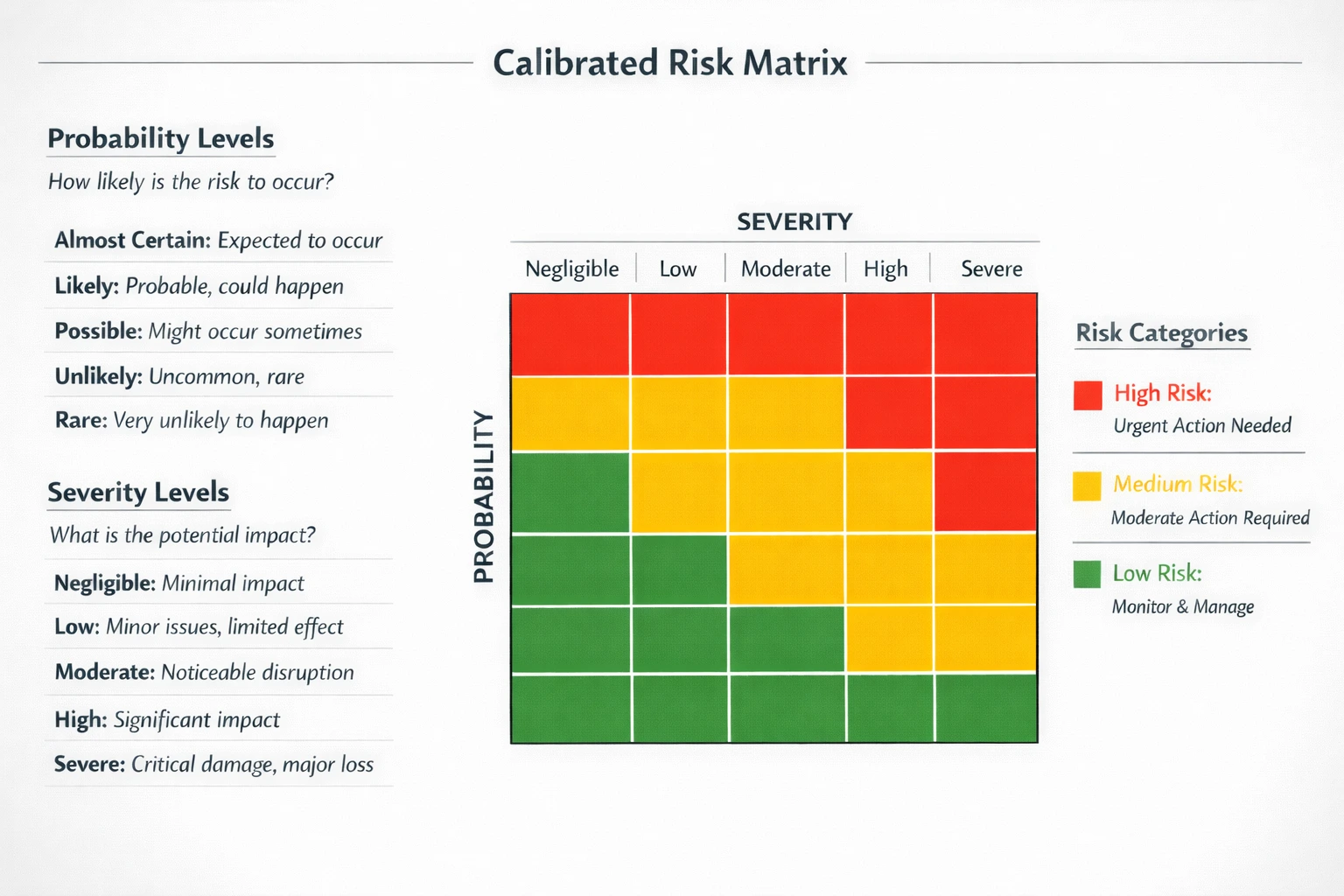
A calibrated risk matrix will have the classic matrix layout with colors. But the other portion can be called “bins” which direct how the user determines the probability and severity for different hazards. Using a PEAR model a facility could have up to four different calibrated risk matrices.
Key Points:
- Helps bridge the gap between qualitative and quantitative risk assessments.
- Often used during semi-quantitative SIL determination.
- Intertwines with the PEAR approach.
- It is how stated risk tolerance is documented
Example:
A calibrated risk matrix for a facility defines “catastrophic” consequences as those resulting in more than $10M in losses or one fatality.
See Also: risk matrix, PEAR model, stated risk tolerance, TMEL
Cited Source:
- IEC 61511-3:2016, Annex G
- CCPS Guidelines for Hazard Evaluation Procedures.
- Science Direct – Calibration of risk matrices for process safety
- Study-lib.net full example